What is the issue?
India is yet to declare its net-zero targets.
What is net-zero?
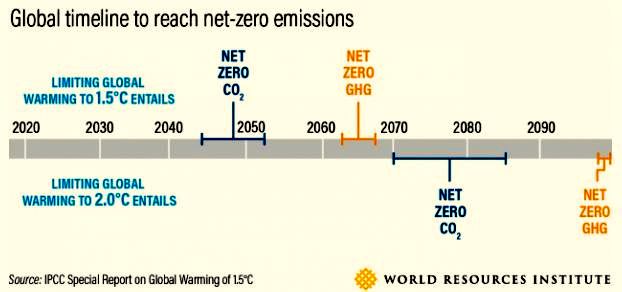
- It is also referred to as carbon-neutrality.
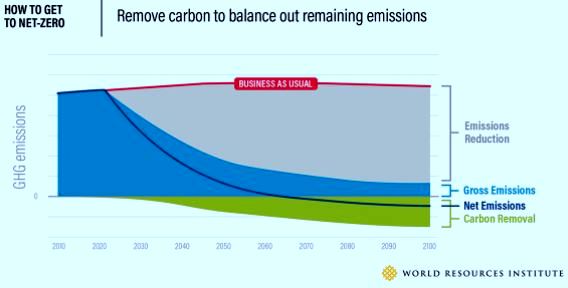
- It does not mean that a country would bring down its emissions to zero.
- Rather, net-zero is a state in which a country’s emissions are compensated by absorption and removal of greenhouse gases from the atmosphere.
- It is achieved by creating more carbon sinks such as forests, while removal of gases from the atmosphere requires futuristic technologies such as carbon capture and storage.
- It is even possible for a country to have negative emissions, if the absorption and removal exceed the actual emissions.
- IPCC report finds that if the world reaches net-zero emissions by 2040, the chance of limiting warming to 1.50C is considerably higher.
What is the status of the rest of the world?
- 50% of the global economy is already committed to net zero emissions by 2050.
- China is committing to be so before 2060.
- It is not only governments but the businesses are increasing climate action too to take advantage of the new opportunities arising.
- Investors injected over $500 billion into climate transition in 2020.
Why India has not committed yet?
- Environmental justice - India is not committing to net zero on the basis that it needs to see significant support from developed countries.
- India demands long promised environment reparation ($100 billion) from developed nations for adaptation strategies of emerging economies to achieve their net zero target by 2030.
- CoP targets - It states that the net-zero goal does not figure in the 2015 Paris Agreement, which only requires every signatory to take the best climate action it can.
- It argues that instead of opening up a parallel discussion on net-zero targets outside of the Paris Agreement framework, countries must focus on delivering on what they have already promised.
- India is set to significantly exceed its Paris Agreement commitment of reducing the emissions intensity of its GDP by 33-35% below 2005 levels by 2030.
“India’s climate burden is four times its climate guilt,” says climate journalist David Wallace Wells.
Why is this tactic dangerous?
- India has a national interest in global and national climate action as it is among the most vulnerable countries to climate change
- Therefore it should be among the more active against the threats.
- As a rising power, India must involve in climate action to seek stronger influence globally.
- India is already the 3rd largest emitter in the world
- With US, China, and the EU being signed up to net zero, it will become a significant drag on India’s international diplomacy not to sign up.
- There is no longer a trade-off between reducing emissions and economic growth.
- e.g U.K. has reduced emissions over 40% and grown its economy over 70% since 1990.
- Solar energy costs have fallen 90% in recent years, providing the cheapest electricity in India.
- Given the negative impacts, addressing climate is now central to economic development, not an added luxury to consider.
- E.g Agricultural policy that does not consider adaptive approaches in the face of increased flooding & drought is irresponsible.
Is net zero the one-stop solution?
- Global warming is just one input in the carrying capacity of the Earth.
- So Net Zero should not treat as a form of ‘cognitive bargain’ to reverse climate change.
- There is a lengthy road beyond Net Zero to achieve a carbon negative environment.
Source: The Hindu, BusinessLine, The Indian Express, WRI



