Why in News?
Recently the outflow of foreign portfolio investors are high and raised serious concerns.
What is FPIs?
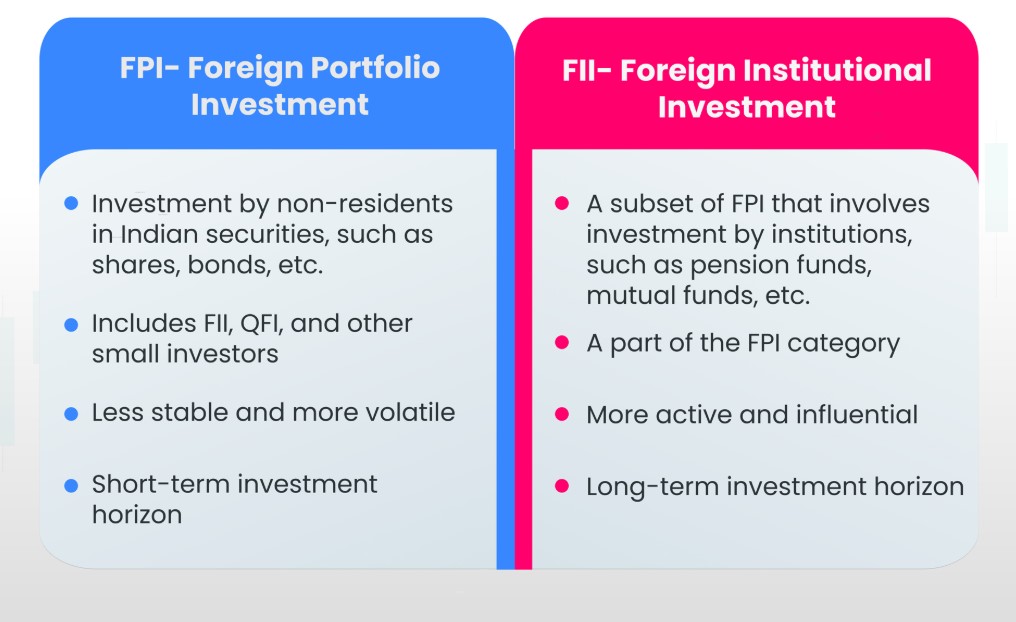
- FPI – Foreign Portfolio Investors (FPIs) are non-resident individuals, institutions, or entities that invest in a country's financial assets—such as stocks, bonds, and mutual funds—without seeking direct ownership or managerial control.
- They offer appreciation high liquidity and enable international diversification, primarily investing for short-to-medium-term capital.
- Recent trend – Foreign Portfolio Investor (FPI) outflows from India since October 2024 have been persistent and significant, amounting to over $45 billion in 18 months.
- Concerns – This sustained selling has raised concerns about India’s attractiveness as an investment destination.
- Despite strong domestic inflows, FPIs continue to remain net sellers.
- Understanding this phenomenon requires an analysis of valuation concerns, shifting global dynamics, structural challenges, and evolving investor perceptions.
What are the scale and persistence of FPI outflows?
- Exceeding previous level – The magnitude of FPI selling is notable, even exceeding levels seen during the Global Financial Crisis in terms of market capitalisation impact.
- India has underperformed emerging markets (EMs) by nearly 5,000 basis points, and foreign ownership has dropped to a 15-year low.
- Deeper change – This trend reflects a deeper shift rather than short-term volatility.
- While domestic institutional investors (DIIs) have provided stability, the absence of foreign capital inflows has affected overall market sentiment and relative performance.
- Valuation concerns – A primary driver of FPI selling is India’s elevated valuation relative to other emerging markets.
- Even after recent corrections, Indian equities trade at a nearly 50% premium to EM averages.
- From an investor’s perspective:
- Paying ~20x earnings for 10–15% growth appears unattractive.
- Comparable or higher growth opportunities exist in other markets at lower valuations.
- Valuation multiples reflect expectations of:
- Sustained growth
- High return on equity (RoE)
- Predictability of earnings
- The recent compression in multiples indicates declining confidence in either the pace or duration of India’s growth story.
What are the changing global investment landscape?
- Earlier scenario – India was perceived as the “only game in town” among emerging markets.
- However, this narrative has shifted significantly.
- Re-emergence of competing markets – China is regaining investor confidence due to policy stability and leadership in sectors like EVs, AI, and renewables.
- Taiwan dominates semiconductor manufacturing, making it indispensable.
- South Korea is witnessing corporate governance reforms, improving investor sentiment.
- Brazil offers opportunities in commodities and cyclical sectors.
- India is no longer the sole large, liquid, growth-oriented EM option. Increased alternatives have led to portfolio rebalancing.
- Growth concerns and sectoral stagnation – A key concern among FPIs is that India’s earnings growth may be structurally capped at 10–15%.
What are the Sectoral Challenges?
- IT services – Facing disruption from Artificial Intelligence (AI).
- Private banks – Competition from revitalized public sector banks.
- Consumer staples – Viewed as overvalued with limited growth upside.
- Pharmaceuticals – Transition challenges towards biosimilars.
- With traditional sectors stagnating and new-age sectors underrepresented, investors question the sustainability of higher earnings growth.
- Innovation deficit and technological leadership – Global investors increasingly prioritize innovation-driven economies.
- India faces a perception challenge in this regard:
- Lack of dominance in sunrise sectors like AI, robotics, or advanced biotechnology.
- Limited global market share in high-tech manufacturing.
- Even in traditional strengths like IT and pharmaceuticals, India is not seen at the cutting edge of innovation compared to global peers.
- This raises concerns about the quality and durability of long-term growth.
What are the concerns and challenges?
- China-Plus-One Strategy – India was expected to benefit significantly from global supply chain diversification under the “China-plus-one” strategy.
- However, progress has been slower than anticipated:
- Manufacturing investments from multinational corporations (MNCs) remain limited.
- Foreign Direct Investment (FDI) inflows have stagnated.
- Structural issues such as regulatory complexity, land acquisition challenges, and infrastructure gaps continue to hinder large-scale manufacturing expansion.
- Ease of Doing Business and Regulatory Concerns – Investor perception of India as a difficult market persists:
- Complex tax structures and retrospective taxation concerns
- Regulatory unpredictability
- Compliance burdens
- While these challenges were previously overlooked due to strong returns, they have now become significant deterrents in a lower-return environment.
- AI Disruption and India’s Economic Model – Artificial Intelligence poses a structural challenge to India’s services-led growth model:
- India’s IT sector relies heavily on billable human hours.
- AI-driven automation threatens this cost advantage.
- If productivity gains from AI reduce demand for outsourced services, India’s core export sector could face long-term pressure.
- Cyclical vs Structural Factors – It is important to distinguish between cyclical and structural drivers:
- Cyclical factors
- Global capital rotation towards North Asia.
- Short-term earnings acceleration in AI-linked sectors abroad.
- Temporary sentiment-driven outflows.
- Structural factors
- High valuation premium.
- Limited innovation leadership.
- Slower-than-expected manufacturing growth.
- Regulatory bottlenecks.
- While cyclical factors may reverse, structural issues require policy and corporate intervention.
What should be done?
- Policy measures – Simplifying regulatory frameworks.
- Enhancing ease of doing business.
- Providing stable and predictable tax policies.
- Economic strategy – Accelerating manufacturing under global supply chain shifts.
- Promoting high-tech industries and innovation ecosystems.
- Increasing R&D investments.
- Corporate actions – Greater capital expenditure (capex).
- Focus on productivity and technological adoption.
- Expansion into emerging sectors.
- A contrarian perspective – Despite current negativity, there are reasons for cautious optimism:
- Domestic flows remain robust, providing market stability.
- India’s macroeconomic fundamentals—demographics, consumption base, and digital infrastructure—remain strong.
- Negative sentiment itself may act as a contrarian indicator for future inflows.
- The argument that India cannot innovate or sustain growth may be overstated, as structural reforms and private sector dynamism could revive the growth narrative.
What lies ahead?
- FPI selling in India is driven by a combination of high valuations, shifting global opportunities, and structural concerns regarding growth and innovation.
- While the country is no longer the default choice among emerging markets, its long-term fundamentals remain intact.
- Addressing regulatory bottlenecks, fostering innovation, and accelerating manufacturing growth are critical to restoring investor confidence.
- Although near-term challenges persist, India’s economic trajectory still holds promise, making the current phase one of recalibration rather than decline.
Reference
Business Standards| FPI Selling



