Mains: GS III – Science and Technology
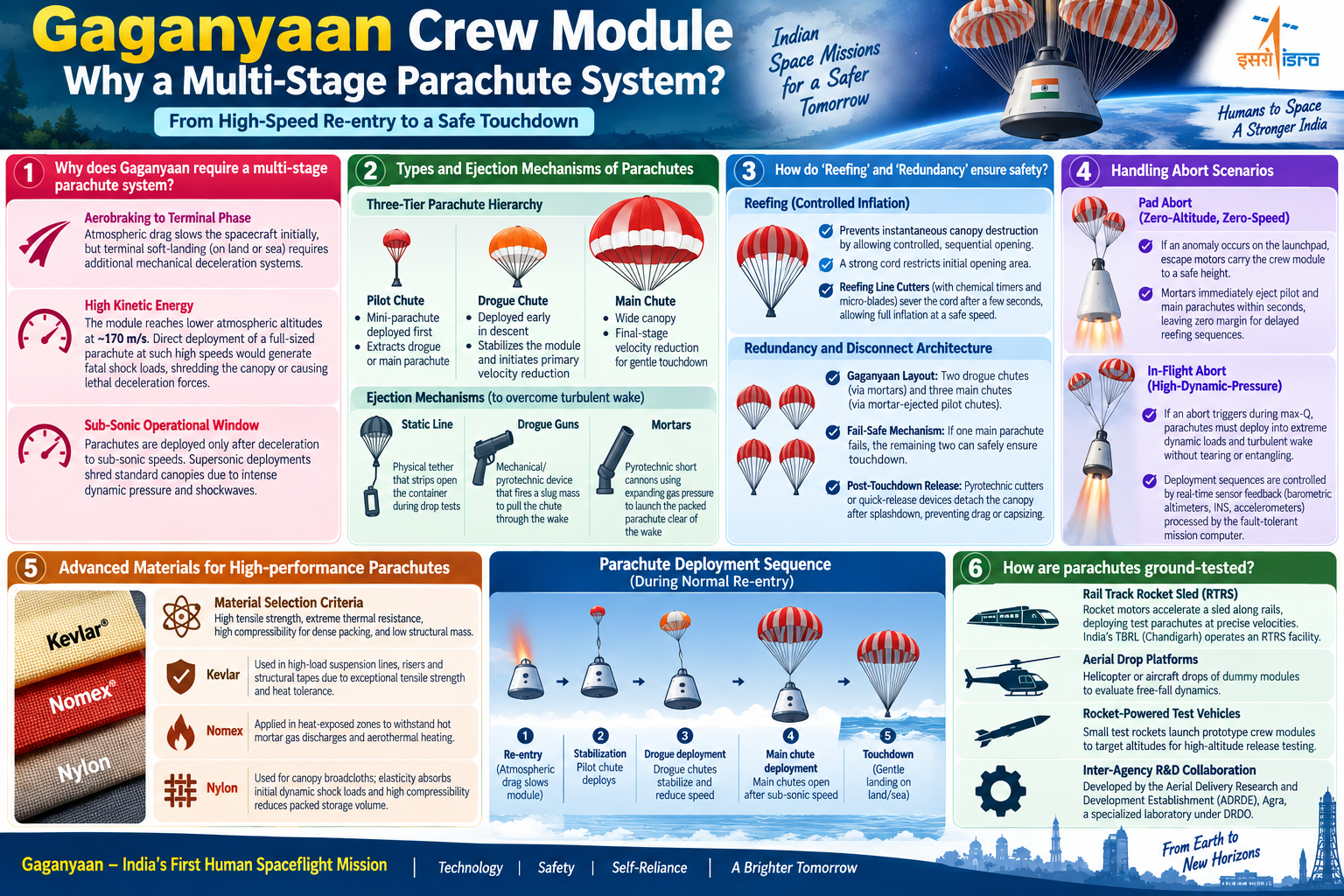
Why does the Gaganyaan Crew Module require a multi-stage parachute system for re-entry?
- Aerobraking To Terminal Phase – Spacecraft re-entering Earth's atmosphere rely primarily on atmospheric drag for initial high-speed decelerations.
- However, terminal phase soft-landing (on land or sea) requires additional mechanical deceleration systems.
- High Kinetic Energy – The returning Gaganyaan module reaches lower atmospheric altitudes at velocities of 170 m/s.
- Direct deployment of a full-sized main parachute at these speeds would generate fatal opening shock levels, shredding the canopy fabric or subjecting astronauts to lethal deceleration forces.
- Sub-Sonic Operational Window – Parachute deployment occurs after the module decelerates to sub-sonic speeds.
- Supersonic deployments shred standard canopies due to intense dynamic pressure and shockwave interaction.
What are the primary types and ejection mechanisms of parachutes used in aerospace recovery?
- Three-Tier Parachute Hierarchy –
- Pilot Chute – A mini-parachute deployed first to extract larger drogue or main parachutes.
- Drogue Chute – Deployed early in descent to stabilize the module and initiate primary velocity reduction.
- Main Chute – Features a wide canopy designed for final-stage velocity reduction to ensure gentle touchdown conditions.
- Overcoming Turbulent Wake Energy – The blunt crew module creates a turbulent wake at its rear.
- Ejection mechanisms must impart sufficient energy to launch the parachutes past this wake into the free-stream air –
- Static Line – A physical tether anchored to an aircraft that strips open the container during drop tests.
- Drogue Guns – Mechanical/pyrotechnic devices that fire a slug mass at high velocity to pull the chute through the wake.
- Mortars – Pyrotechnic short cannons that use expanding gas pressure from controlled explosions to launch the packed parachute clear of the wake.
How do 'Reefing' and 'Redundancy' ensure safety during atmospheric descent?
- Reefing (Controlled Inflation) –
- Prevents instantaneous canopy destruction by allowing the parachute mouth to open in controlled, sequential steps analogous to opening an umbrella gradually in strong winds.
- A strong cord runs around the canopy skirt to restrict initial opening area.
- Integrated Reefing Line Cutters (containing chemical timers and micro-blades) sever the cord after a few seconds, allowing the canopy to fully bloom once speed drops to a safe threshold.
- Redundancy and Disconnect Architecture –
- Gaganyaan System Layout – Equipped with two drogue chutes (deployed via mortars) and three main chutes (deployed by mortar-ejected pilot chutes).
- Fail-Safe Mechanism – If one main parachute fails completely, the remaining two independent parachute chains can safely achieve a touchdown.
- Post-Touchdown Release – Immediate activation of pyrotechnic cutters or mechanical quick-release devices detaches the canopy upon splashdown, preventing winds from dragging or capsizing the module.
How do parachute deployment systems handle abort scenarios like Pad Abort and In-Flight Abort?
- Pad Abort Scenario (Zero-Altitude, Zero-Speed) – If an anomaly occurs on the launchpad, escape motors carry the crew module to a safe height where mortars must immediately eject the pilot and main parachutes within seconds, leaving zero margin for delayed reefing sequences.
- In-Flight High-Dynamic-Pressure Abort – If an abort triggers during max-Q (maximum dynamic pressure), the extraction parachutes must deploy into extreme aerodynamic loads and turbulent wake without tearing or entangling with jettisoned rocket stages.
- System Interfacing with the Flight Computer – Deployment sequences are controlled by real-time sensor feedback (barometric altimeters, INS, and accelerometers) processed by the fault-tolerant mission computer, automatically overriding default timelines if descent rates exceed safety thresholds.
What advanced materials are utilized to withstand high dynamic and thermal loads?
- Material Selection Criteria – Demands high tensile strength, extreme thermal resistance, high compressibility for dense packing, and low structural mass.
- Kevlar – Deployed in high-load suspension lines, risers, and structural reinforcement tapes due to its exceptional tensile strength and heat tolerance.
- Nomex – Applied in heat-exposed zones to withstand hot mortar gas discharges and aerothermal friction heating.
- Nylon – Utilized for canopy broadcloths because its elasticity absorbs initial dynamic shock loads during inflation, and its high compressibility reduces packed storage volume.
How are aerospace parachutes ground-tested before spaceflight?
- Rail Track Rocket Sled (RTRS) – Ground facility where rocket motors accelerate a sled along rails, deploying test parachutes at precise velocities. India's Terminal Ballistic Research Lab (TBRL) in Chandigarh operates an RTRS facility.
- Aerial Drop Platforms – Helicopter or aircraft drops of dummy modules to evaluate free-fall dynamics.
- Rocket-Powered Test Vehicles – Small test rockets launch prototype crew modules to target operational altitudes for high-altitude release testing.
- Inter-Agency R&D Collaboration – Developed by the Aerial Delivery Research and Development Establishment (ADRDE) in Agra, a specialized laboratory under DRDO.
Reference
The Hindu | Gaganyaan Parachutes



