Mains: GSIII – Economic Development
Why in News?
The World Circular Economy Forum (WCEF) recently concluded in Gandhinagar, highlighting the growing importance of the circular economy (CE).
What is Circular Economy?
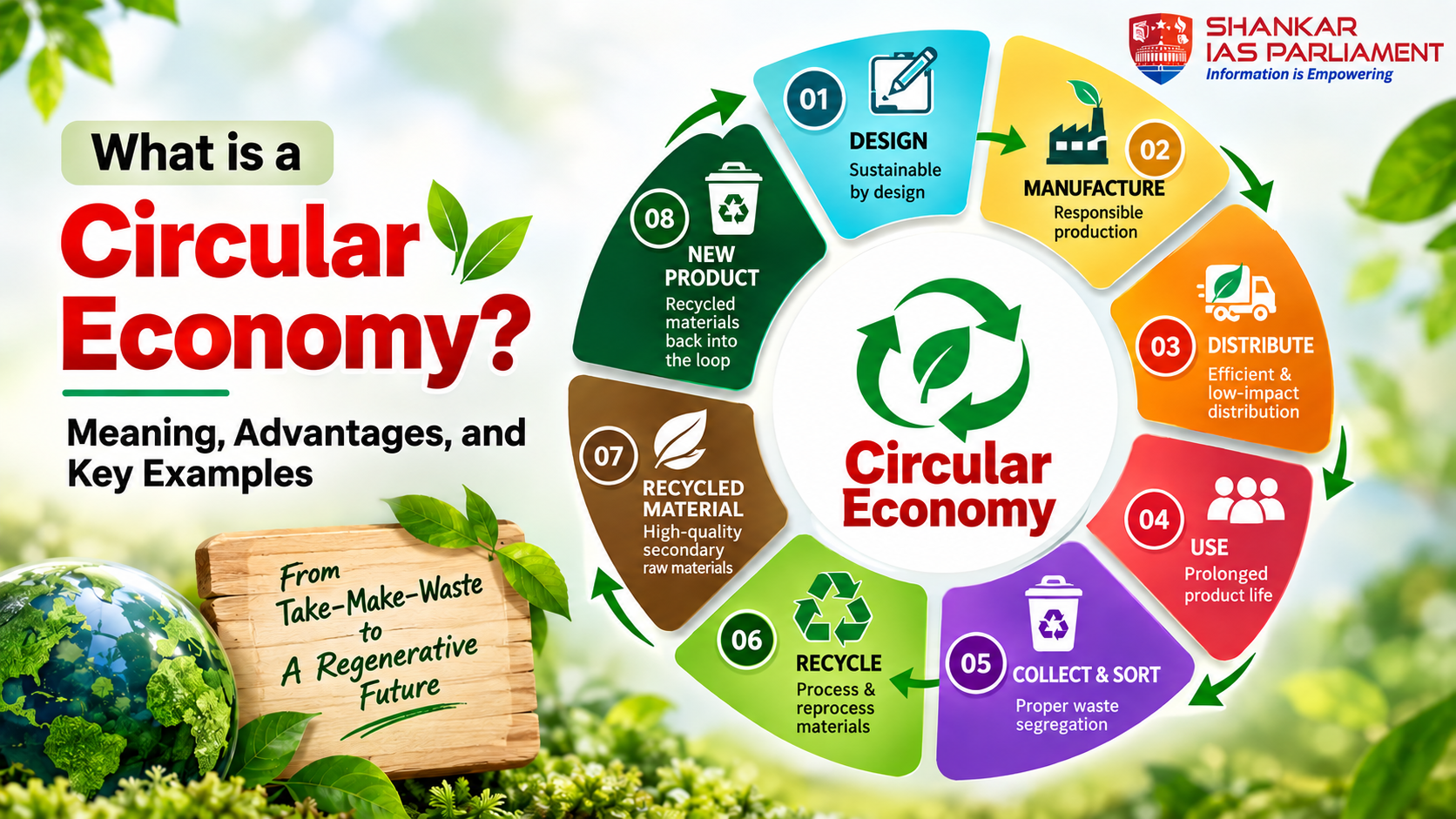
- Circular economy – It is an economic system that seeks to minimise resource extraction and waste generation by keeping products, materials and resources in use for as long as possible.
- Unlike the traditional linear model “take, make, use and dispose”, a circular economy promotes:
- Reduce, Reuse, Repair, Refurbish, Remanufacture, Recycle, Recover.
- Objective – To decouple economic growth from resource depletion and environmental degradation.
- Evolution of the Concept – The term “circular economy” is associated with Pearce and Turner (1990).
- However, the underlying ideas existed earlier through concepts such as closed-loop economy, cyclic economy and closed spaceship economy.
- Initially, the focus was on resource scarcity, pollution and waste containment.
- Later, CE has evolved from a defensive environmental approach into a broader economic and development strategy.
|
3 Dimensions of Circular Economy
|
|
1. How – Principles
- Reduce resource use and waste.
- Reuse, repair and refurbish products.
- Remanufacture and recycle materials.
- Recover resources where necessary.
- Design for durability and recyclability.
2. Why – Objectives
- Reduce waste and pollution.
- Conserve resources and improve efficiency.
- Minimise environmental degradation.
- Promote sustainable economic growth.
- Ensure intergenerational sustainability.
3. Who – Enablers
- Government and policymakers
- Industries and businesses
- Consumers and communities
- Academia and researchers
- Waste-management sector
|
What are the Key Gaps in the Circular Economy Approach?
- Overemphasis on Recycling – A major concern is that CE is often reduced to recycling alone than reduction, reuse and repair.
- Incineration or recovery may also be wrongly presented as circularity.
- This can allow fundamentally linear production systems to continue under a “circular” label.
- Neglect of “Reduce” – Reduce receives comparatively less attention than reuse and recycling.
- Business Model Gap – Although business models are considered central to CE, they appear explicitly in only a minority of definitions.
- A genuinely circular business model could involve: Product-as-a-service, Leasing + Repair + Take-back systems + longer product life.
- For example, simply recycling discarded mobile phones does not make the entire business model circular if products continue to be designed for rapid replacement.
- Social Equity Deficit – Social equity and the interests of future generations remain relatively weak elements in CE frameworks.
- A truly sustainable circular economy should also address –
- Employment transitions.
- Informal waste workers.
- Access to affordable products and services.
- Distribution of costs and benefits.
- Intergenerational equity.
- Country and Sector-Specific Approaches
- Circular economy does not have a single universal implementation model.
|
Specific examples
|
- China – Circular Economy Promotion Law, 2008, emphasises the 3R approach — Reduce, Reuse and Recycle.
- European Union – Focuses on resource efficiency, closing material loops and circular supply chains.
Industry-specific examples –
- Textiles – Reuse, recycling and employment transition.
- Automobile sector – End-of-life recovery, remanufacturing and component reuse.
- Construction – Deconstruction and reuse of building materials.
- Eco-industrial parks – Exchange of waste and by-products between industries.
- Packaging/FMCG – Increasing use of recycled materials and closed-loop packaging systems.
|
What is its Significance for India?
- Resource Security – Reducing dependence on virgin raw materials can improve resource and supply-chain security.
- Waste Management – India faces growing challenges from plastic, electronic, construction and municipal waste.
- Employment – Repair, refurbishment, recycling and remanufacturing can generate green jobs, particularly for informal workers.
- Industrial Competitiveness – Efficient resource use can reduce input costs and improve the competitiveness of Indian industries.
- Climate Goals – Reducing extraction, production-related emissions and waste can contribute to India's climate and sustainability objectives.
- Sustainable Urbanisation – Circular approaches can support sustainable cities through resource-efficient infrastructure, waste management and reuse of materials.
What could be done?
- Follow the Waste Hierarchy – Policy should prioritise Reduce, Reuse, Repair, Refurbish, Remanufacture, Recycle, Recover rather than treating recycling
- Promote Circular Product Design – Encourage durability, repairability, modularity, recyclability and longer warranties.
- Transform Business Models – Promote leasing, product-as-a-service, take-back systems and sharing models rather than only end-of-life recycling.
- Integrate Social Equity – Recognise and formalise the role of informal waste workers while ensuring a just transition towards green employment.
- Develop Sector-Specific Strategies – Circularity should be adapted to sectors such as textiles, automobiles etc. while maintaining common national principles.
- Strengthen Measurement – India needs clear indicators measuring material consumption, product lifespan, reuse rather than just measuring recycling rates.
What lies ahead?
- Circular economy should not become merely a new label for conventional recycling.
- Its transformative potential lies in redesigning how products are made, used, repaired, reused and eventually recovered.
- The focus should therefore shift from a narrow “waste-to-value” approach to a whole-system transformation of production and consumption, while ensuring social and intergenerational equity.
Reference
Down To Earth| Circular Economy



