Mains: GS III – Conservation, Environmental Pollution and Degradation
Why in News?
Recently, the 2024 Annual Groundwater Quality Report by the Central Ground Water Board (CGWB) reveals more than 20% of samples from 440 districts were contaminated with nitrates and identified groundwater death zones.
What is groundwater pollution?
- Groundwater – It exists beneath the Earth's surface, filling the spaces within soil and rocks in a saturated zone.
- It's a vital source of freshwater, often accessed through wells and springs.
- Groundwater pollution – It is also known as groundwater contamination, occurs when harmful substances contaminate underground water sources.
- Causes – This can happen due to natural occurrences or human activities.
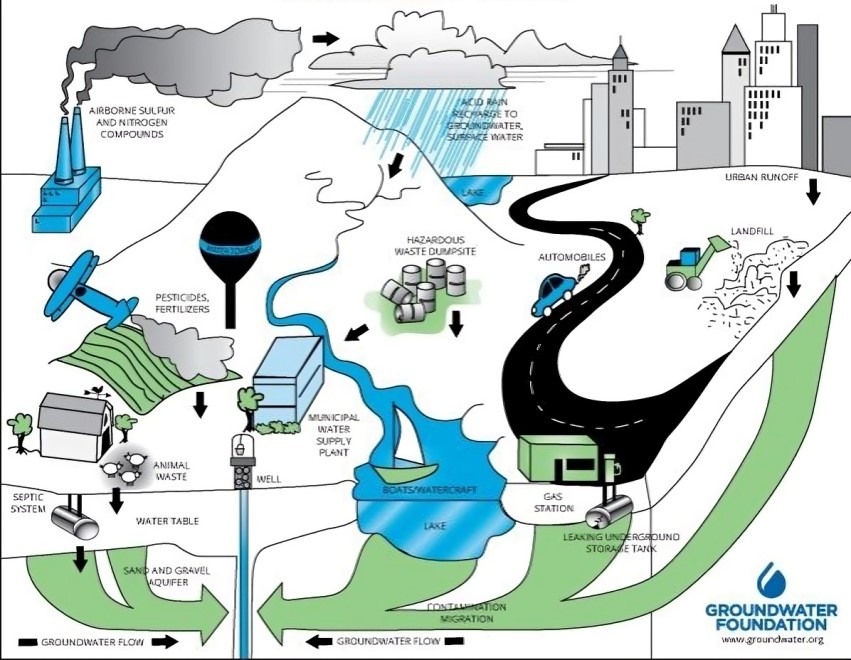
- Pollutants can enter groundwater through various pathways, including surface contamination, industrial waste, and agricultural runoff.
- It is largely due to the overuse of chemical fertilisers and leaching from septic systems.
- Groundwater death zones – These are areas in groundwater systems where dissolved oxygen levels are significantly depleted, making it difficult or impossible for life to survive.
- For example, In Budhpur, Baghpat (Uttar Pradesh), 13 people died within a fortnight this year, from kidney failure and related complications.
- It is allegedly linked to toxic discharges from nearby paper and sugar mills contaminating local borewells.
What are the major contaminants and associated diseases?
- Fluoride – The 2024 CGWB report found that 9.04% of 15,259 samples groundwater samples exceeded the WHO’s 1.5 mg/L fluoride limit.
- Around 66 million people suffer from skeletal fluorosis caused by fluoride contamination.
Skeletal fluorosis is a debilitating condition that causes joint pain, bone deformities, and stunted growth, particularly in children.
-
- In Rajasthan, over 11,000 villages have reported cases.
-
- In Jhabua (Madhya Pradesh), fluoride levels exceed 5 mg/L, with 40% of tribal children affected.
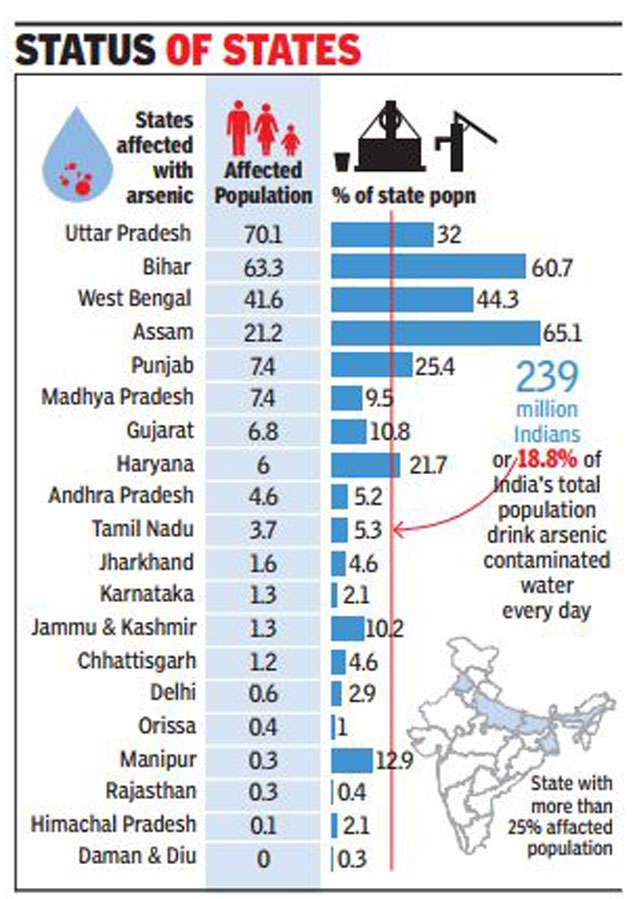
- Arsenic – Its exposure is concentrated in the Gangetic belt—including West Bengal, Bihar, Uttar Pradesh, Jharkhand, and Assam.
- It leads to skin lesions, gangrene, respiratory problems, and various internal cancers.
Gangrene is a serious medical condition where body tissues die due to a lack of blood supply.
- Elevated blood arsenic levels make 1 in 100 individuals highly vulnerable to cancer, including cancers of the skin, kidney, liver, bladder, and lungs, as well as other secondary cancer types.
- In Ballia (U.P.), arsenic concentrations reached 200 µg/L—20 times the WHO limit— linked to over 10,000 cases of cancer and other diseases.
- In Bihar’s Bhojpur and Buxar districts, similar impacts have been observed.
- While arsenic is geogenic, its mobilisation is worsened by groundwater over-extraction, mining, and irrigation.
Geogenic refers to something originating in or caused by geological processes, especially those occurring naturally within the Earth.
Nitrate contamination – It is rampant in northern India and poses a severe threat to infants.
- When baby formula is mixed with nitrate-laced water, it can cause blue baby syndrome.
Blue baby syndrome, also known as cyanosis or infant methemoglobinemia, is a condition where a new born baby’s skin appears bluish due to low oxygen levels in the blood.
- The 2023 National Health Profile recorded a 28% rise in hospital admissions from acute nitrate toxicity over five years, particularly in Punjab, Haryana, and Karnataka.
- Today, 56% of Indian districts exceed safe nitrate levels.
- Uranium contamination – It is increasingly detected due to excessive groundwater extraction and fertiliser use.
- A study by the Central University of Punjab in the Malwa region found increased uranium levels in groundwater.
- It is exceeding the WHO threshold of 30 µg/L, posing serious risks of chronic organ damage and nephrotoxicity.
- The results showed that 66% of samples posed health risks for children and 44% for adults.
Nephrotoxicity refers to kidney damage caused by exposure to toxic substances, including certain medications and chemicals.
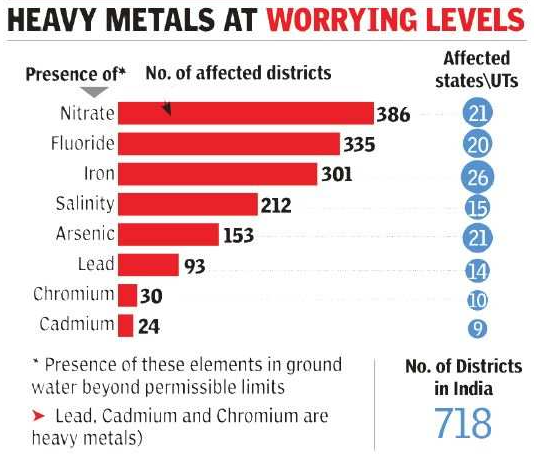
- Heavy metals — Lead, cadmium, chromium, mercury enter groundwater from unchecked industrial discharges.
- They cause developmental delays, anaemia, immune system issues, and neurological damage.
- The ICMR-National Institute for Research in Environmental Health (NIREH) found dangerously high blood lead levels among children near industrial clusters in Kanpur (U.P.) and Vapi (Gujarat).
- Contamination from leaking septic systems and sewage infiltration has triggered repeated outbreaks of cholera, dysentery, and hepatitis A and E.
- In Paikarapur, Bhubaneswar, over 500 residents were recently affected by a waterborne disease outbreak tied to sewage-contaminated groundwater.
Why the crisis persists?
- Ineffective policies – The Water (Prevention and Control of Pollution) Act, 1974, scarcely addresses groundwater pollution.
- The CGWB lacks statutory authority, and State Pollution Control Boards (SPCBs) are under-resourced and technically constrained.
- Inadequate industrial regulation – Industries operate with minimal oversight, and sanitation infrastructure, especially in rural and peri-urban India, remains deficient.
- Institutional fragmentation – Agencies such as CGWB, CPCB, SPCBs, and the Ministry of Jal Shakti operate in silos, often duplicating efforts and lacking coordination for integrated, science-based interventions.
CPCP – Central pollution control board.
SPCB – State pollution control board.
- Weak legal enforcement – While the Water Act exists, its enforcement on groundwater discharge is inadequate.
- Regulatory loopholes and negligent compliance encourage polluters.
- Lack of real-rime data – Monitoring is infrequent and poorly disseminated.
- Without early warning systems or integration with public health surveillance, contamination often goes undetected until after serious health outcomes emerge.
- Over extraction – Excessive pumping lowers water tables and concentrates pollutants, making aquifers more vulnerable to geogenic toxins and salinity intrusion.
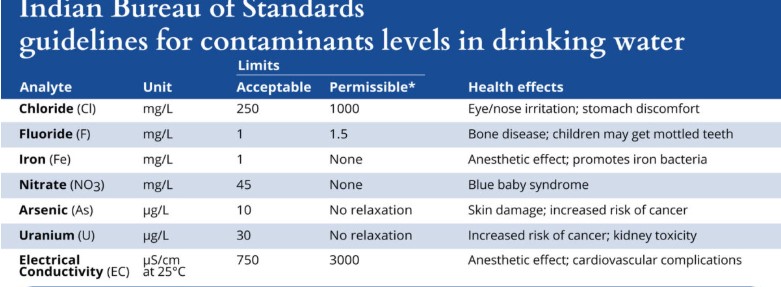
What are the acceptable limits of contaminants?
What changes to be done?
- Unified framework – A National Groundwater Pollution Control Framework can clearly define responsibilities across agencies and empower the CGWB with regulatory authority.
- Modernized monitoring infrastructure – Use of real-time sensors, remote sensing, and open-access platforms.
- Integrating water quality data with health surveillance systems like Health Management Information System (HMIS) for early detection.
- Targeted remediation and health interventions – Installing community-level arsenic and fluoride removal systems, especially in high-risk regions.
- Expand piped water access and awareness campaigns in water stressed areas.
- Urban and industrial waste reforms – Mandating Zero Liquid Discharge (ZLD), regulate landfills strictly, and enforce penalties for illegal discharges.
- Agrochemical reform – Promoting organic farming, regulate fertiliser and pesticide use, and encourage balanced nutrient management.
- Citizen-Centric groundwater governance – Strengthening the role of panchayats, water user groups, and school programmes in water testing, monitoring, and advocacy.
What lies ahead?
- Effective interventions could be taken including defluoridation, improved nutrition, and provision of safe drinking water.
- India’s groundwater crisis calls for a bold, coordinated, and multi-dimensional strategy that integrates regulation, technology, health, and public participation.
Reference
The Hindu| Groundwater Pollution in India



