0.1422
7667766266
x

Cultivating Constitutional Morality

iasparliament Logo
November 27, 2026

Mains: GSII – Polity 

Why in News?

The Constitution Day (November 26) provides an opportunity to examine the importance of constitutional morality in strengthening Indian democracy.
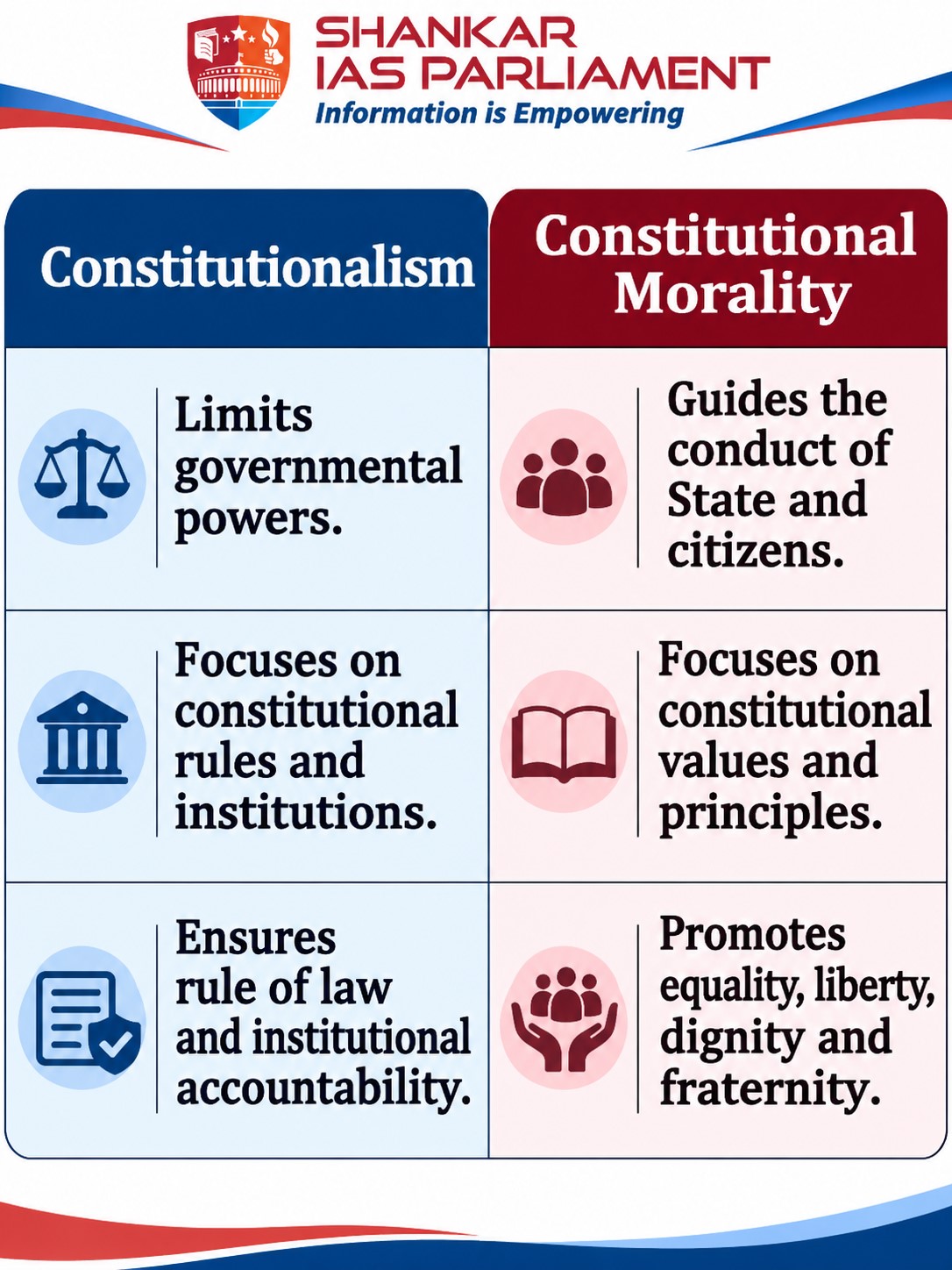
What is it meant by Constitutionalism and Constitutional Morality?

  • Constitution – A written legal document that establishes the structure, powers and functions of government.
  • Constitutionalism – A political framework that ensures limited government and prevents arbitrary exercise of power through constitutional restrictions.
  • Constitutional Morality – Adherence to constitutional ideals such as justice, liberty, equality and fraternity, even when they conflict with majority opinion or traditional social practices.
    • In other-words, it means living by the spirit and core values of the Constitution.

Constitutionbal morality

  • Essential Features of Constitutionalism
    • Rule of Law – Everyoneis subject to the law.
    • Separation of Powers – Distribution of powers among Legislature, Executive and Judiciary.
    • Checks and Balances – Prevents concentration and misuse of governmental authority.
    • Protection of Individual Rights – Safeguards fundamental rights against arbitrary State action.
    • Judicial Review – Courts can invalidate laws violating constitutional provisions.

Part III of the Constitution, particularly Fundamental Rights, reflects the principles of constitutionalism.

  • Constitutional Morality in the Indian Context –
    • Constitutional morality requires both State institutions and citizens to uphold constitutional values in public and private life.
    • It prioritises constitutional principles over social orthodoxy, caste discrimination, religious prejudice and majoritarian tendencies.

Case

Constitutional Significance

Kesavananda Bharati (1973)

Established the Basic Structure Doctrine and referred to constitutional morality.

K.S. Puttaswamy (2017)

Recognised the Right to Privacy as a Fundamental Right.

Indian Young Lawyers Association (2018)

Allowed entry of women into the Sabarimala temple.

Navtej Singh Johar (2018)

Decriminalised consensual same-sex relations by reading down Section 377 IPC.

What is Dr. B.R. Ambedkar's Perspective on Constitutional Morality?

  • Need to be cultivated – constitutional morality is not a natural sentiment but needs to be cultivated through education, practice and democratic institutions.
  • Three Major Threats to Indian Democracy Identified by Ambedkar –
    • Hero-Worship – Personality cults in politics may undermine democratic institutions and eventually lead to dictatorship.
    • Social and Economic Inequality – Political equality without social and economic equality may threaten the stability of democracy.
    • Extra-Constitutional Methods – Democratic demands must be pursued through constitutional methods rather than violence or anarchy.
  • Ambedkar's Warning – Political democracy cannot survive without social democracy, which rests on liberty, equality and fraternity.

What are the Major Challenges to Constitutional Morality?

  • Majoritarianism – Electoral victories are sometimes interpreted as unrestricted political authority, undermining individual liberties and institutional checks.
  • Politicisation of Institutions – Political interference weakens the neutrality and credibility of constitutional institutions.
  • Administrative Expediency – Political convenience often takes precedence over fairness, transparency and accountability.
  • Institutional Weakness – Weak accountability mechanisms undermine constitutional governance and the rule of law.
  • Citizen-Level Challenges
    • Social Orthodoxy – Caste, religious and linguistic prejudices often take precedence over constitutional equality and fraternity.
    • Weak Public Responsibility – Citizens frequently prioritise individual and sectional interests over collective welfare.
    • Lack of Constitutional Awareness – Limited understanding of constitutional rights, duties and values weakens democratic participation.

What is the Way Forward?

  • Constitutional Education – Integrate constitutional values into educational curricula and encourage awareness of Fundamental Rights and Duties.
  • Institutional Independence – Strengthen the autonomy, neutrality and accountability of constitutional institutions.
  • Democratic Accountability – Ensure transparency, parliamentary oversight and adherence to the rule of law.
  • Social Transformation – Address caste discrimination, religious intolerance and other social inequalities through constitutional principles.
  • Responsible Citizenship – Encourage citizens to uphold fraternity, tolerance, public duty and respect for diversity.
  • Constitutional Methods – Promote peaceful democratic participation and discourage extra-constitutional approaches to resolving public grievances.
  • Family and Civil Society – Encourage families, educational institutions and civil society organisations to inculcate constitutional values.

What lies ahead?

  • Constitutional morality is essential for transforming constitutional principles into everyday democratic practices.
  • Strengthening it requires both responsible governance and active citizenship, ensuring that liberty, equality, justice and fraternity remain the foundations of Indian democracy.

Reference

The Hindu| On Cultivating Constitutional Morality

There are no reviews yet. Be the first one to review.

ARCHIVES

sidetext


