0.1562
7667766266
x

CRMA-1001 - Gene Therapy to beat Hepatitis B Virus

iasparliament Logo
October 30, 2026

Prelims: Current events of national and international importance | Health

Why in News?

Recently, advances in genetic medicine highlighted CRMA-1001—an innovative, liver-targeted epigenetic editing therapy entering Phase 1/2 clinical trials (developed by nChroma Bio).

  • Unlike conventional gene editing (e.g., CRISPR-Cas9) that cuts or mutes DNA sequences by breaking strands, CRMA-1001 achieves a potential functional cure for Chronic Hepatitis B (HBV).
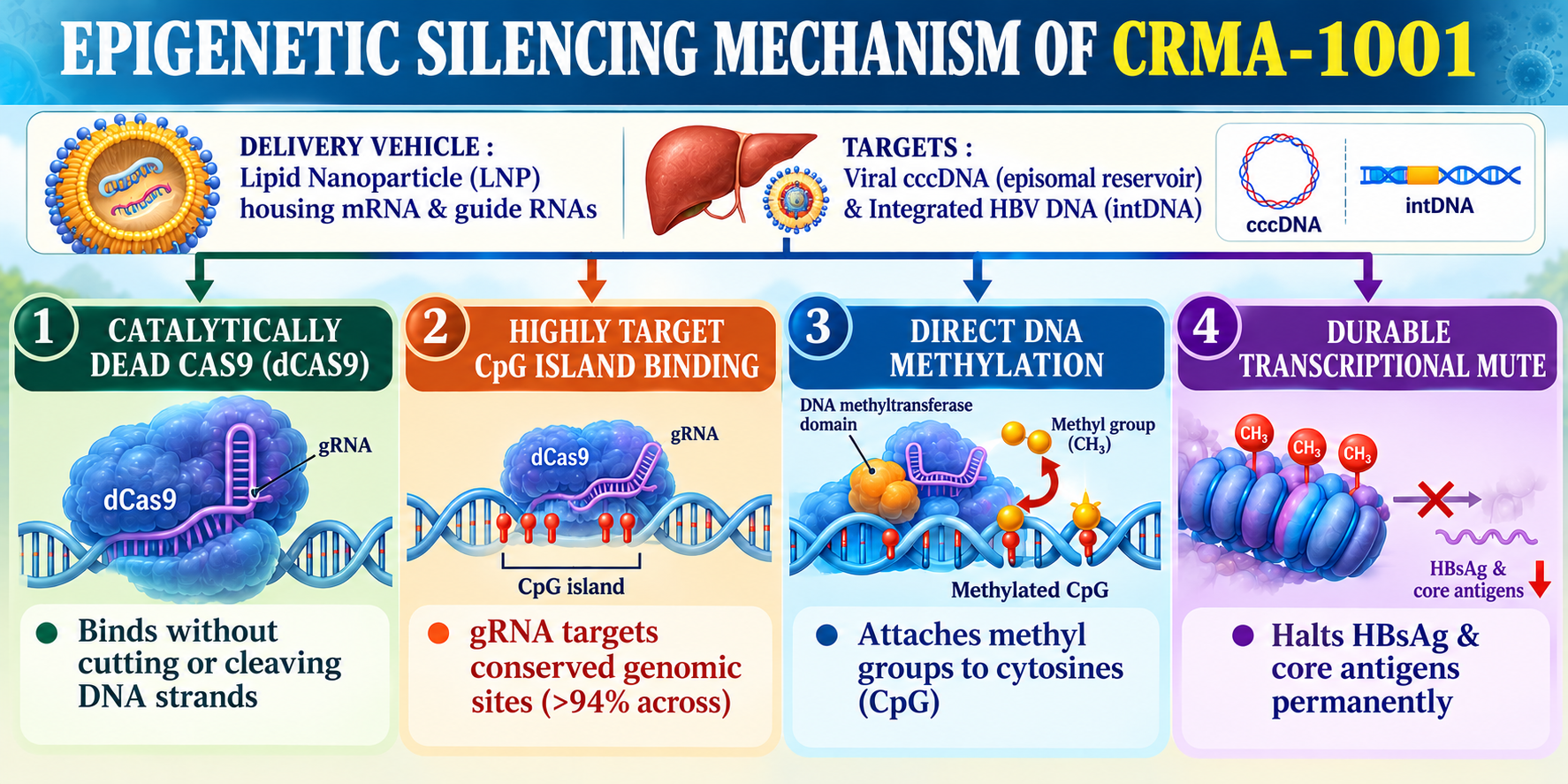
  • It is done by directly methylating and durably silencing (muting) viral DNA without modifying the host or viral genetic code.

Key Highlights

Parameter

Traditional Antivirals

CRMA-1001 Epigenetic Silencer

Mechanism of Action

Inhibits reverse transcription (Nucleos(t)ide Analogs) or physically cuts DNA double strands (CRISPR-Cas9).

Epigenetic Modification- Uses a catalytically dead Cas9 (dCas9) fused to a methyltransferase effector to methylate cytosines at viral target promoter regions.

Target Reservoirs

Suppresses circulating virus but fails to eliminate/silence nuclear cccDNA and integrated HBV DNA (intDNA).

Dual Silencing -  Directly methylates and silences both nuclear episomal cccDNA and integrated host-genome viral DNA (intDNA).

Genomic Safety Profile

High risk of insertion/deletion mutations (indels), off-target double-strand breaks (DSBs), and chromosomal translocations.

Zero Strand Cleavage - Leaves the underlying host DNA sequence completely intact, avoiding double-strand break toxicity and unintended chromosomal damage.

Delivery Strategy

Daily lifelong oral pills or viral vectors (AAVs).

Intravenous Lipid Nanoparticles (LNPs) delivering mRNA constructs transiently to hepatocytes.

Addressing the Core Challenge of Chronic HBV

  • The cccDNA and Integrated DNA Barrier - Chronic HBV persists inside liver cells (hepatocytes) primarily due to covalently closed circular DNA (cccDNA), a stable episomal micro-chromosome operating inside the host cell nucleus.
  • Standard therapies stop viral replication in the bloodstream, but cccDNA continues churning out Hepatitis B surface antigen (HBsAg), leading to immune exhaustion, liver cirrhosis, and hepatocellular carcinoma (HCC).
  • Epigenetic "Muting" via Methylation - CRMA-1001 deposits methyl groups (-CH3) onto specific CpG islands along the HBV genome.
  • This alters chromatin structure, blocking RNA polymerase from transcribing viral genes into mRNA and stopping the production of viral antigens (HBsAg and HBcAg) permanently.

Strategic Significance

  • Demonstrates the paradigm shift in genetic engineering from cleaving/modifying DNA sequences to epigenetically modulating gene expression, a far safer modality for infectious diseases and metabolic disorders.
  • Chronic HBV affects over 250 million people worldwide (with India housing ~40 million chronic carriers).
  • Achieving a single-course functional cure (defined as sustained clearance of serum HBsAg) would significantly reduce global liver cancer rates and healthcare expenditure.

CRMA-1001

Reference

The Hindu | Gene Therapy to beat Hepatitis B Virus

There are no reviews yet. Be the first one to review.

ARCHIVES

sidetext