Mains: GS III - Disaster and Disaster Management.
Why in the news?
Recently, India is considering the use of catastrophic bonds for disaster resilience and management.
What are catastrophic bonds?
- Definition - Catastrophe bonds are hybrid financial instruments that combine features of insurance and debt.
- Origin - It originated in the U.S. in late 1990s after hurricanes.
- Objective - To strengthen disaster risk financing and enhance climate resilience amid the increasing frequency of natural disasters.
- Importance – They turn a country’s hazard exposure into a tradable security, opening access to a wider pool of capital beyond traditional insurers and reinsurers.
- They allow at-risk entities, usually sovereign states, to transfer pre-defined disaster risks to investors, thereby enabling quicker payouts and reduces counterparty risk.
- They help in diversification of natural hazard risks.
Nobel laureate Harry Markowitz’s emphasis on diversification aligns with the strategic rationale for including cat bonds in investment portfolios.
- They are statistically independent of traditional financial risks, making them valuable for risk-averse portfolios.
How do Cat bonds work?
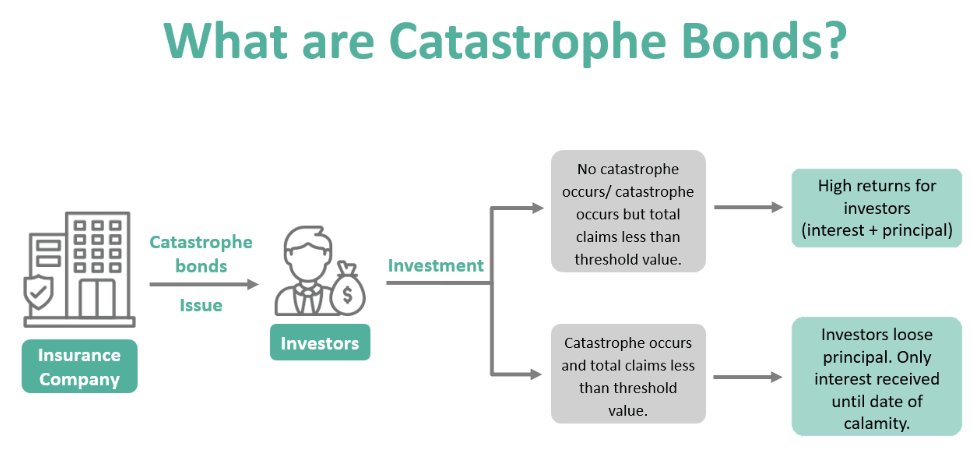
- Creation – They are created by sovereign nations, which sponsor the bond and pay the premium, with the principal being the sum insured.
- Issuance – The sponsor requires an intermediary to issue the bond, thereby reducing counterparty risk.
- Intermediaries - It can include the World Bank, the Asian Development Bank, or a reinsurance company.
U.S., catastrophe bonds have seen over $180 billion in issuances globally, with approximately $50 billion currently outstanding, since their inception in the late 1990s following major hurricanes.
- Purchaser – It is generally purchased by global investors, including pension funds, hedge funds, and family offices, who are attracted by high returns and the diversification benefits of non-market associated risks.
- Coupon rates – If a disaster does occur, the investor runs the risk of losing a part of the principal, a key reason for higher coupon rates of such bonds, compared to regular debt instruments.
- The risk level and frequency of disaster occurrence directly influence coupon rates.
- For example, earthquake-related bonds often offer lower premiums (1-2%) compared to those covering cyclones or hurricanes.
Why does India need Cat bonds?
- Less insurance penetration - The traditional insurance coverage remains sparse, especially for individuals and small businesses.
- Lack of disaster insurance - Less availability of insurance on individual property and livelihoods leaves much of the population exposed to irretrievable damage and loss.
- Burden on public finance – It places a significant burden on public finances for recovery, rehabilitation and reconstruction.
- Increased climate crisis - As climate change intensifies the frequency and severity of natural disasters, India is increasingly vulnerable to financial shocks arising from catastrophic disasters.
- India faces an increasingly precarious climate future with rising occurrences of floods, cyclones, forest fires, and earthquakes.
How could sponsoring cat bonds help India?
- Reserving the finances for disaster recovery - Leverage its strong sovereign credit profile to negotiate favourable terms.
- Transfer of risk - It takes away risk from the government to global investors.
- Ensure quicker post-disaster recovery – Finances for pre-defined risk helps in easier availability of risk finances.
- Lowers bond premiums – India’s proactive disaster management steps, including an annual allocation of Rs.15,000 crore ($1.8 billion) for mitigation and capacity building, could further.
What is India’s potential in South Asian Cat bonds?
- India’s financial stability - India could be lead-sponsor for a South Asian cat bond, given that most such regional risks remain unhedged.
- Regional collaboration - India is well-positioned to lead the creation of a regional catastrophe bond framework for South Asia.
- Risk spreading - It spreads risk across multiple countries and reduce overall premium costs.
- Financial preparedness – India could foster financial preparedness across the region of south Asia.
- Cover high-impact hazards
- Earthquakes across India, Nepal, and Bhutan
- Cyclones and tsunamis are affecting India, Bangladesh, the Maldives, Myanmar, and Sri Lanka.
- By pooling diverse risks across geographies, a South Asian cat bond would be more attractive to investors and more robust in coverage.
What are the challenges?
- Insufficient design - Poorly designed bonds may miss payouts due to rigid trigger conditions.
- For example, a bond triggered only by earthquakes above 6.6 magnitude may not activate for a 6.5 event, even if damage is severe.
- Wasted premium payments - Governments may question the cost-benefit ratio if no disasters occur during the bond period, leading to a perception of lost premium payments.
- Limited coverage - Most cat bonds generally covered primary risks like major hurricanes and earthquakes.
- It can be more expensive to build bonds for secondary risks like floods, wildfires, etc. which are becoming more frequent due to climate change.
- Lack of technical knowledge – These bonds are difficult to value and understand for generalist investors, requiring specialized knowledge and reliance on catastrophe modelling firms.
What lies ahead?
- Accountable insurance framework can be made through, transparent cost comparisons with past disaster recovery expenditures.
- Engagement with reliable intermediaries and risk modellers could be an efficient way to administer the disaster insurance network.
Reference
The Hindu| Cat Bonds for a Natural Disaster Mitigation



