Why in news?
Recently launched Rs 11,000-crore National Edible Oil Mission-Oil Palm (NEOM-OP) is a bold step to augment domestic edible oil supplies but still much more is needed to boost edible oil production.
How import-dependent is India?
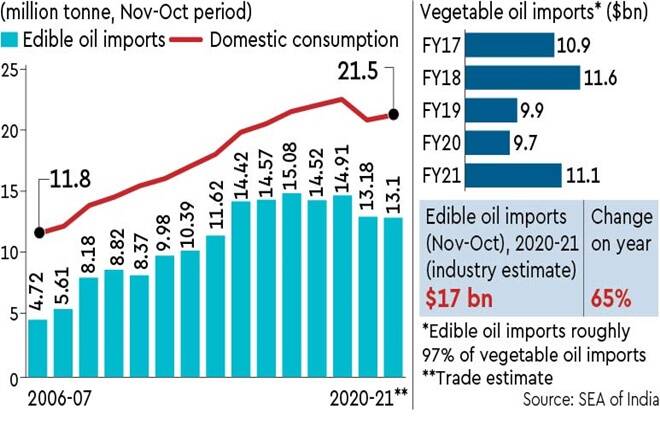
- 60 % of the edible oil consumed in the country is imported and more than half of this is palm oil
- In FY 2020-21, edible oil imports touched $ 11 billion or about Rs 80,000 crore
- Despite these imports, edible oil inflation in July 2021 was 32.5 %
What are the government initiatives taken in this regard?
- National Edible Oil Mission-Oil Palm (NEOM-OP)
- Oil Palm Area Expansion under Rastriya Krishi Vikas Yojana
- Increasing the MSP of rapeseed-mustard up by 8.6 % recently
- Creation of buffer stock for oilseeds
- Cluster demonstration of oilseed crops
Why is the recent oil palm mission so significant?
- Productivity - Oil palm is the only crop that can give up to four tonnes of oil productivity per hectare under good farm practices
- Area Expansion - The National Re-assessment Committee (2020) has identified 28 lakh hectares suitable for oil palm cultivation but actual area under oil palm cultivation, as of 2020, is only 3.5 lakh hectares
- Thus a huge potential of area expansion is waiting to be tapped especially in North East, Andhra Pradesh and Telangana
- The government plans to boost cultivation of oil palm to 10 lakh hectares by 2025-26
- Reduction in imports - Comprehensive assistance package is offered to attract farmers and industries to boost edible oil production in a globally competitive manner thereby reducing the import bill.
- Pricing formula - There will be no MSP, but the price for farmers would be fixed at 14.3 % of average landed CPO price of the past five years, adjusted with the wholesale price index
What is needed beyond the mission?
- Import duty needs to be in sync with rational domestic price policy as recommended by Commission for Agricultural Costs and Prices (CACP)
- Revisit the existing incentive structure that unduly favours rice, wheat and sugarcane through heavy subsidisation of power, fertilisers and MSP
- Devise a crop-neutral incentive structure where cropping patterns are aligned with demand patterns
Source: The Indian Express
Quick Facts
India’s edible oil economy
- India is the world’s largest importer of edible oil with a share of 20.7 per cent, followed by EU and China.
- 60% of edible oil requirement is met through imports and the share of palm oil is about 60% of the import bill.
- India is the second-largest edible oil consuming country.
Palm oil
- Palm oil is currently the world’s most consumed vegetable oil
- Top consumers are India, China, and the European Union (EU)
- It is used extensively in the production of detergents, plastics, cosmetics, and biofuels



