Powering India’s Farms, Growing a Sustainable Future
- Agrivoltaics, also known as agrisolar or dual-use solar, refers to the simultaneous cultivation of crops or rearing of livestock and generation of solar electricity on the same land.
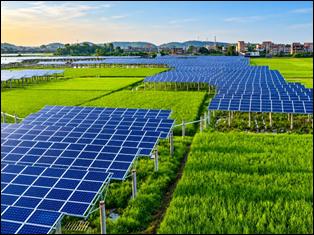
- Solar panels are installed above crops or between crop rows, allowing agricultural activities to continue while generating renewable energy.
- It promotes efficient land use, diversifies farmers’ incomes and strengthens food and energy security.
Agrivoltaics Important for India
- Agricultural significance: Agriculture and allied activities support approximately 46.1% of India’s population, with sectoral GVA estimated at ₹52.08 lakh crore in 2025–26.
- Land-use efficiency: Agriculture accounts for approximately 55% of India’s reported geographical area of 306.96 million hectares. Agrivoltaics enables dual use of suitable agricultural land.
- Renewable energy transition: Solar electricity can power irrigation pumps and other farm operations, reducing dependence on diesel and conventional electricity.
- Income diversification: Farmers can earn from both agricultural produce and surplus electricity supplied to the grid. In some cases, annual earnings could increase from around ₹60,000 to over ₹1 lakh per acre.
-
Climate resilience: Partial shading can reduce soil moisture loss and protect certain crops from extreme heat, depending on local conditions and system desig
Design and Functioning of Agrivoltaic Systems
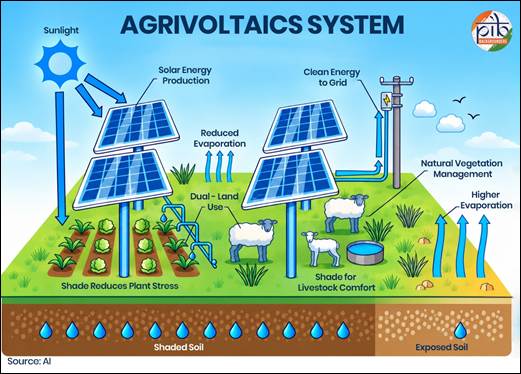
- Elevated solar structures: Panels are mounted high enough to allow sunlight, rainfall and the movement of agricultural machinery beneath them.
- Partial shading: Solar panels create a microclimate that may reduce temperatures and water evaporation, benefiting suitable crops.
- Dual land productivity: Crop cultivation or livestock rearing continues alongside solar power generation, improving overall land productivity.
Agrivoltaics Development and Potential in India
- As of August 2025, India had 36 operational agrivoltaic projects with 37.54 MW capacity, alongside 10 pilot projects under development.
- India's estimated agrivoltaic potential ranges from 3,000 GW to nearly 14,000 GW.
- GIS-based national screening identified 47.35 million hectares of restricted cropland potentially suitable for AgriPV after environmental, agronomic and technical filters.
- Fruits, vegetables, spices and medicinal plants offer promising cultivation opportunities.
- Maharashtra, Rajasthan, Andhra Pradesh, Madhya Pradesh, Karnataka and Uttar Pradesh collectively account for nearly 50% of India's estimated AgriPV power-generation potential.
Government Initiatives
- PM-KUSUM: Launched in February 2019, it promotes solar-powered irrigation, decentralised solar generation and opportunities for farmers to earn from surplus electricity.
- It envisages central financial assistance of approximately ₹34,422 crore.
- Centre of Excellence on Agrivoltaics: Established by the National Institute of Solar Energy in collaboration with ICAR's Indian Agricultural Research Institute, it supports research, demonstrations and capacity building, including a 100-kW pilot system.
- India Agrivoltaics Alliance (IAA): Launched in 2023 and anchored by the National Solar Energy Federation of India, it promotes policy advocacy, research, pilot projects and scalable business models.
- State initiatives:
- Maharashtra's Mukhyamantri Saur Krushi Vahini Yojana 2.0 promotes 16,000 MW of solar projects;
- Gujarat's Kisan Suryoday Yojana expands daytime agricultural power supply; and
- Karnataka's Surya Raitha Scheme supports solar irrigation and surplus-power earnings.
Way Forward
- Promote locally suitable panel designs and crop selection through scientific research and field demonstrations.
- Ensure farmer participation, affordable financing and fair revenue-sharing arrangements.
- Monitor agricultural yields, soil health, water use and ecological impacts to prevent energy generation from undermining food production.
Conclusion
Agrivoltaics can connect agricultural prosperity with India's clean-energy transition by improving land-use efficiency, diversifying farm incomes and strengthening rural resilience.
Reference
PIB



