Mains – GS III – Infrastructure
Why in News?
The India’s potential of vehicle retrofitment to transform India's mobility sector highlights creating decentralised employment and establishing India as a global provider of affordable EV conversion solutions.
What is Vehicle Retrofitment?
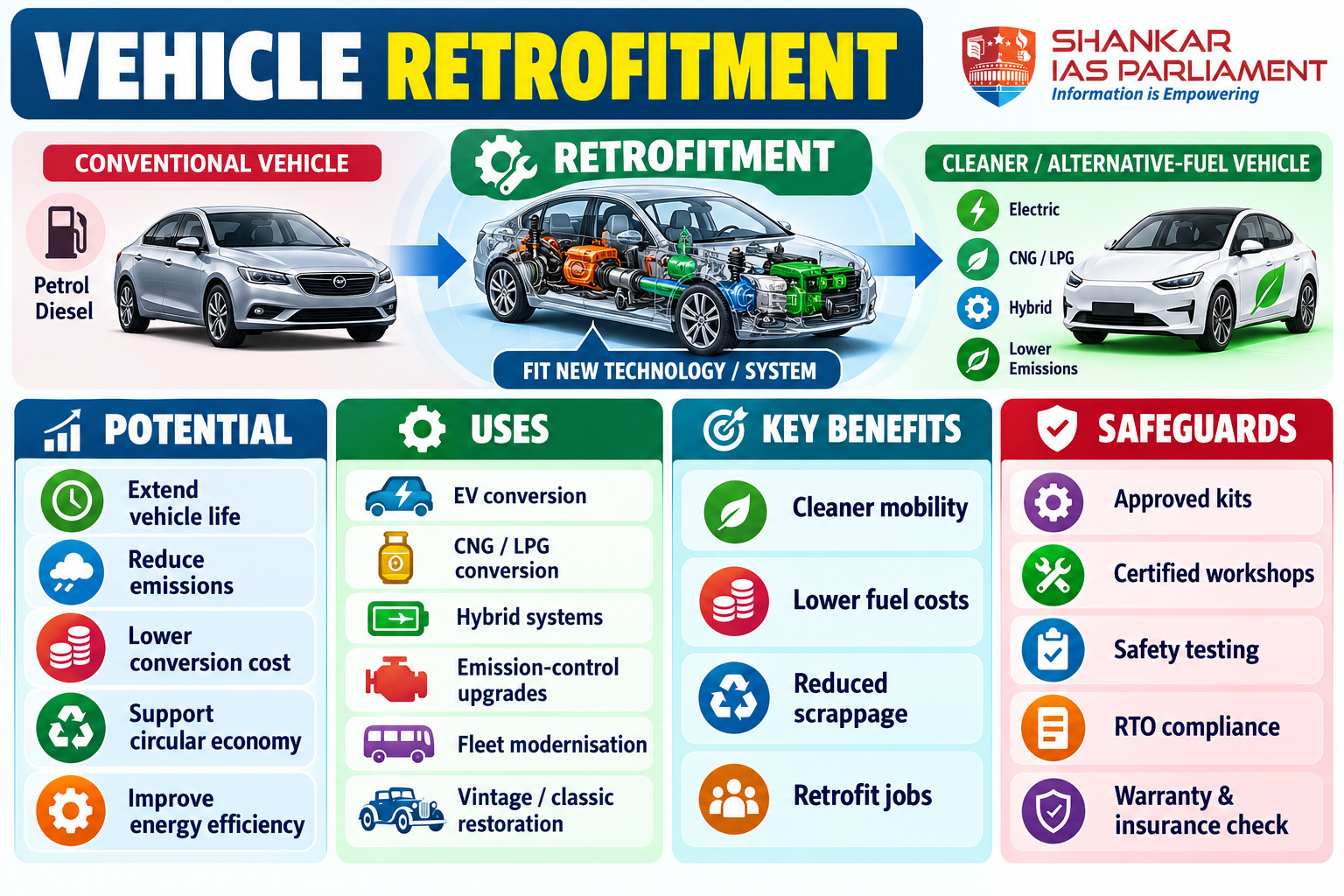
- Vehicle retrofitment – It involves converting an existing petrol or diesel vehicle into an electric vehicle (EV) by replacing its conventional powertrain while retaining the chassis.
- Promotes – The reuse of existing vehicles, reduces dependence on fossil fuels and offers a potentially affordable pathway to electric mobility.
What is the Potential of Vehicle Retrofitment in India?
- Accelerating the EV Transition – Converts existing petrol and diesel vehicles into EVs, making electric mobility more affordable and reducing dependence on imported crude oil.
- Promoting a Circular Economy – Reuses existing vehicle parts, reduces material waste and extends vehicle life while meeting safety standards.
- Generating Decentralised Employment – Creates local jobs by enabling mechanics and technicians to convert and maintain EVs through workshops and service centres.
- Encouraging Indigenous Innovation – Promotes the development of affordable batteries, motors and conversion technologies using India's engineering skills.
- Strengthening Energy Security – Reduces oil imports by electrifying existing vehicles, with benefits depending on clean electricity and proper battery recycling.
- Creating Global Export Opportunities – Enables India to export EV conversion kits, training and safety standards to developing countries with ageing vehicles and high fuel-import dependence.
How Can India Promote Decentralised Vehicle Retrofitment?
India can draw lessons from the PM Surya Ghar – Muft Bijli Yojana (PMSGY), which has expanded rooftop solar through a network of empanelled vendors.
- Establish Local Retrofitment Centres – Set up certified conversion and service centres in cities, towns and rural areas, following the PM Surya Ghar Yojana model.
- Train Local Mechanics – Provide skill training and certification to existing mechanics to convert and maintain EVs.
- Strengthen Local Service Networks – Ensure easy access to repairs and after-sales services to build consumer trust.
- Ensure Safety and Quality Standards – Encourage government and private-sector collaboration to establish common safety, testing and certification standards.
|
Existing Laws Governing Vehicle Retrofitment in India
|
- India has a legal framework for vehicle retrofitment, particularly for converting petrol and diesel vehicles into electric vehicles (EVs).
- The main provisions are under
- Motor Vehicles Act, 1988 (Section 52) – Regulates vehicle alterations and permits approved conversions subject to prescribed conditions.
- Central Motor Vehicles Rules, 1989 (Rule 115D) – Governs hybrid and electric vehicle retrofitment and requires compliance with applicable standards.
|
What Measures Are Needed to Scale Up Retrofitment?
- National retrofitment framework – Establish uniform safety, performance, certification and inspection standards.
- Skill development – Train local mechanics and technicians through recognised vocational programmes and industry partnerships.
- Financial support – Explore targeted credit, incentives and insurance products to reduce conversion costs.
- Research and development – Encourage indigenous innovation in batteries, motors, power electronics and vehicle-specific conversion technologies.
- Quality assurance – Develop accredited testing centres, approved conversion kits, warranties and post-conversion inspections.
- Pilot projects – Begin with suitable vehicle categories, such as commercial fleets and high-utilisation vehicles, where fuel savings may justify conversion costs.
What lies ahead?
- Vehicle retrofitment can complement new EV manufacturing by making India's electric mobility transition more affordable, employment-intensive and decentralised.
- By integrating local workshops, indigenous engineering, robust safety standards and accessible financing, India can transform retrofitment from a stopgap solution into a scalable mobility industry.
Reference
The Hindu|Can India turn retrofitment into the next mobility revolution?



