Emerging Pillar of India’s Clean Energy Transition
Green hydrogen is emerging as a key pillar of India’s clean energy transition.
The National Green Hydrogen Mission (NGHM) promotes domestic manufacturing, production, demand creation and certification.
Early initiatives, including green ammonia auctions and India’s first hydrogen-powered train, indicate progress towards industrial decarbonisation and energy security.
Green Hydrogen
- Meaning: Hydrogen is an energy carrier that stores and delivers energy.
- In fuel cells, it reacts with oxygen to generate electricity, producing water and heat without direct greenhouse gas emissions.
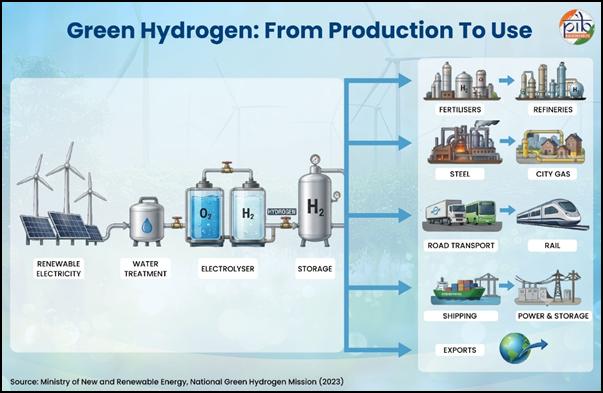
- Green production: Green hydrogen is produced by splitting water through electrolysis using renewable electricity from solar and wind sources.
- Hard-to-abate sectors: It can reduce emissions in fertilisers, petroleum refining, steel, heavy-duty transport and shipping, where direct electrification is difficult.
- Energy security: Domestic production can reduce fossil fuel imports, exposure to global price fluctuations and dependence on imported energy.
- Economic benefits: It can attract investment, create jobs, strengthen domestic supply chains and expand exports, supporting net-zero emissions by 2070.
What Makes Hydrogen “Green”?
India’s Green Hydrogen Standard, notified by the Ministry of New and Renewable Energy (MNRE) in August 2023, defines green hydrogen as hydrogen with emissions not exceeding 2 kg of CO₂ equivalent per kg of hydrogen, calculated on a well-to-gate basis as a 12-month average.
Green Hydrogen Production
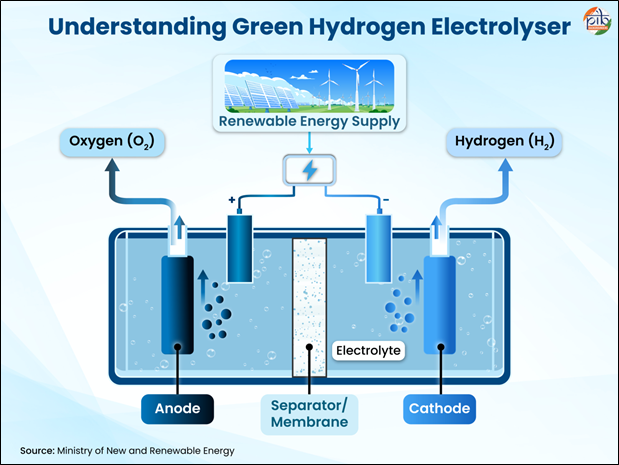
Electrolysis: Renewable electricity splits purified water into hydrogen and oxygen using an electrolyser.
2H2O → 2H2 + O2
- Electrolyser: It uses a cathode and anode, an electrolyte and a diaphragm to facilitate electrolysis and keep the gases separate.
- Water requirement: Approximately 9 litres of demineralised water are required per kg of hydrogen. The hydrogen is subsequently dried, purified and compressed.
Applications of Green Hydrogen
- Fertilisers: Replaces natural-gas-based hydrogen in ammonia production, enabling lower-emission green ammonia.
- Petroleum refineries: Supports desulphurisation and fuel processing with reduced emissions.
- Steel: Enables direct reduction of iron ore, potentially replacing coal and reducing carbon dioxide emissions.
- City gas networks: Can be blended with natural gas in limited proportions, subject to safety standards and infrastructure compatibility.
- Road and rail transport: Fuel-cell vehicles can power buses, trucks and trains with water vapour as the direct emission. India’s first indigenous hydrogen-powered train was inaugurated on 17 July 2026 on the Jind–Sonipat section. Its 10-car trainset can carry around 2,600 passengers.
- Shipping: Green ammonia and green methanol can serve as alternative marine fuels.
- Exports: Green hydrogen and its derivatives can help India access international low-emission fuel markets.
India’s Green Hydrogen Policy Architecture
1. National Green Hydrogen Mission (NGHM)
Approved by the Union Cabinet in January 2023 with an outlay of ₹19,744 crore, the Mission aims to establish India as a global hub for green hydrogen and its derivatives.
- Target: At least 5 million metric tonnes (MMT) annually by 2030, potentially reaching 10 MMT with export demand.
- It supports domestic manufacturing, production, demand creation, research and infrastructure.
2. SIGHT Programme
The Strategic Interventions for Green Hydrogen Transition (SIGHT) Programme has an outlay of ₹17,490 crore up to 2029–30.
- Incentives support domestic electrolyser manufacturing and green hydrogen production.
- Incentives have been awarded to 15 companies for 3,000 MW per annum of electrolyser manufacturing capacity.
- Around 8,000 tonnes per annum of green hydrogen capacity had been commissioned by February 2026; incentives cover 8,62,000 tonnes per annum of production capacity.
3. Pilot Projects
The Mission supports pilot projects in steel, heavy-duty mobility and shipping to identify technological, regulatory and infrastructure gaps.
- Five steel-sector projects have been sanctioned, including ₹84 crore for testing 100% hydrogen injection.
- Twelve mobility projects will deploy 70 hydrogen vehicles, comprising 27 buses and 43 trucks, with 16 refuelling stations across 21 routes.
- V.O. Chidambaranar Port Authority has awarded a ₹38.12-crore green methanol bunkering and refuelling project, including a ₹35-crore MNRE grant.
4. Green Hydrogen Hubs and Hydrogen Valley Innovation Clusters
These clusters integrate production, consumption and infrastructure to reduce transportation difficulties and achieve economies of scale.
- Recognised hubs: Deendayal Port (Kandla), V.O. Chidambaranar Port (Tuticorin) and Paradip Port.
- A 1 MW indigenous green hydrogen plant was commissioned at Kandla Port in July 2025.
- Four Hydrogen Valley Innovation Clusters have been awarded: Jodhpur, Odisha, Pune and Kerala.
5. Enabling Policy Framework
The Government promotes renewable energy access, grid connectivity and financial incentives to make green hydrogen affordable.
- Green hydrogen and green ammonia plants commissioned by 31 December 2030 are exempt from inter-state transmission charges for 25 years.
- The Green Hydrogen and Green Ammonia Policy provides for Open Access within 15 days and banking of surplus renewable electricity for up to 30 days, subject to applicable provisions.
- Eligible projects receive specified environmental-clearance exemptions and other renewable energy and SEZ-related benefits.
6. Regulations and Standards
- India’s Green Hydrogen Standard establishes a common emissions benchmark.
- MNRE launched the Green Hydrogen Certification Scheme of India in April 2025, with the Bureau of Energy Efficiency accrediting certification agencies.
- A dedicated certification portal became operational in June 2026. Standards for green ammonia and green methanol have also been notified.
7. Research and Development
The Strategic Hydrogen Innovation Partnership (SHIP) promotes public-private research. An allocation of ₹400 crore supports R&D, with an initial roadmap worth ₹113 crore supporting approved projects in hydrogen production, storage and safety technologies as of June 2026.
8. Skilling
- The Mission aims to generate over 6 lakh jobs by 2030.
- So far, 8,149 candidates have been trained and 7,248 certified across 14 States and Union Territories.
- ₹100 crore has been allocated for start-ups, with nine start-ups approved for funding totalling ₹22 crore.
9. International Cooperation
India is collaborating with Australia, Finland, France, Germany, Saudi Arabia, the UAE and Uzbekistan through agreements and joint initiatives.
Cooperation also includes an India–US Hydrogen Task Force and the Renewable Energy Technology Action Platform (RETAP).
10. State-level Initiatives
- Six States have notified dedicated green hydrogen policies: Gujarat, Andhra Pradesh, Maharashtra, Uttar Pradesh, Rajasthan and West Bengal.
- Haryana, Punjab, Bihar and Kerala are drafting dedicated policies.
- Several other States have incorporated hydrogen into their existing industrial and renewable energy policy frameworks.
The Road Ahead
The NGHM seeks to mobilise over ₹8 lakh crore in investment, generate more than 6 lakh jobs and reduce fossil fuel imports by approximately ₹1 lakh crore by 2030.
Achieving the annual production target could help avoid nearly 50 MMT of CO₂ emissions annually, strengthening energy security, industrial competitiveness and India’s commitment to net-zero emissions by 2070.
Reference
PIB



