Prelims: Current events of national and international importance | Environment
Why in News?
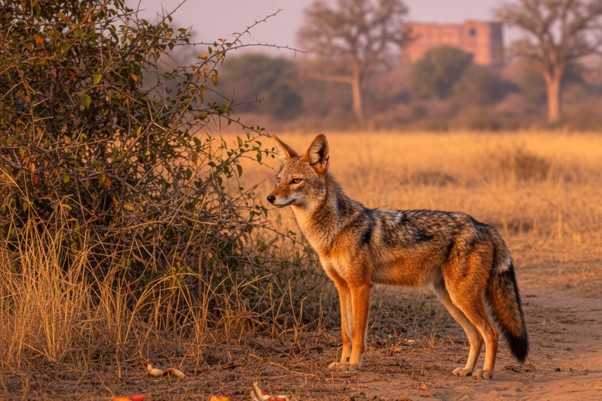
Recently, a research team detailed the unexpected habitat shift and ecological adaptation of the golden jackal (Canis aureus) in Gujarat.
Key Observations
- Habitat Shift (Grasslands to Intertidal Forest)
- Traditionally associated with the semi-arid Banni grasslands and saline mudflats of the Rann of Kachchh.
- Now, golden jackals were recorded actively navigating dense mangrove thickets (Avicennia marina) and tidally inundated creeks.
- Dietary Plasticity
- Scat analysis revealed a notable dietary shift from terrestrial rodents, berries (Salvadora persica), and livestock offal to marine and estuarine prey.
- The jackals' coastal diet includes mudskippers, crabs, stranded marine fish, aquatic birds, and marine turtle eggs, demonstrating an opportunistic transition to marine-subsidised foraging.
- Adaptation to Tidal Rhythms
- Jackals synchronizing their movement patterns with low-tide cycles to forage across exposed mudflats and mangrove roots, seeking elevated dry hummocks during high tides.
Significance
- Role as an Ecological Bridge - As mesocarnivores, golden jackals act as vital biological conduits between terrestrial semi-arid ecosystems and marine coastal wetlands, facilitating nutrient transfer across ecotones.
- Conservation Status - IUCN Red List Status-Least Concern; protected under Schedule I of India's Wild Life (Protection) Act, 1972 (as amended in 2022).
- Key Threats - Coastal industrial development, port expansions, destruction of mangrove buffers, hyper-salinization, and potential exposure to domestic dog-borne pathogens (such as Canine Distemper Virus and Rabies) along coastal settlements.
- Implications for Mangrove Management - Emphasizes that coastal mangrove restoration programs must account for terrestrial and semi-aquatic mammalian carnivores, rather than viewing mangroves solely as marine/fisheries nurseries or avian habitats.
Reference
Down to Earth | Golden jackal in Kachchh’s mangroves



