0.1093
7667766266
x

Discovery of a Candidate "Second-Generation" Planet

iasparliament Logo
October 07, 2026

Prelims: Current events of national and international importance | Science & Technology

Why in News?

Recently, an international research team detailed the discovery of a candidate "second-generation" planet (also termed a "phoenix planet") orbiting a young white dwarf star named HS 0209+0832.

Key Astronomical Discoveries
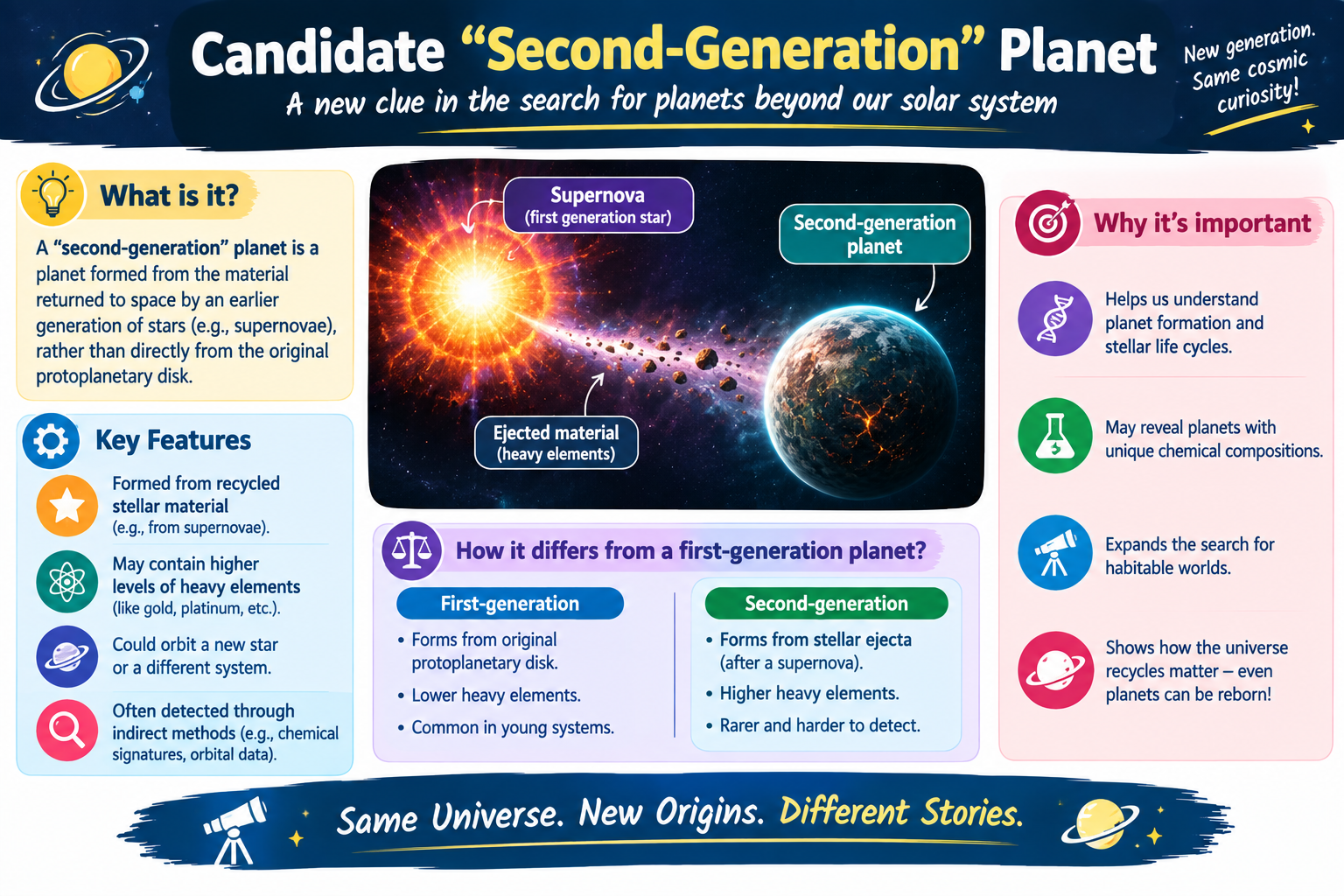
  • Stellar Host (HS 0209+0832) - Located approximately 270 light-years away, HS 0209+0832 is a hot, young white dwarf (cooling age of ~5 million years). 
  • Chemical Fingerprint (s-process Elements)
    • Analysis of spectroscopic data from the Hubble Space Telescope (HST) revealed extreme photospheric contamination in the white dwarf's atmosphere.
    • It showed massive enrichments of trans-iron elements, including zinc, copper, and niobium, at concentrations over 1,000 times higher than in the Sun.
    • These heavy elements are created exclusively via the slow neutron-capture process (s-process) inside giant stars prior to shedding their outer envelopes, confirming that the accreting material originated from the star's own ejected layers rather than terrestrial/rocky asteroids.
  • Orbital Characteristics - Photometric data from NASA's Transiting Exoplanet Survey Satellite (TESS) revealed a periodic 4.4-day light fluctuation.
  • It matches a close-in, gas-giant-sized exoplanet undergoing photo-evaporation and mass transfer onto the white dwarf.

Candidate "Second-Generation" Planet

Stellar Evolution

Planetary Generation

Formation Mechanism

Stellar Environment

First-Generation Planets

Formed within the initial protoplanetary disc surrounding a main-sequence star (e.g., Earth, Jupiter).

Protoplanetary discs of young, hydrogen-fusing stars.

Second-Generation Planets

Formed out of debris/ejected gas expelled during a star's Asymptotic Giant Branch (AGB) / Red Giant death phase.

Debris discs or post-common envelope envelopes surrounding compact stellar remnants like white dwarfs or pulsars.

Significance

  • Post-Stellar Planet Formation - Proves that planet formation is not restricted to early stellar life; planetary synthesis can occur in the "ashes" of a dying star.
  • Future of our Solar System - Provides insights into the distant future of our own Solar System (~5 billion years from now), suggesting that after the Sun collapses into a white dwarf, second-generation planet formation could theoretically occur from ejected Solar material.
  • Pulsar vs. White Dwarf Systems- While second-generation planet candidates were previously inferred around pulsars (like PSR B1257+12), this discovery extends the phenomenon to white dwarfs, which are far more common stellar remnants in the universe.

Reference

India Today | Candidate for a second-generation planet

There are no reviews yet. Be the first one to review.

ARCHIVES

sidetext


