Prelims: Current events of national and international importance | Environment
Why in News?
Recently, an open-cast bauxite mining project across the forest in the Nageswari Reserve Forest (Balda Hills) in Odisha’s Koraput district posed an existential threat to the Jeypore ground gecko.
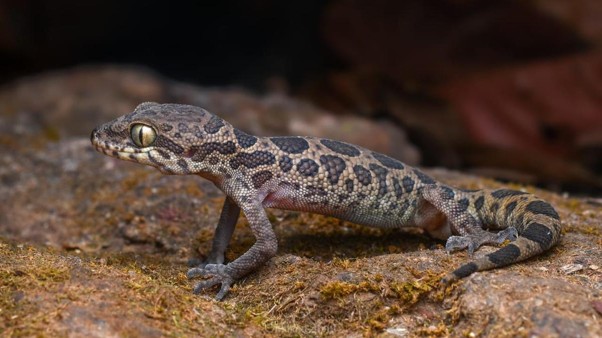
Jeypore Ground Gecko
- The Jeypore Ground Gecko (Cyrtodactylus jeyporensis) is a rare, endangered gecko endemic to India’s Eastern Ghats, especially parts of southern Odisha and northern Andhra Pradesh.
- Scientific name - Cyrtodactylus jeyporensis
- Common names- Jeypore Ground Gecko / Patinghe Indian Gecko
- Family - Gekkonidae
- Distribution - Eastern Ghats of Odisha and Andhra Pradesh.
- Habitat - Moist, high-elevation forest patches, often beneath rocks and boulders.
- Elevation- Around 1,100–1,400 metres in reported records.
- Conservation Status
- IUCN Red List- Endangered (EN).
- CITES - Listed in Appendix II in 2022 to regulate international trade.
- Wild Life (Protection) Act, 1972 - Schedule I (highest statutory protection under Indian law).
- Protected Area Gap - The species' known habitat falls almost entirely outside designated National Parks or Wildlife Sanctuaries, leaving it vulnerable to land-use conversion.
- Key Threat - Field surveys documented only 4 individual geckos in the Balda hills over the past year.
- The bauxite mining has triggered dual opposition from conservationists and local Bondo and Porja Adivasi communities who are protesting to protect their ancestral forest rights.
- Historical Background
- Originally described in 1878 by British naturalist Richard Henry Beddome.
- Presumed extinct for over 130 years, it was rediscovered in 2010 by Indian herpetologists Ishan Agarwal and Aniruddha Datta-Roy in the high-elevation forests of Koraput.
- Habitat Specialization
- Highly range-restricted, endemic strictly to high-elevation plateau edges (900 to 1,400 metres) in the northern Eastern Ghats (Odisha and Andhra Pradesh border).
- Inhabits semi-evergreen and moist deciduous forest patches with rock-strewn leaf litter, making its survival completely dependent on undisturbed, cool micro-topography.
- Evolutionary Significance
- Evolutionary studies show that its lineage diverged from its closest relatives over 20 million years ago, representing an ancient, biogeographically unique relict lineage of Indian geckos.
Key Drivers of Extinction Risk
- Bauxite deposits in the Eastern Ghats form caps on high plateaus.
- Strip mining requires completely removing vegetation, rock boulders, and topsoil—permanently destroying the cool, shaded leaf-litter micro-habitats essential for ground-dwelling geckos.
- A similar bauxite extraction project by NALCO in nearby Potangi (Koraput) previously destroyed the gecko’s micro-habitat, leading to local extinction of the species in that belt.
- The resident Bondo and Porja Adivasi tribes have conducted active protests for 2 years against the Nageswari forest land clearance, citing violations of the Forest Rights Act (FRA), 2006, and threat to perennial water sources.
Reference
The Hindu | Rare Jeypore ground gecko



