Creating Investment-Ready Manufacturing Ecosystems
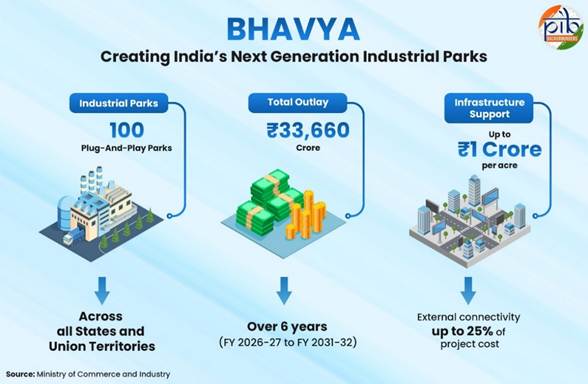
The Union Cabinet approved the Bharat Audyogik Vikas Yojna (BHAVYA) in March 2026, with an outlay of ₹33,660 crore to develop 100 plug-and-play industrial parks across India.
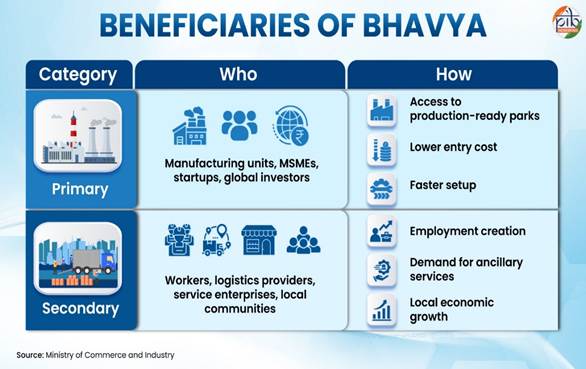
The scheme aims to attract investment, support MSMEs, generate employment and strengthen manufacturing through ready-to-use infrastructure and faster approvals.
A New Phase in Manufacturing Policy
- Manufacturing contributes around 16–17% of India’s GDP and employs over 27 million workers.
- The National Manufacturing Mission aims to raise its GDP share to 25% by 2035.
- Mediumand high-technology industries account for 46.3% of manufacturing value addition, reflecting a shift towards technology-intensive production.
- BHAVYA promotes investment-ready industrial ecosystems to reduce setup costs, simplify approvals and strengthen India’s role in global supply chains.
Policy Evolution – From Pre-2020 to Plug-and-Play Ecosystems
- Industrial Estates and SEZs – India had 370 notified SEZs as of February 2026, attracting ₹7.82 lakh crore in investment and generating over 31.7 lakh jobs.
- Industrial Corridors – The National Industrial Corridor Development Programme (NICDP) integrates industrial zones with utilities, logistics and urban services.
- Industrial Land Bank – The India Industrial Land Bank had mapped 4,164 industrial parks as of October 2026.
- BHAVYA – Expands the plug-and-play model nationwide through 100 proposed industrial parks.
Inside the BHAVYA Framework
- Financial Assistance – Provides up to ₹1 crore per acre for industrial park development.
- Core Infrastructure – Includes internal roads, power, water supply, drainage, common effluent treatment facilities, ICT-enabled administration and underground utility corridors.
- Industrial Facilities – Provides ready-built factory sheds, built-to-suit units, testing and certification facilities, and warehousing.
- Worker Welfare – Includes housing, healthcare, skill development centres and other social amenities.
- External Connectivity – Up to 25% of approved funding can support external road, rail and last-mile logistics infrastructure.
- Implementation – The scheme will run from FY2026–27 to FY2031–32. Up to 50 parks will be selected in the first phase through two challenge-based selection rounds.
- Project Management – Parks covering 25–1,000 acres will be developed and managed through Special Purpose Vehicles (SPVs).
- Digital Monitoring – The BHAVYA Portal supports project submission, appraisal, evaluation and transparent selection.
Plug-and-Play Industrial Parks – Concept and Features
- These are pre-developed industrial ecosystems offering land, trunk infrastructure, utilities and common facilities before industries begin operations.
- Single-window systems and streamlined approvals help reduce initial costs and delays, enabling faster transition from investment to production.
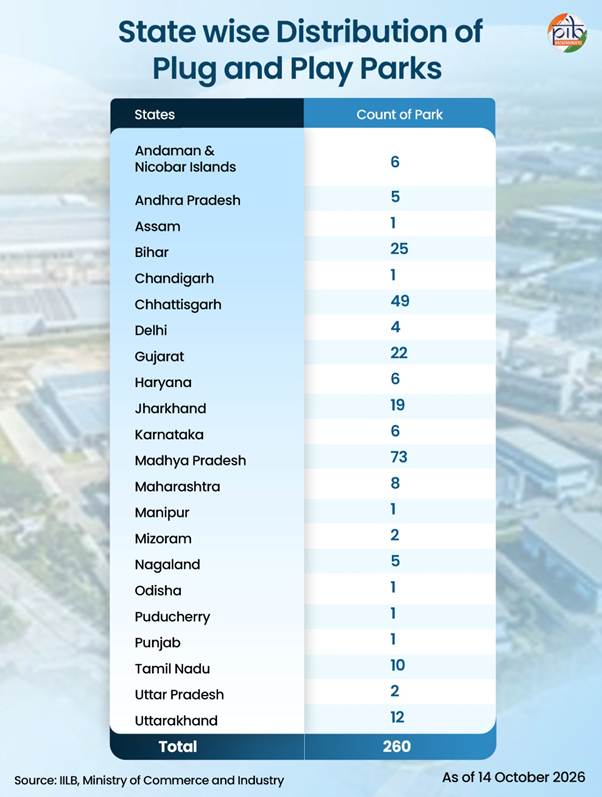
- India has 260 plug-and-play industrial parks, while the Union Budget 2025–26 allocated ₹2,500 crore for their development.
- The model is expanding into specialised facilities, including chemical parks under the BHAVYA-Rasayan Scheme approved in July 2026.
Dholera SIR – An Integrated Industrial City
- Dholera Special Investment Region in Gujarat is developing as an industrial hub for semiconductors, aerospace and defence, solar manufacturing, green hydrogen, biotechnology and heavy engineering.
- Land allotted – 495 acres across 11 plots.
- Investment potential – ₹97,328 crore.
- Employment potential – Over 6,000 jobs.
- Connectivity to ports, airports, expressways and the Dedicated Freight Corridor supports access to domestic and global markets.
Towards a New Manufacturing Ecosystem
- BHAVYA marks a shift from conventional industrial estates towards integrated, infrastructure-ready manufacturing hubs.
- By reducing setup delays, improving connectivity and simplifying approvals, it aims to attract investment, support MSMEs, create jobs and strengthen India’s global manufacturing competitiveness.
Reference
PIB



