0.1361
7667766266
x

FSSAI prosecution sanction against Bisleri

iasparliament Logo
November 27, 2026

Mains: GS II | Statutory bodies

Why in News?

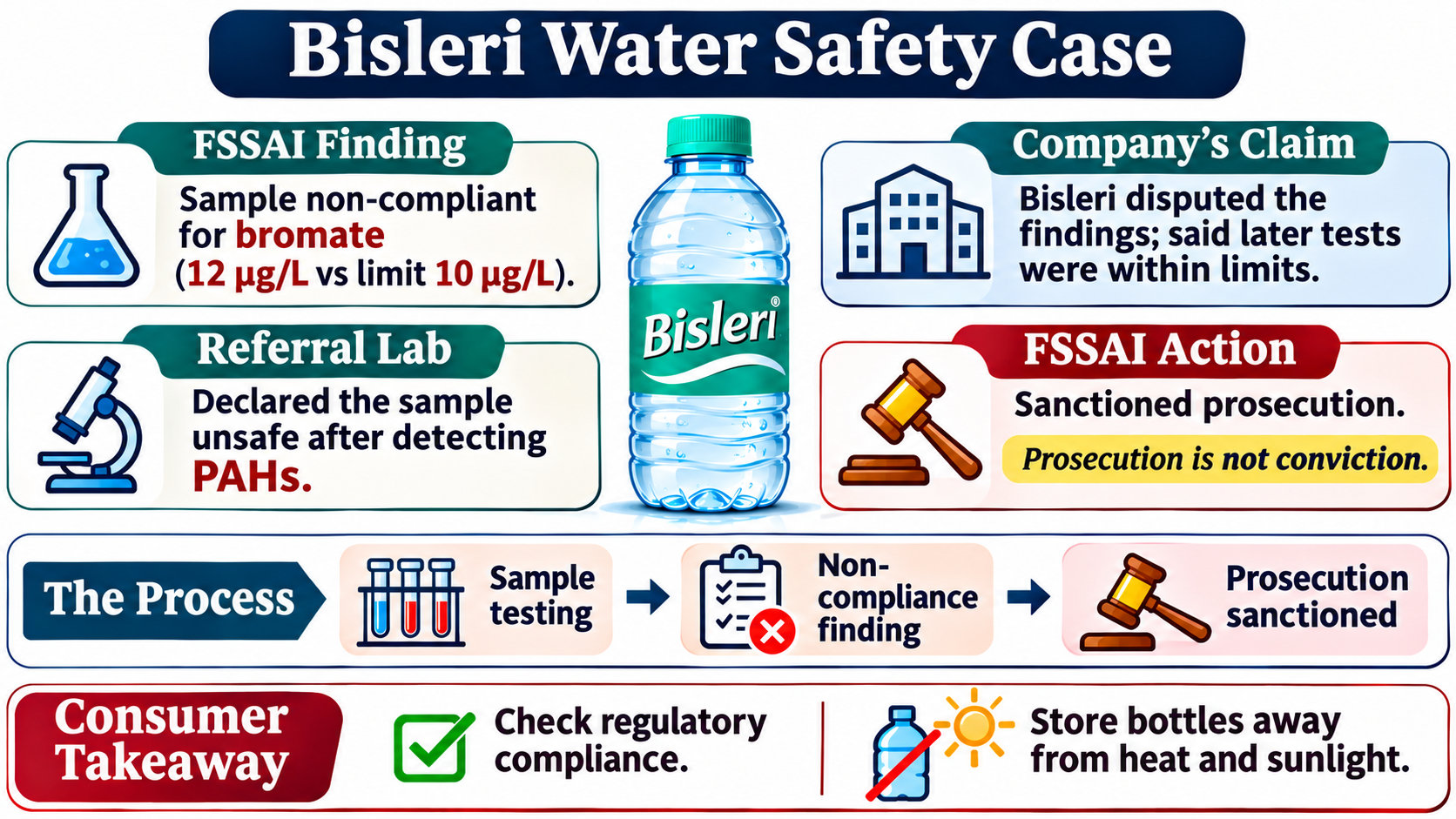
The Food Safety and Standards Authority of India (FSSAI) sanctioned prosecution against Bisleri International Pvt. Ltd. in late November 2026 under the Food Safety and Standards Act, 2006.

What is the issue?

  • India's packaged drinking water industry valued at roughly $3.6 billion in 2025 serves millions of households, travellers, and institutions daily.
  • The regulatory action involving a market leader has sparked debate over chemical by-products in water treatment, laboratory testing consistency.
  • The adequacy of post-2024 regulatory oversight after mandatory Bureau of Indian Standards (BIS) certification was removed for packaged water.
  • Importantly, granting sanction to prosecute initiates legal proceedings before a court and does not amount to a judicial conviction or prove that all products from the company are unsafe.

How to understand the chemical contaminants?

Contaminant

Chemical nature and source in drinking water

Prescribed limit and health risks

Bromate

An inorganic disinfection by-product formed when ozone (used to disinfect water) reacts with naturally occurring bromide ions in source water.

Permissible limit is 10 micrograms per litre (μg/L) in line with WHO guidelines (the contested sample recorded 12 μg/L); classified as a possible human carcinogen (IARC Group 2B), with prolonged high exposure linked to kidney, thyroid, and nervous-system effects.

Polycyclic Aromatic Hydrocarbons (PAHs)

A group of organic compounds generated primarily through incomplete combustion of fossil fuels, wood, coal, or industrial/packaging residues.

Certain PAHs are toxic, mutagenic, and carcinogenic over sustained exposure, raising concerns about source-water contamination, industrial emissions, or packaging/storage migration.

How food safety enforcement and appeal testing work under the FSS Act, 2006?

  • Regulatory sampling and primary analysis- Food Safety Officers draw statutory samples from manufacturing or retail premises and send them to accredited food laboratories for parameter testing.
  • Prohibition of sale (section 36(3)) - Where a batch is found unsafe, authorities can prohibit the sale and distribution of the specific non-compliant batch and direct the Food Business Operator (FBO) to conduct a root-cause analysis.
  • Statutory appeal to a referral food laboratory - If an FBO disputes initial findings, it may appeal for re-examination at a designated Referral Food Laboratory, whose report carries statutory finality under the law.
  • Sanction for prosecution- Based on confirmed violations involving "unsafe food" (punishable under provisions such as Section 59 of the FSS Act), the authority sanctions prosecution, enabling formal trial before a competent court where both regulatory evidence and the company's defence are examined.

What are the key challenges in packaged drinking water governance?

  • Ozonation trade-offs in treatment plants- While ozonation effectively eliminates microbes without chlorine taste, treating bromide-rich source water requires tight process control to prevent bromate formation.
  • Inter-Laboratory variability and technical disputes- Divergent readings across primary, referral, and private accredited laboratories especially near threshold limits can trigger protracted legal challenges and public confusion.
  • Batch traceability and rapid recall execution- Tracking and recalling affected batches swiftly across fragmented wholesale and retail supply chains remains operationally difficult.
  • Oversight of unorganized and small operators- Beyond large national brands, numerous regional and unorganized bottling units have repeatedly shown microbiological or chemical non-compliance during state surveillance drives.

What is the way forward?

  • Require bottled-water plants using ozonation to monitor source-water bromide levels continuously and adopt catalytic or alternative treatment controls to keep bromate well below 10 μ g/L.
  • Standardize testing methodologies across notified and referral laboratories, and strictly enforce annual third-party audits under the high-risk food classification.
  • Implement QR-based batch tracking from plant to retail point so non-compliant lots can be isolated and recalled immediately.
  • Regulators and companies should communicate test outcomes, batch numbers, and health implications clearly and promptly so consumers receive accurate, proportionate guidance without misinformation.

Bisleri Case

Reference

The Hindu | Why has the FSSAI sanctioned prosecution against Bisleri?

There are no reviews yet. Be the first one to review.

ARCHIVES

sidetext