0.2401
7667766266
x

Ellora Caves

iasparliament Logo
December 01, 2025

Prelims: Current events of national and international importance | History

Why in News?

Recently, the historian William Dalrymple has urged the Maharashtra government to highlight the lesser-known treasures of the Ellora Caves, beyond the famous Kailasa Temple.
  • Location – Charanandri Hills, near Aurangabad, Maharashtra.
  • It is among India’s 1st UNESCO World Heritage sites.
  • Timeline – Excavated between 600–1000 AD, showcasing continuous artistic and religious activity.
  • Belief – Buddhism, Hinduism (Brahmanism), and Jainism — illustrating religious tolerance in ancient India.
  • Extent – 34 monasteries and temples carved into a basalt cliff, stretching over more than 2 km (17 Brahmanical, 12 Buddhist and 5 Jain).
    • Buddhist caves (1–12) – Excavated from 5th–8th centuries - Both Mahayana and Hinayana.
    • Hindu (Brahmanism) caves (13–29) - 7th–10th centuries.
    • Jain caves (30–34) - 9th–12th centuries, with delicate carvings and paintings dedicated to the Digambara sect.
  • Managed by – Archaeological Survey of India (ASI).
  • Protected under – Multiple acts, including the Ancient Monuments and Archaeological Sites and Remains Act (1958).
  • Features –
    • Rock-cut architecture – The structures were created by carving into the rock face, rather than stacking stones.
    • Monolithic Architecture – Kailasa Temple (Cave 16) is the world's largest monolithic structure, carved top-down from a single rock and resembling Mount Kailash.
    • Multi-story Caves – Features double and triple-story caves, showcasing a unique design.
    • Patronage – Patrons included the Rashtrakutas and Chalukyas, with guilds from states like Vidarbha, Karnataka, and Tamil Nadu also contributing.
    • Art and Sculpture – Includes elaborate sculptures and fresco murals, such as the Kailashnath Temple, depicting mythological scenes.
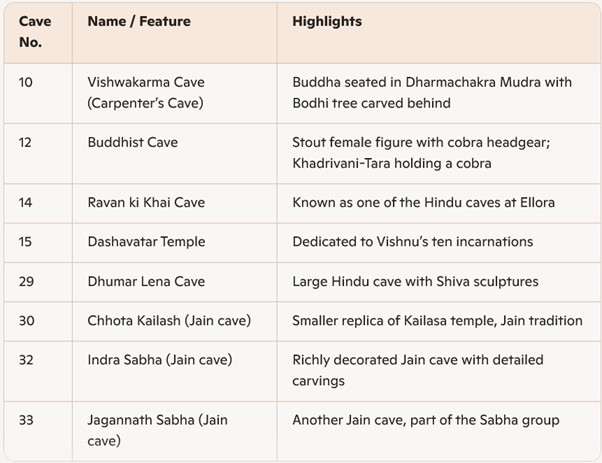
  • Some important caves -

Ellora Caves

Quick Fact

Highlights of neglected sites around Ellora

  • Empty tomb of Abdulmejid II (last Ottoman Caliph) – located in Khuldabad, Maharashtra, built by his daughter (married to the Nizam Mir Osman Ali Khan’s son), though the Caliph died in Paris.
  • Malik Ambar’s tomb – the Ethiopian-born regent of the Deccan, a towering figure in 17th century history.
  • 1st Peshwa’s tomb – pre-dating the Marathas, tied to the Ahmednagar rulers.
  • Sufi shrines & Naga traditions – representing centuries of spiritual continuity before and alongside Hindu, Buddhist, and Jain monuments.
  • Suggestion – Historian suggests linking Ajanta, Ellora, Daulatabad, and Khultabad into a unified tourism circuit by creating Golden Quadrangle of Heritage.

References

  1. The Hindu | Unknown treasures at Ellora Caves
  2. UNESCO | Ellora Caves
Login or Register to Post Comments
There are no reviews yet. Be the first one to review.

ARCHIVES

MONTH/YEARWISE ARCHIVES

sidetext
Free UPSC Interview Guidance Programme
sidetext


