Mains: GS III – Environmental conservation
Why in News?
India’s Compensatory Afforestation (CA) policy is currently under review, with ongoing debate regarding whether tree plantations can adequately replace the ecological functions of diverted natural forests.
What is Compensatory Afforestation Fund Management and Planning Authority (CAMPA)?
- CAMPA – It is an institutional mechanism allocates funds collected from agencies diverting forest land to compensatory afforestation and related forest and wildlife conservation activities.
- Legal basis – Compensatory Afforestation Fund Act, 2016
- Aim – To compensate the loss of ecosystem and forest land due to diversion of forests for non-forest use through compensatory afforestation, restoration of degraded forest, improvement of wildlife habitats, enrichment of biodiversity, etc.
- Funds dispersal – Allocated between the National Compensatory Afforestation Fund Management and Planning Authority (CAMPA) and the respective State CAMPAs.
- State governments utilize CAMPA funds for the following activities:
- Compensatory afforestation
- Assisted natural regeneration
- Forest protection
- Wildlife habitat improvement
- Forest fire prevention
- Development of infrastructure for forest management
- Biodiversity conservation
What are the major challenges in compensatory afforestation?
- Low ecological value – The act of planting thousands of saplings does not result in the immediate restoration of a mature forest ecosystem.
- A natural forest is characterised by the following features:
- Multiple strata of vegetation
- Presence of native plant and animal species
- Diverse communities of soil organisms
- Abundant pollinator populations
- Rich assemblages of birds and mammals
- Complex and interconnected food webs
- Natural water regulation functions
- Inappropriate Species Selection – Afforestation initiatives often prioritise fast-growing species over ecologically suitable native species.
- Such practices may result in the following consequences:
- Reduced biodiversity
- Increased water consumption
- Degraded habitat quality
- Disruption of local ecological processes
- Monoculture Plantations – The cultivation of a single species across extensive areas increases ecosystem vulnerability to the following factors:
- pest infestations,
- disease outbreaks,
- drought conditions,
- increased fire risk,
- and greater climate variability.
- Poor Survival Rates – The quantity of saplings planted is frequently employed as a primary performance indicator.
- However, more meaningful indicators include the following: Plantation establishment, sapling survival, subsequent growth, natural regeneration, and overall ecosystem recovery.
- Fragmentation of Forests – Although the total area of forest cover may be maintained in other locations, diversion activities can result in habitat fragmentation.
- Habitat fragmentation impacts the following ecological processes:
- Wildlife movement
- Genetic exchange
- Pollination
- Predator-prey relationships
- Migration routes
- Loss of Ecosystem Services – Natural forests deliver essential ecosystem services, including:
- carbon sequestration,
- groundwater recharge,
- flood regulation,
- soil conservation,
- temperature regulation,
- pollination,
- biodiversity conservation,
- and livelihood support.
- Community and Livelihood Challenges – Forest conservation is intrinsically linked to the livelihoods of communities residing in proximity to forested areas.
- Key challenges include the following:
- High dependence on fuelwood and fodder resources
- Reliance on non-timber forest products
- Prevalence of land-use conflicts
- Limited community participation in conservation initiatives
- Weakness of local institutional frameworks
- Climate Change – Plantations established for current climatic conditions may not be resilient to future environmental changes.
- Increased frequency and intensity of heat waves
- Prolonged periods of drought
- Altered rainfall patterns
- Increased risk of forest fires
- Emergence of new pests and diseases
What is the new ecological method of conservation?
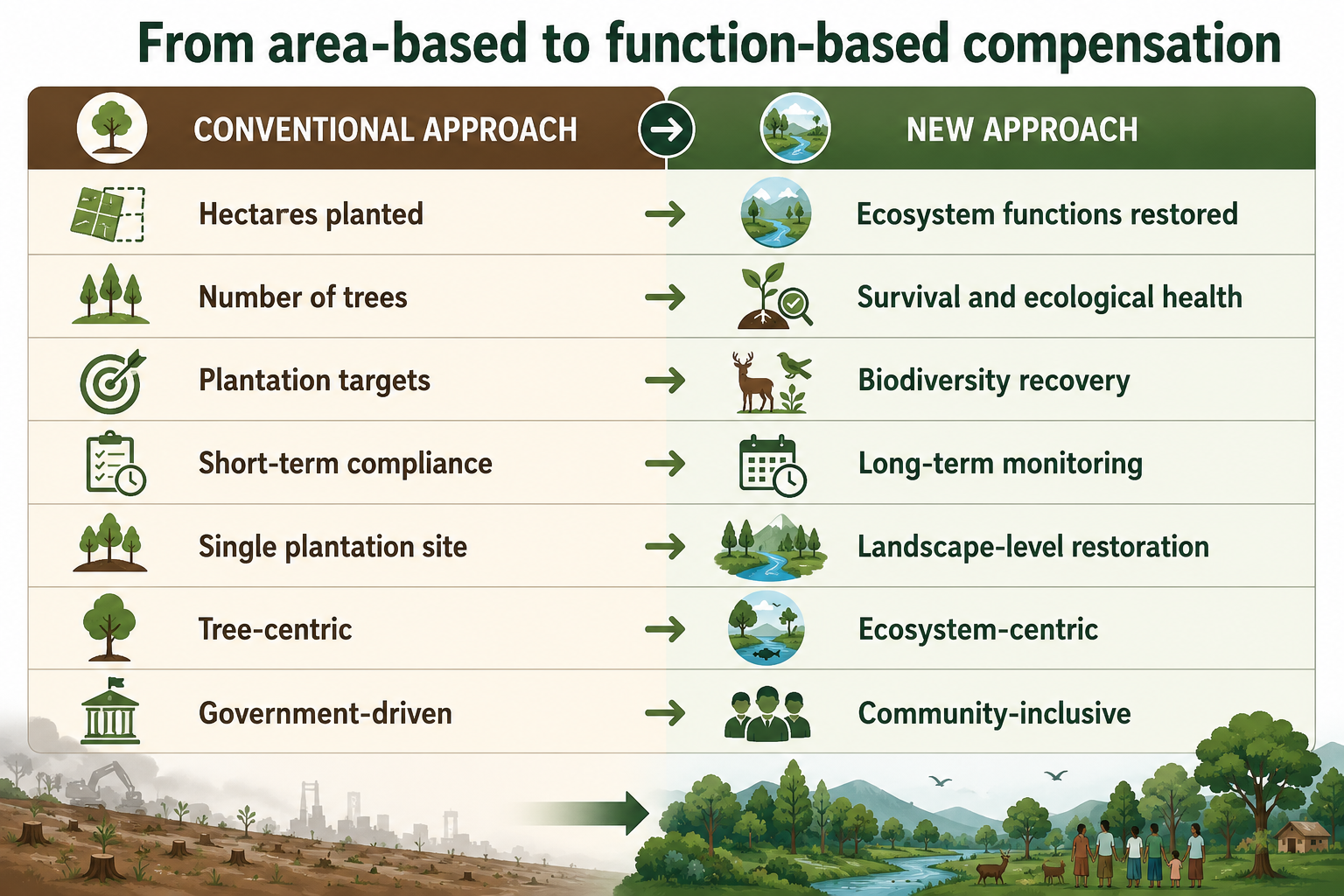
- Modest Ecological Compensation – A realistic approach to environmental restoration that focuses on recovering essential ecosystem functions rather than pretending mature natural habitats can be fully recreated.
- It shifts mitigation from simple tree-counting to targeted, science-based recovery.
What are global practices for forest conservation and restoration?
- Assisted Natural Regeneration – When natural regeneration proves inadequate, targeted human interventions such as protecting seedlings, controlling invasive species, preventing grazing, and managing fires are implemented.
- This approach is considered more ecologically appropriate than intensive plantation methods.
- Landscape Restoration – Many countries are increasingly implementing landscape-level restoration strategies rather than isolated plantations.
- These approaches seek to connect forests, wetlands, rivers, agricultural land, and wildlife corridors to improve ecological resilience.
- Payment for Ecosystem Services – Costa Rica’s Payment for Ecosystem Services (PES) approach offers landowners incentives for carbon storage, water regulation, biodiversity conservation, and landscape protection.
- This model demonstrates how India could develop economic incentives for communities and landowners to promote ecosystem conservation.
- Large-Scale Ecological Restoration – China’s initiatives, such as the Grain for Green program, convert vulnerable farmland into forests and grasslands.
- These efforts underscore the significance of watershed-based restoration, soil erosion control, sustained government investment, and landscape-scale planning.
- Community Forestry – Nepal’s community-based forest management demonstrates that conservation is more sustainable when local communities, entrusted with rights and responsibilities, actively manage forest resources and receive appropriate incentives.
- Ecological Connectivity – European conservation emphasizes the significance of wildlife corridors, habitat connectivity, river and wetland restoration, rewilding, and the protection of native biodiversity.
- This approach demonstrates that effective conservation prioritizes ecological connectivity and integrity rather than focusing solely on forest area.
What should India do?
- Ecosystem Accounting over Tree Counting – Conservation efforts should prioritize evaluating not only the number of trees planted, but also tree survival rates, increases in biodiversity, groundwater recharge, reductions in soil erosion, wildlife return, and improvements in carbon stocks.
- This comprehensive approach enables a more accurate assessment of ecosystem health and resilience.
- Prioritization of Native and Diverse Species – Emphasizing native species, mixed forests, and adaptation to local ecological conditions, rather than establishing uniform plantations, promotes healthier and more resilient ecosystems.
- Prioritization of Natural Regeneration – Where conditions allow, natural regeneration is preferable to assisted regeneration, which is generally more appropriate than establishing plantations.
- Promote Comprehensive Landscape Restoration – CAMPA investments should incorporate forests, watersheds, wetlands, grasslands, wildlife corridors, and local communities to achieve holistic ecological restoration.
- Enhancing Community Participation – Forest governance achieves greater sustainability when institutions such as Gram Sabhas, Joint Forest Management bodies, Forest Rights Act-based groups, and local self-governments empower communities to act as active partners rather than passive recipients.
- Implement Long-term Monitoring – Restoration success should be monitored over a period of 10 to 20 years or more using an Ecological Success Index that includes biodiversity, water security, soil health, carbon sequestration, habitat connectivity, and community livelihood.
- Immediate post-plantation assessments are insufficient for evaluating long-term outcomes.
Reference
Down to Earth | Environmental Compensation