Prelims: Current events of national and international importance | Environment
Why in News?
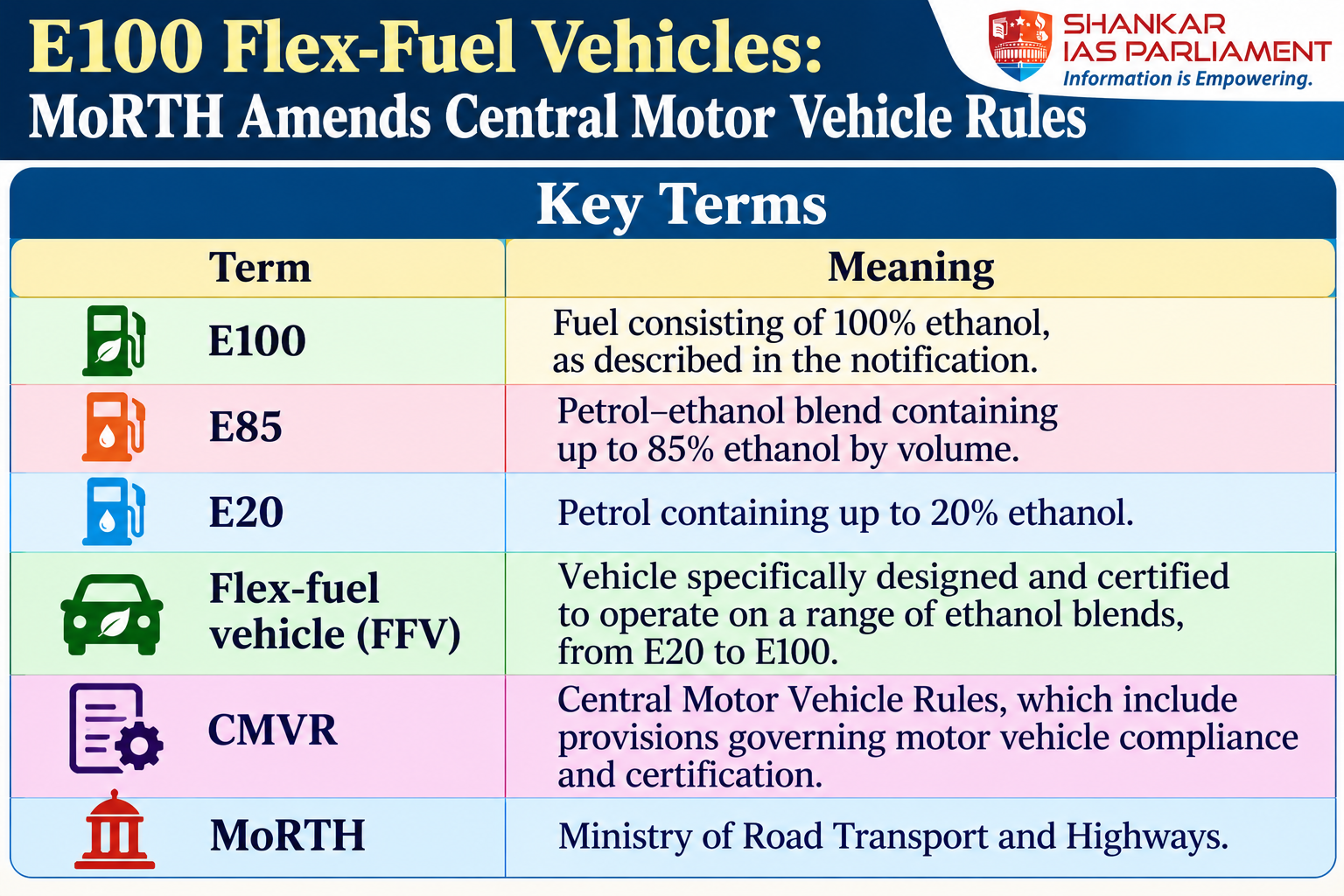
The Ministry of Road Transport and Highways (MoRTH) has amended the Central Motor Vehicle Rules (CMVR) to allow vehicles operating on 100% ethanol (E100).
- The amendment explicitly incorporates E100, in addition to E85, within the emission testing and certification provisions.
- This notification does not require existing vehicles to change fuels or undergo modifications.
Key Provisions of the Amendment
- Inclusion of E100 in certification rules – Emission certification provisions now explicitly include E100 in addition to E85.
- Compliance requirements – Vehicles certified for E85 or E100 must meet all applicable emission and safety standards for their respective categories.
- No compulsory conversion – Owners of existing vehicles are not required to convert to E85 or E100, nor to modify their vehicles, as a result of this notification.
- Vehicle-specific compatibility – E85 and E100 fuels are intended exclusively for vehicles that are specifically designed and certified for their use.
- Biodiesel provisions – The notification updates biodiesel-related provisions and incorporates technical corrections.
Ethanol Blending in India
- Oil marketing companies currently offer E20 petrol, which contains up to 20% ethanol.
- The government promotes ethanol blending and the adoption of flex-fuel vehicles to decrease reliance on imported crude oil.
- The central government also seeks to increase the proportion of isobutanol blended into diesel.
Advantages of Ethanol Blending and Flex-Fuel Vehicles
- Energy Security – Increased utilization of domestically produced ethanol can reduce dependence on imported crude oil.
- Environmental Benefits – Higher ethanol blends can reduce tailpipe emissions of carbon monoxide (CO) and specific hydrocarbons (HC).
- Lifecycle greenhouse gas emissions may also decrease, depending on the feedstock and production process.
- Fuel Flexibility – Flex-fuel vehicles, specifically engineered for ethanol compatibility, can operate on various ethanol blends, thereby reducing exclusive reliance on conventional petrol.
International Experience
- Brazil and the United States have already implemented flex-fuel technology.
- India is promoting ethanol blending and flex-fuel vehicles as part of its effort to reduce fossil-fuel import dependence.
Reference
BS | E100 Flex-Fuel Vehicles



