Prelims: Current events of national and international importance | Science & Technology
Why in News?
A research team from Nagoya University analyzed an ancient Chinese record documenting a total solar eclipse that occurred on 17 July 709 BCE.
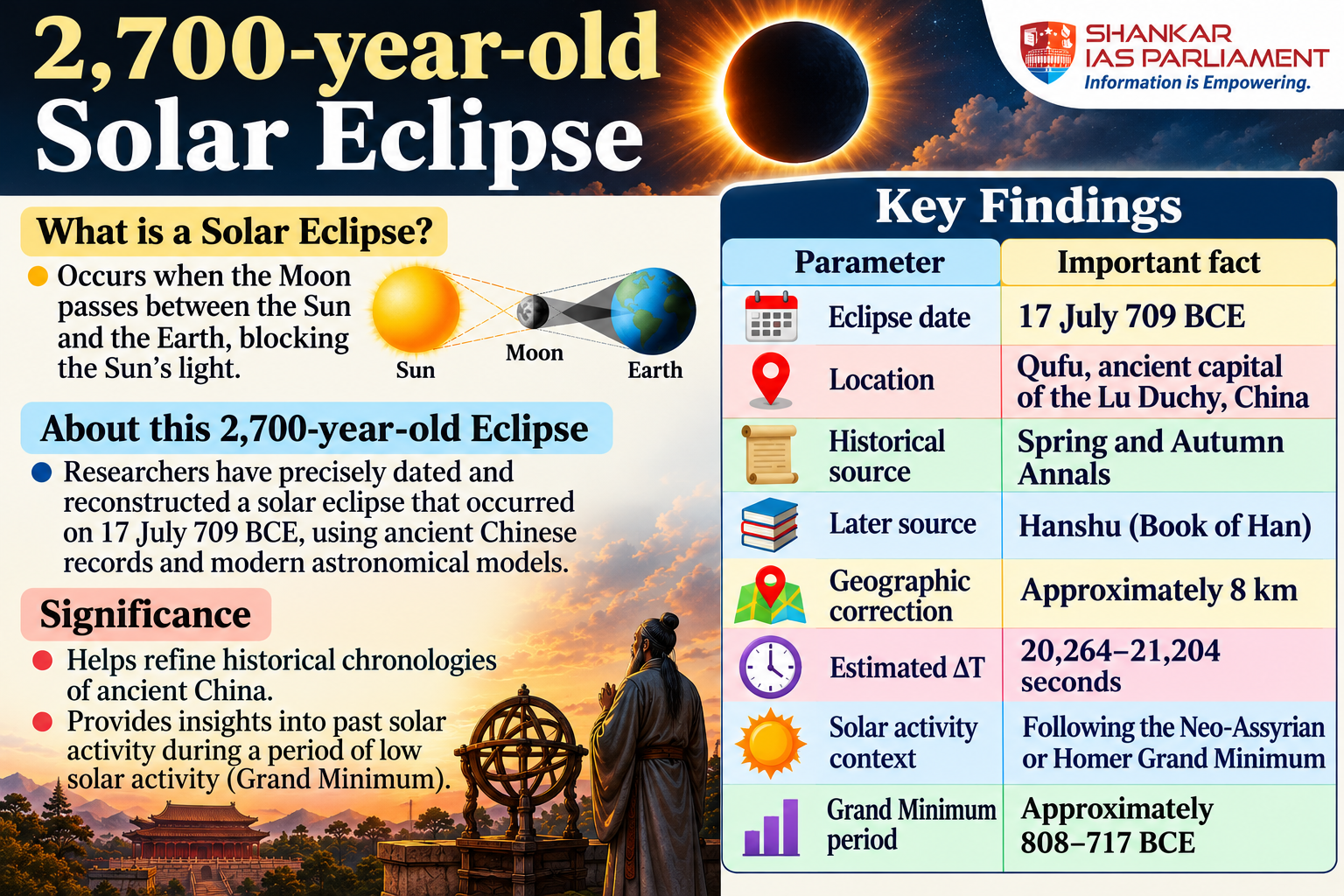
- Correction of an approximately 8 km error in the estimated location of ancient Qufu, China, enabled scientists to reconstruct the eclipse with greater accuracy.
- The study offers refined estimates of Earth's historical rotation and presents possible evidence for the Sun's recovery following an extended period of low solar activity.
|
Solar Eclipse
|
- A solar eclipse takes place when the Moon moves between the Sun and Earth, obstructing all or part of the Sun's light as observed from a specific location on Earth.
- Classification of solar eclipses:
- Total solar eclipse - The Moon entirely obscures the Sun's bright disc for observers located within the path of totality.
- Partial solar eclipse - A portion of the Sun's disc is obscured by the Moon.
- Annular solar eclipse - The Moon appears smaller than the Sun, resulting in a bright ring, or annulus, visible around the lunar silhouette.
- Hybrid solar eclipse - This type may appear as either a total or annular eclipse, depending on the observer's position along the eclipse path.
|
|
Solar Corona
|
- The corona constitutes the Sun's outermost atmospheric layer.
- This layer extends millions of kilometres into space and exhibits temperatures significantly higher than those of the Sun's visible surface, known as the photosphere.
- The corona is typically difficult to observe due to the much greater brightness of the photosphere.
- During a total solar eclipse, the Moon obscures the bright solar disc, which enables the corona to become visible.
- Research significance: A later historical account described the eclipsed Sun as “completely yellow above and below.” Researchers suggest this may refer to the corona, but the interpretation is uncertain since the account was recorded centuries after the eclipse.
|
The Role of Ancient Eclipses in Revealing Earth's Rotation
The Concept of Delta T (ΔT)
- Delta T quantifies the difference between two distinct time scales:
Delta T = TT - UT
- Where:
- TT — Terrestrial Time: a uniform time scale used for precise astronomical calculations.
- UT — Universal Time: a time scale based on Earth's rotation.
- Earth's rotation is not perfectly constant. As a result, historical eclipse records enable scientists to estimate how Earth's rotation has differed from a uniform time scale.
Causes of Changes in Earth's Rotation
- The gravitational pull of the Moon generates ocean tides on Earth.
- Tidal friction facilitates the transfer of rotational energy from Earth to the orbital motion of the Moon.
- Over extended timescales, this process results in a gradual deceleration of Earth's rotation.
- In addition, short-term variations in Earth's rotation arise from fluctuations in the planet's interior, atmosphere, oceans, and other contributing factors.
Revealing Solar Activity Through Ancient Records
- Historical solar activity can be reconstructed using both astronomical observations and natural archives.
- Historical Astronomical Records – Ancient descriptions of eclipses and potential solar-coronal structures provide valuable evidence regarding the Sun's past activity, although the reliability of these records must be carefully evaluated.
- Radiocarbon in Tree Rings – Trees absorb atmospheric carbon, including carbon-14. Variations in radiocarbon production enable researchers to reconstruct past solar activity.
Relationship Between Solar Activity and Radiocarbon
- Cosmic rays enter Earth's atmosphere and generate carbon-14.
- Increased solar magnetic activity deflects a greater proportion of incoming cosmic rays.
- This process reduces the production of atmospheric carbon-14.
- Carbon-14 preserved in annual tree rings serves as evidence for historical changes in solar activity.
- Radiocarbon levels are also influenced by Earth's magnetic field and the carbon cycle; therefore, these factors must be considered when reconstructing solar activity.
Solar Activity Cycle and Grand Minima
|
Term
|
Explanation
|
|
Solar cycle
|
The Sun's activity follows an approximately 11-year cycle.
|
|
Sunspots
|
Relatively cooler, darker regions associated with strong magnetic fields.
|
|
Solar maximum
|
Period of relatively high solar activity and more sunspots.
|
|
Solar minimum
|
Period of relatively low solar activity.
|
|
Grand minimum
|
An extended period of unusually low solar activity lasting much longer than an ordinary solar minimum.
|
Historical Context
- The Neo-Assyrian Grand Minimum, also referred to as the Homer Grand Minimum, persisted from approximately 808 to 717 BCE, according to the supplied source.
- The solar eclipse of 709 BCE occurred shortly after the conclusion of this period.
- Researchers propose that the potential description of the solar corona aligns with the Sun resuming its typical activity cycle.
- This interpretation may support previous reconstructions based on tree-ring radiocarbon data; however, it does not constitute definitive evidence.
Key Historical Sources
- Spring and Autumn Annals – This ancient Chinese chronicle contains the earliest explicit written record of a total solar eclipse that can be securely dated, according to the study.
- Hanshu (Book of Han) – This later Chinese historical text preserves an additional description that may refer to the solar corona.
- The study demonstrates how historical documents, archaeological evidence, geographical corrections, and modern astronomical models collectively enhance scientific understanding.
Reference
Science Daily | 2,700-Year-Old Solar Eclipse



