Why in News?
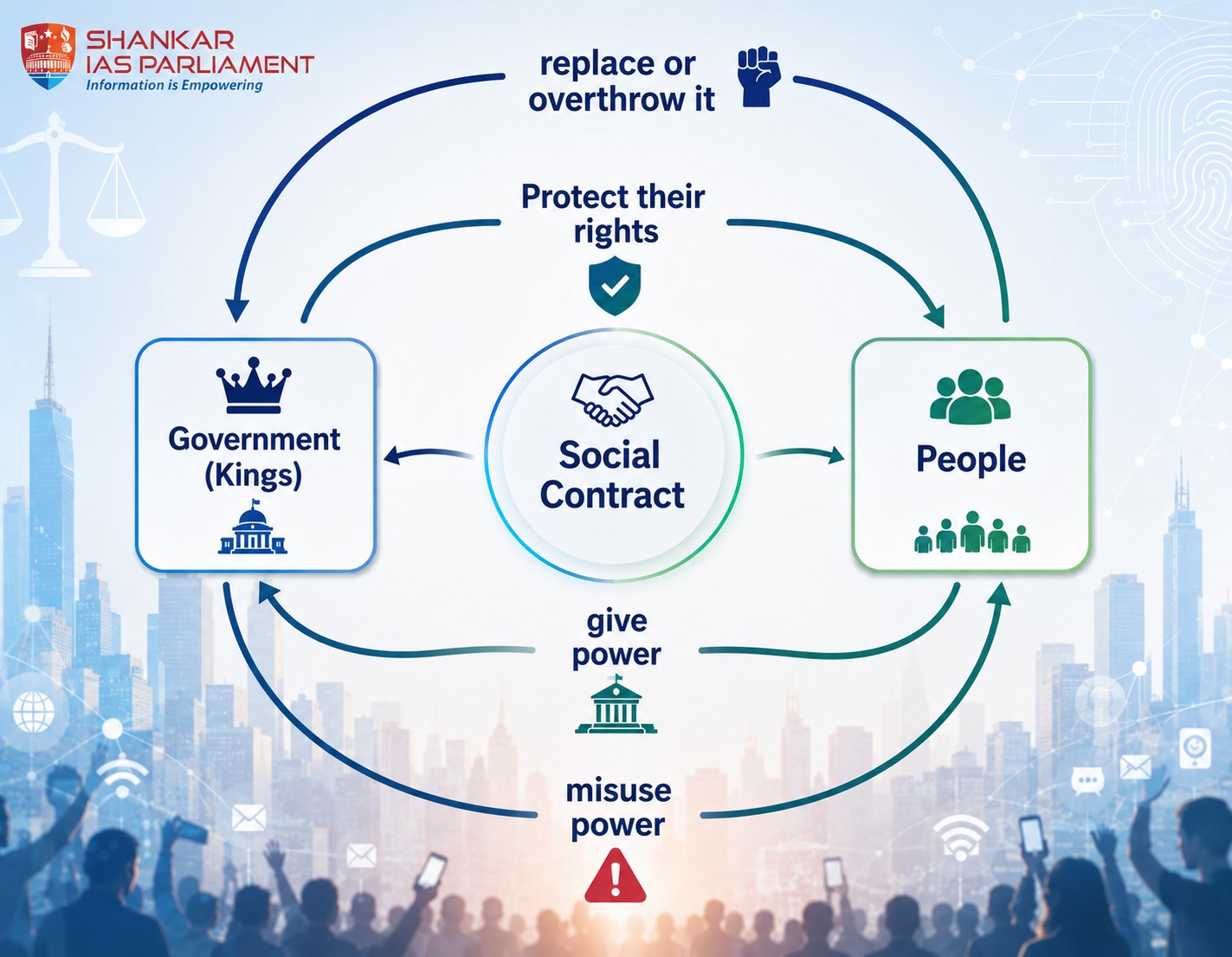
Recent student protests in Delhi have revived debates on democratic dissent, accountability, constitutional reform and this issue invokes “Rousseau’s Social Contract Theory”.
What is Jean-Jacques Rousseau's social contract theory?
The theory argues that individuals voluntarily surrender certain freedoms to create an organised society governed by common rules.
- Core Principles of the Social Contract
- Freedom & Law – Freedom is not absolute; it exists within the framework of laws that shape society.
- Legitimacy of Institution – Institutions gain legitimacy through the collective consent of citizens.
- Democracy endures when citizens respect institutions and seek reforms through constitutional processes.
- Rights & Responsibility – Citizens have both rights and responsibilities.
- Liberty without responsibility may cause disorder, while responsible participation reinforces democracy.
How educational institutions act as microcosms of democracy?
- Schools and universities – They function as democratic institutions in which students learn the principles and practices of governance.
- They teach students to:
- Respect established rules and procedures,
- Actively participate in discussions,
- Resolve conflicts through peaceful means,
- Develop an understanding of accountability,
- Appreciate a diversity of perspectives.
- Consequently, educational institutions serve as microcosms of the social contract by preparing students to become responsible citizens.
What is the importance of democratic dissent?
- Dissent – It is the expression of disagreement or opposition to an opinion, decision, policy, law, or authority.
- It constitutes a fundamental aspect of democracy, as it allows governments and institutions to recognise shortcomings and enhance governance.
- The Constructive Role of Dissent
- Dissent serves to protect democratic freedoms.
- It holds institutions accountable for their actions.
- Dissent encourages the implementation of policy reforms.
- It promotes active public participation in democratic processes.
- Dissent provides a platform for marginalised groups to express their concerns.
- For Instance, the Indian freedom movement was founded on democratic resistance, exemplified by Mahatma Gandhi's leadership through nonviolent methods.
- Therefore, dissent should not be regarded as anti-democratic. Instead, when exercised responsibly, it serves to strengthen democratic institutions.
What are the counterproductive effects of democratic dissent?
- Challenges – Serious concerns emerge when democratic disagreement escalates into persistent confrontation or violence.
- Excessive disruption may lead to the following consequences:
- The erosion of public trust in institutions,
- Increased political polarisation,
- The disruption of academic activities,
- The weakening of governance,
- And a shift in focus from constructive reforms to ongoing conflicts.
- Rather than focusing on educational improvements, debates are increasingly dominated by ideological conflicts and physical confrontations.
- Therefore, while questioning institutions is a legitimate aspect of democracy, entirely delegitimising them can undermine democratic stability.
What are the roles of teachers and educational institutions?
- Promoting Constitutional Values
- Justice
- Liberty
- Equality
- Fraternity
- Encouraging Critical Thinking – Students should be taught to critically evaluate policies based on factual information and evidence, rather than relying on emotion or misinformation.
- Developing Civic Responsibility – Educational programs should enable students to understand the following:
- Constitutional rights,
- Civic duties,
- Institutional processes,
- Peaceful conflict resolution.
- Building Institutional Trust – Teachers should emphasise that, although institutions may be imperfect, they are capable of improvement through democratic participation.
What are the significance of institutional accountability?
- Mandates of public institutions – Public institutions must also maintain the following characteristics:
- Transparency,
- Responsiveness,
- Accountability,
- Participation,
- A citizen-centric approach.
- Students are entitled to accessible grievance mechanisms and equitable administrative procedures.
- Institutional accountability enhances public confidence and diminishes the likelihood of confrontational political engagement.
- Respect for institutions does not necessitate uncritical acceptance of all decisions.
What are democratic mechanisms for institutional reform?
- Significant democratic instruments – The constitutional framework of India establishes multiple peaceful mechanisms for addressing public grievances.
- Right to Information (RTI)
- Public grievance portals
- Student unions
- Academic councils
- Judicial remedies
- Public consultations
- Social audits
- Digital governance platforms
- Utilising these institutional mechanisms contributes to the strengthening of democratic processes.
What are the challenges before Indian democracy?
- Political Polarization – Public debates are increasingly characterised by ideological divisions rather than a focus on pragmatic solutions.
- Declining Institutional Trust – Ongoing confrontations erode public confidence in governmental and civic institutions.
- Misinformation – Social media platforms frequently amplify misinformation, thereby hindering the possibility of informed public discourse.
- Youth Alienation – A lack of effective institutional response may lead students to lose confidence in democratic processes.
- Weak Civic Education – A significant proportion of young citizens remain unaware of constitutional mechanisms available for pursuing reforms.
What could be done?
- Strengthen Civic Education – Educational curricula should prioritise the teaching of constitutional values, democratic participation, and civic responsibility.
- Improve Institutional Responsiveness – Governments and universities must establish transparent and efficient systems for grievance redressal.
- Promote Dialogue – Regular and structured interactions among students, faculty, and administrators can mitigate misunderstandings and foster mutual understanding.
- Encourage Peaceful Participation – Student activism should prioritise evidence-based advocacy, nonviolent protest, and constructive engagement with policy processes.
- Build Institutional Trust – Institutions must remain receptive to constructive criticism while upholding principles of fairness, transparency, and accountability.
- Foster Constitutional Morality – Dr B.R. Ambedkar emphasised that democracy endures only when citizens uphold constitutional methods rather than resorting to extra-constitutional means.
Reference
The Indian Express | Democracy Needs Dissent



