Why in News?
India has reshaped its economy by making digital transformation a key driver of growth; introduced wide-ranging reforms to improve Ease of Doing Business (EoDB).
What are the measures for Business Registration & Regulatory Framework?
- MCA21 – It is an AI-driven platform used for end-to-end registry & incorporation of Companies & LLPs since 2006 to enhances transparency and Ease of Doing Business (EoDB).
- MCA21 Version 3 Features – Like e-Scrutiny, e-adjudication and e-consultation, Compliance Management System and MCA Lab.
- Application Programming Interface (API) – It acts as a bridge that enables tasks like searching, retrieving, submitting, updating, or triggering actions.
- Usage – 3.84 crore filings (2021–2025).
- ISO 27001 – International framework for managing information security risks; shows robust data protection practices.
- Udyam Registration Portal – It offers a free, paperless, and self-declaration-based system for MSMEs & integrating with CBDT (Central Board of Direct Taxes) and GSTN (GST Network) databases.
- Impact (12 Feb 2026) – 7.71 crore registrations & 33.97 crore jobs supported.
- Business Reforms Action Plan (BRAP) & District Reforms – Designed to compare regulatory requirements across States and encourage them to reduce compliance burdens and create a more business-friendly environment.
- Started in – 2015, promotes transparency, simplify regulatory procedures, and enhance service delivery.
- Till date, 7 editions of BRAP have been completed, and the eighth edition, BRAP 2026, was formally rolled out on 11 November 2025.
- Progress – 7th editions completed & 8th edition (BRAP 2026) launched on 11 Nov 2025.
- District BRAP – Launched to strengthen EoDB at the District Level.
- Achievements of States
- Kerala – Aspirer (2022), Fast Mover (2024)
- Uttar Pradesh – Aspirer (2022 & 2024)
- Tamil Nadu – Aspirer (2022 & 2024)
- SPICe+ Form – It is an integrated web form which saves many procedures, time and cost for starting a business in India.
- Offers 11 services by 3 Central Govt Ministries & Departments and 3 State Governments (Maharashtra, Karnataka, West Bengal) and NCT – Delhi.
- It has consolidated 10 essential procedures – including incorporation; DIN Allotment; issue of PAN, TAN, ESIC Registration, EPFO Registration; etc.
What are the measures for Integrated Clearance & Environmental Approvals?
- National Single Window System (NSWS) – A digital platform which guides in identifying and applying for approvals according to the business requirements.
- Benefits – Streamlined approvals, reduced timelines, secure document repository, fast query management.
- Integration – Covers 32 Central Departments + 32 State Govts → access to 698 central & 7,435 state approvals.
- PARIVESH 3.0 – Pro-Active and Responsive facilitation by Interactive, Virtuous, and Environmental Single Window Hub
- Purpose – For environmental clearances and post-approval compliance monitoring.
- Integration – Baseline data, afforestation land banks, inter ministerial dashboards, AI enabled support, enhances transparency, predictability, efficiency.
- e-Gram SWARAJ portal – It provides a single window with the complete Gram Panchayat Profile (Sarpanch/Secretary, demography, finances, other assets, etc).
- It serve as a unified reporting and tracking platform, strengthens decentralised planning & improves fund utilisation.
What are the measures related to Taxation, Customs & Trade Facilitation?
- GST Network (GSTN) – Provides a synchronised interface for over a crore of taxpayers, ensuring effortless B2B electronic invoicing which fosters a transparent and efficient fiscal framework..
- Processing of over Rs.102.91 lakh crore payments (as of January 2026).
- E-Way Bill – It replaces multiple state-level permits with a single, electronic document for the movement of goods.
- It has facilitated the removal of static border check posts to reduce transport time and improved tax compliance.
- Growth – 21% year-on-year increase during April- December 2025.
- ICEGATE (Indian Customs Electronic Gateway) – It serves as a centralized hub for all electronic interactions between Indian customs and the trading community.
- Services – Offers a range of services including e-filing, online amendment submission, online duty payment, query resolution, and IGST refunds.
- Benefit – Enhances the ease of doing business by streamlining customs procedures and promoting transparency in cross-border trade.
- eCoO (Enhanced Certificate of Origin) 2.0 – It is a digital upgrade by simplifying the certification process for exporters.
- Features used – Multi-user access under a single IEC, Aadhaar-based e-signing, and dashboard for FTA.
- Benefit – Flexible, transparent online applications for Certificates of Origin.
- TReDS (Trade Receivables Discounting System) – It is an electronic platform that facilitates financing / discounting of trade receivables of MSMEs through multiple financiers.
- These receivables can be due from corporates and other buyers, including Government Departments and PSUs.
- Trade Connect e-Platform – It provides comprehensive international trade information and services to all exporters, including MSMEs.
- Features – It enables directs connections between global buyers via missions abroad, single govt engagement channel, digital learning & trade intelligence.
- Impact (12 Feb 2026) – Currently, it has over 19.25 lakhs registered users with more than 28 lakhs certificate of origin issued.
What are the key measures for Logistics & Market Access?
- PM GatiShakti National Master Plan – Launched in October 2021, for integrated infrastructure planning and multimodal connectivity.
- Unified platform – 57 Central Ministries + all States/UTs, with 1,700+ data layers.
- Adoption – 27 States notified logistics policies; 28 Aspirational Districts using District Master Plan Module (to expand to all 112).
- Impact (Feb 2026) – NPG evaluated 352 projects worth Rs.16.10 lakh crore; 201 sanctioned, 167 under implementation.
- Benefits – Reduces delays, avoids duplication, strengthens freight movement, improves EoDB.
- National Logistics Portal (Marine) – It is a maritime single-window platform for exporters, importers, service providers.
- Features – Aligns with global standards, integrating G2G, G2B, and B2B models, real-time tracking of vessel terminal gate, and container freight station (CFS) gate transactions.
- Logistics Data Bank (LDB 2.0) – This platform provides real time tracking & multimodal visibility (road, rail, sea) through integration with Unified Logistics Interface Platform (ULIP) APIs.
- Features – Introduces high-seas container tracking, live container heatmap to identify bottlenecks, to fosters a transparent, data-driven ecosystem that reduces costs and improves supply chain management.
- GeM (Government e-Marketplace) – A digital procurement system connecting sellers and service providers across the country, including women entrepreneurs, startups, micro and small enterprises (MSEs), artisans, self-help groups (SHGs) and Divyangjans.
- ONDC (Open Network for Digital Commerce) – It aimed at promoting open digital networks for goods and services over digital or electronic networks.
- It envisions creating a level playing field for sellers, buyers, and service providers across India, particularly small and medium enterprises (MSMEs).
- The sellers and service providers are spread across 616+ cities expanding the geographical coverage of the ONDC network.
What are the key initiatives in Digital Public Infrastructure to improve ease of doing business?
- Digital Public Infrastructure (DPI) – It enables secure, co-ordinated interactions between people, businesses and governments.
- It reduces operational friction and enhances the Ease of Doing Business through instant, secure, and transparent digital interactions.
- UPI (Unified Payments Interface) – It is a real-time payment system that enables instant money transfers between bank accounts through a mobile application.
- It brings multiple bank accounts into a single app and supports various features such as fund transfers, merchant payments, and peer-peer payment requests and provides QR code convenience.
- Scale – It connects 691 banks on a single platform allowing people to make payments easily.
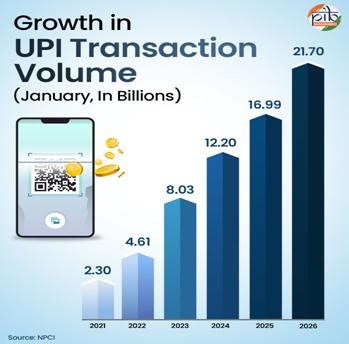
- In January 2026 alone it handled 21.70 billion transaction
- Impact (Jan 2026) – 21.70 billion transactions amounting to Rs. 28.33 lakh crore.
- International Recognition of UPI
- IMF (June 2025) – Recognized UPI as world’s largest retail fast‑payment system (FPS).
- ACI Worldwide (2024) – 49% share of global real‑time transactions volume.
- It surpassed Visa in daily transactions.
- Live in 8 countries (UAE, Singapore, Bhutan, Nepal, Sri Lanka, France, Mauritius, Qatar) positioning India as a global leader in digital payments.
- cKYC (Central Know Your Customer) Registry – It is a centralized repository of KYC records of customers in the financial sector with uniform KYC norms and inter-usability of the KYC records across the sector.
- Objective – Reduce repeated submission & verification of KYC documents when creating new financial relationships.
- Entity Locker – It is a secure, cloud-based platform for storing, sharing, and verifying digital documents and certificates.
- This platform ensures safe, efficient, and streamlined document management for businesses and institutions.
- API Setu – It is a unified digital platform for discovering, accessing, and integrating APIs.
- Users – Govt departments, private organizations, startups, developers to discover, access, and integrate APIs with ease.
- It enables swift, transparent, safe and reliable information sharing across applications and promote innovation.
What lies ahead?
- India’s digital reforms have fundamentally transformed the business environment, making approvals, registration, and trade processes seamless and efficient.
- Robust digital infrastructure is fostering innovation, reducing costs, and enabling smooth interactions between businesses, citizens, and government.
- These initiatives collectively position India as a secure, efficient, and highly attractive destination for enterprise setup and growth.
Reference
PIB | The Digital Blueprint for Ease of Doing Business



