Mains: GSIII – Infrastructure
Why in News?
India’s rapid digitalisation, AI, cloud computing, digital payments and e-Governance are driving rising demand for data centres.
What are Data Centres?
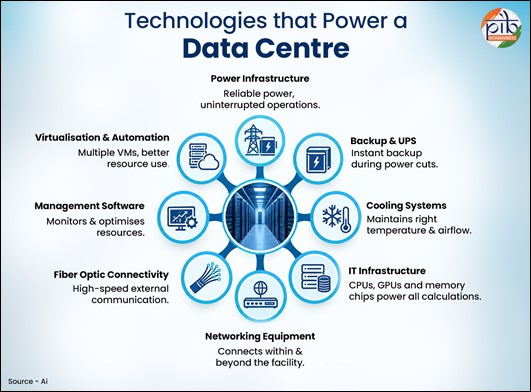
- Data centres – These are secure facilities housing servers, storage, networking, power, cooling and cybersecurity systems to store, process and distribute digital information.
- They form the physical foundation of cloud services, AI applications, digital payments, e-Governance and other digital services.
What is the Significance of Data Centres for India?
- Digital economy – Provide the computing and storage infrastructure required for India’s rapidly expanding digital economy.
- Support digital payments, banking, e-commerce, cloud services and online public services.
- AI and emerging technologies – AI requires large-scale high-performance computing, data processing and storage.
- The IndiaAI Mission and semiconductor initiatives are expected to further increase demand.
- Data sovereignty – Domestic data-centre capacity can strengthen data localisation, digital sovereignty and cybersecurity.
- Reduces excessive dependence on overseas infrastructure for critical digital services.
- Economic growth – They attracts domestic and foreign investment and creates opportunities in cloud computing, electronics, semiconductors, and skilled employment.
What is the Status of the Government Initiatives in this Regard?
- Infrastructure Status – Data centres were included in the Harmonized List of Infrastructure in Union Budget 2022–23, improving access to long-term finance.
- Tax Incentive – Budget 2026–27 introduced a tax holiday for eligible foreign cloud service providers using India-based data-centre infrastructure.
- IndiaAI Mission – It aims to develop AI capabilities and computing infrastructure.
- Semicon 2.0 – Its objective is to build a resilient semiconductor ecosystem.
- Electronics Components Manufacturing Scheme (ECMS) allocation is increased.
- PLI 2.0 for IT Hardware – Promotes domestic manufacturing of servers and other IT hardware.
- NIC Data Centres – National Data Centres at Delhi, Pune, Hyderabad and Bhubaneswar, along with 37 smaller centres at State Capitals, support government digital services.
What are the Key Challenges associated with Data Centre Expansion?
- High energy consumption – Data centres operate continuously and require reliable electricity.
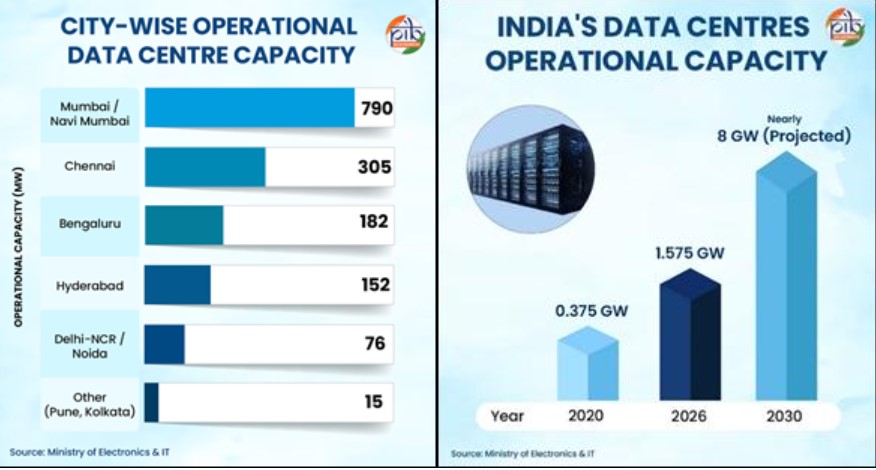
- Electricity demand from data centres could reach 17 GW by 2031–32.
- High water consumption – Conventional cooling systems can create significant water requirements, particularly in water-stressed regions.
- Environmental footprint – Dependence on fossil-fuel-based electricity can increase carbon emissions.
- Growing electronic equipment also raises concerns over e-waste.
- Cybersecurity risks – Concentration of critical data and digital infrastructure makes data centres attractive targets for cyberattacks and disruptions.
- Infrastructure constraints – Reliable power, fibre connectivity, land, cooling infrastructure and skilled manpower are essential for expansion.
- Regional imbalance – Excessive concentration in major metropolitan regions may increase pressure on land, water and electricity infrastructure.
What measures can be taken?
- Green digital infrastructure – Integrate data-centre expansion with renewable energy, storage and potentially nuclear power.
- Resource-efficient cooling – Shift towards low-water and high-efficiency cooling technologies.
- Distributed infrastructure – Develop data centres beyond major metros to improve resilience and reduce regional resource pressure.
- Cyber resilience – Strengthen encryption, redundancy, disaster recovery and critical-infrastructure protection.
- Domestic ecosystem – Build indigenous capabilities in servers, semiconductors, networking equipment and cooling technologies.
- Policy coordination – Align data-centre development with Digital India, IndiaAI, semiconductor, energy and water policies.
What can be done to Make Data Centres More Resource-Efficient?
- Promote renewable energy, green energy open access and energy-efficient infrastructure.
- Expand liquid cooling, immersion cooling, adiabatic cooling and closed-loop systems.
- Adopt efficiency indicators such as:
- PUE – Power Usage Effectiveness
- WUE – Water Usage Effectiveness
- CUE – Carbon Usage Effectiveness
- CER – Cooling Efficiency Ratio
- Encourage waste-heat recovery, water recycling and circular-economy practices.
- Locate facilities strategically based on power availability, renewable potential, connectivity and water sustainability.
What lies ahead?
- India’s data centres are no longer merely storage facilities but strategic digital infrastructure supporting AI, cloud computing, digital governance and economic growth.
- As India moves towards Viksit Bharat 2047, the priority should be to build a data-centre ecosystem that is secure, sovereign, energy-efficient, water-conscious and globally competitive.
Reference
DDNews| Data Centres: The Digital Backbone of India’s Growth



