What the New Margin Cap Means for Patients
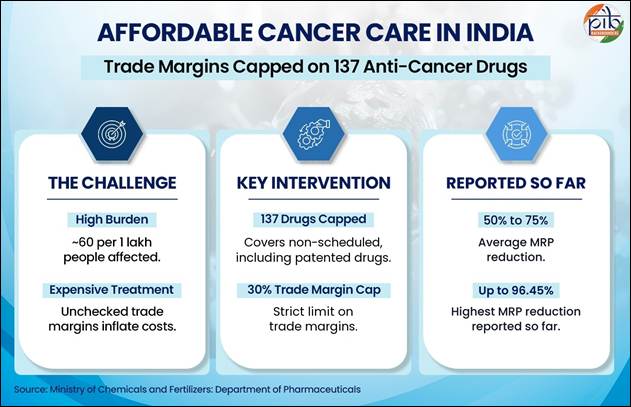
- On 17 October 2026, the National Pharmaceutical Pricing Authority (NPPA) capped trade margins on 137 non-scheduled anti-cancer medicines at 30% of MRP.
- Revised prices came into effect on 9 November 2026.
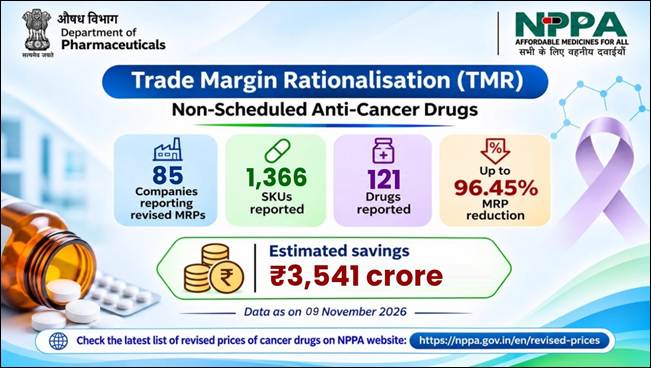
- As of 9 November, 85 companies reported revised MRPs for 121 drugs, with maximum price reduction of 96.45% and estimated annual savings of ₹3,541 crore.
- More than 650 formulations recorded over 50% MRP reduction.
What is a Trade Margin?
- Trade margin is the difference between the manufacturer's price to stockists/istributors and the medicine's Maximum Retail Price (MRP), excluding GST.
- Excessive margins increase medicine prices and patients' out-of-pocket expenditure.
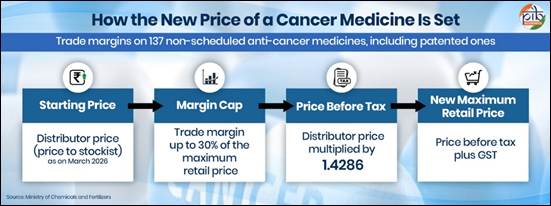
- The new order caps trade margins at 30% of MRP, calculated using average distributor prices of March 2026.
How Are Medicine Prices Regulated?
Under the Drugs (Prices Control) Order (DPCO), 2013, issued under the Essential Commodities Act:
- Scheduled Medicines: Included in the National List of Essential Medicines (NLEM); government fixes ceiling prices. NLEM 2022 contains 388 medicines, including 63 anti-cancer drugs.
- Non-Scheduled Medicines: Manufacturers can increase MRP by a maximum of 10% within 12 months under Paragraph 20 of DPCO.
National List of Essential Medicines (NLEM):
- First introduced in 1996 and revised in 2003, 2011, 2015 and 2022.
- Identifies essential medicines to improve affordability, quality healthcare and public procurement.
Legal Basis – Paragraph 19 of DPCO, 2013:
- Empowers the government to fix or revise drug prices in extraordinary circumstances in public interest.
- The 2026 order builds on the 2019 Trade Margin Rationalisation initiative covering 42 anti-cancer drugs.
How the New Order Limits Trade Margins
- Caps trade margins at 30% of MRP for 137 non-scheduled anti-cancer medicines, including patented drugs.
- Covers different doses, formulations and combinations.
- Revised MRP is calculated using March 2026 average distributor prices, with GST added separately.
What Changes for Patients and Companies?
- Companies must revise MRPs and notify NPPA, retailers and hospitals.
- Hospitals and pharmacies must display revised prices.
- Medicines already priced below the new ceiling cannot become costlier.
- Companies cannot discontinue production without six months' notice.
- Overcharging attracts recovery of excess amounts with interest.
- Revised prices can be checked through NPPA and the Pharma Sahi Daam app.
Wider Government Support for Cancer Care
A. Cashless Hospital Treatment
- AB-PMJAY: Provides ₹5 lakh annual health coverage per eligible family, including senior citizens aged 70 and above.
- Covers medical, surgical and radiation oncology procedures.
B. Cancer Screening and Infrastructure
- NP-NCD: Strengthens screening, early diagnosis and treatment infrastructure.
- 524 Day Care Cancer Centres established.
- 19 State Cancer Institutes and 20 Tertiary Care Cancer Centres approved.
- Ayushman Arogya Mandirs provide oral, breast and cervical cancer screening.
C. Free HPV Vaccination
- Nationwide HPV vaccination campaign launched on 28 February 2026 for approximately 1.2 crore eligible 14-year-old girls.
- Over 80 lakh doses administered by September 2026.
D. Affordable Medicines
- Jan Aushadhi Kendras: Provide affordable generic medicines, including cancer drugs.
- AMRIT: Offers medicines and healthcare products at discounts of up to an average of 50% on MRP.
E. Teleconsultation
eSanjeevani: Provides remote specialist consultations, including oncology services.
Conclusion
The 30% trade margin cap strengthens pharmaceutical price regulation and reduces patients' out-of-pocket expenditure.
Combined with affordable medicines, screening, vaccination and cashless treatment, it advances equitable and accessible healthcare under the vision of affordable healthcare for all.
Reference
PIB



