- The Bal Vivah Mukt Bharat (BVMB) campaign, launched on November 27, 2024, completes two years of implementation.
- It aims to make India child-marriage-free by 2030, aligned with SDG Target 5.3.
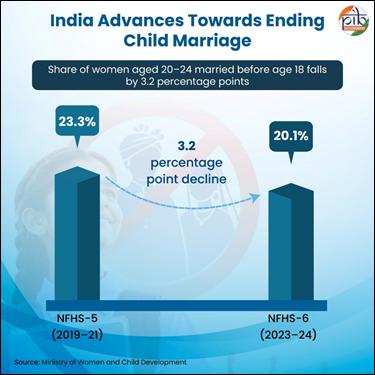
- Child marriage prevalence declined from 23.3% (NFHS-5, 2019–21) to 20.1% (NFHS-6, 2023–24).
Child Marriage in India: Key Concerns
- Early marriage exposes girls to health risks, particularly early pregnancy.
- It increases vulnerability to domestic violence and interrupts education.
- It perpetuates poverty, gender inequality and limited opportunities for women.
Legal Framework: Prohibition of Child Marriage Act (PCMA), 2006
Background: Replaced the Child Marriage Restraint Act, 1929 (Sarda Act), strengthening legal protection against child marriage.
Key Provisions:
- Definition: Male below 21 years and female below 18 years are considered children.
- Validity: Child marriages are generally voidable at the option of the contracting party who was a child. They are void in specified circumstances, including trafficking and force.
- Penalties: Rigorous imprisonment up to two years and/or fine up to ₹1 lakh for specified offenders.
- Relief: Provides maintenance, residence and custody arrangements; children born from such marriages remain legitimate.
- Prevention: Judicial Magistrates can issue injunctions against impending child marriages.
- CMPOs: Child Marriage Prohibition Officers prevent marriages, collect evidence, counsel communities and create awareness.
Supreme Court Framework (2024): In Society for Enlightenment and Voluntary Action v. Union of India, the Court emphasised dedicated CMPOs, coordination mechanisms, awareness campaigns, technology-enabled reporting and databases of high-risk areas.
Beti Bachao Beti Padhao (BBBP)
- Launched on January 22, 2015, to address declining Child Sex Ratio and promote the survival, protection and education of girls.
- Implemented under Mission Shakti, with the Ministry of Women and Child Development as the nodal ministry.
- Promotes behavioural change, girls' education and community mobilisation to address social practices sustaining child marriage.
Bal Vivah Mukt Bharat (BVMB) Campaign
- Launched: November 27, 2024, by the Ministry of Women and Child Development.
- Objective: Eliminate child marriage through legal enforcement, awareness and community participation.
- Target: Child-marriage-free India by 2030.
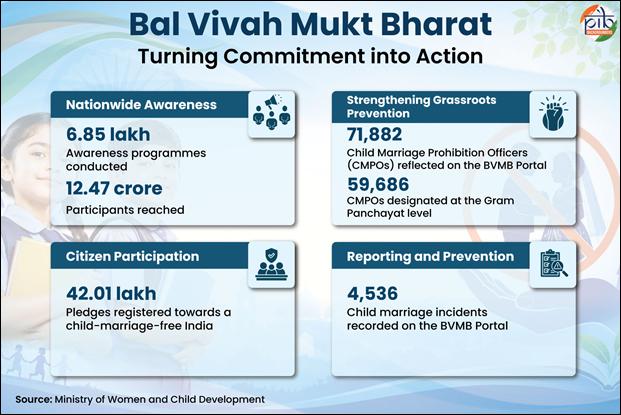
- Priority districts: 257 high-burden districts identified using NFHS-5 data.
BVMB Portal
- Provides public access to CMPO details and facilitates reporting of child marriage incidents.
- Enables monitoring of awareness activities, community mobilisation and citizen pledges.
100-Day Intensive Awareness Campaign
Launched on December 4, 2025, and implemented from November 27, 2025, to March 8, 2026.
- Spell I: Schools, colleges and universities – awareness sessions, competitions and pledges.
- Spell II: Religious institutions, faith leaders and marriage service providers – community outreach and sensitisation.
- Spell III: Gram Panchayats and Municipal Wards – community mobilisation and child-marriage-free resolutions.
State-level Progress
- National prevalence declined by 3.2 percentage points between NFHS-5 and NFHS-6.
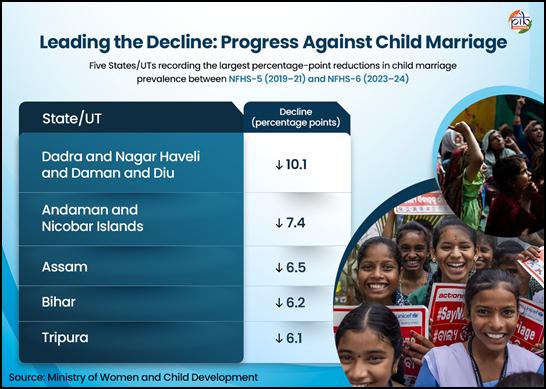
- Largest reductions: Dadra and Nagar Haveli and Daman and Diu (10.1 percentage points), Andaman and Nicobar Islands (7.4), Assam (6.5), Bihar (6.2) and Tripura (6.1).
- 28 States and UTs perform better than the national average.
Way Forward
- Strengthen dedicated CMPOs and grassroots monitoring mechanisms.
- Improve portal data quality and timely reporting of incidents.
- Promote girls' education, skill development and economic empowerment.
- Strengthen participation of Panchayats, schools, families, religious leaders and civil society.
Conclusion
Eliminating child marriage requires more than legal prohibition. Sustained enforcement, girls' empowerment and community participation are essential to achieving a child-marriage-free India by 2030.
Reference
PIB



