Why in News?
Himalayan towns face civic issues due to unique challenges, requiring tailored development, but they often lack the necessary funds and resources.
What is Indian Himalayan Region (IHR)?
- Location- It spans thirteen Indian states and union territories of India
- Ladakh, Jammu and Kashmir, Himachal Pradesh, Uttarakhand, Sikkim, West Bengal, and parts of the northeastern states.
- Geographical divisions- They are divided into three main geographical entities
- Himadri - Greater Himalaya
- Himachal - Lesser Himalaya
- Sivaliks - Outer Himalaya
- Trans-Himalayan Ranges- The northernmost ranges include the Karakoram Mountains, with the Zanskar and Ladakh ranges lying to the south.
- Major rivers- It is home to major rivers such as the Indus, Sutlej, Kali, Kosi, and Brahmaputra.
- These rivers are glacier-fed and carve steep gorges through the Himalayas to flow into the Great Plains.
- Significance- It provides water to a large portion of the Indian subcontinent and supports diverse flora and fauna.
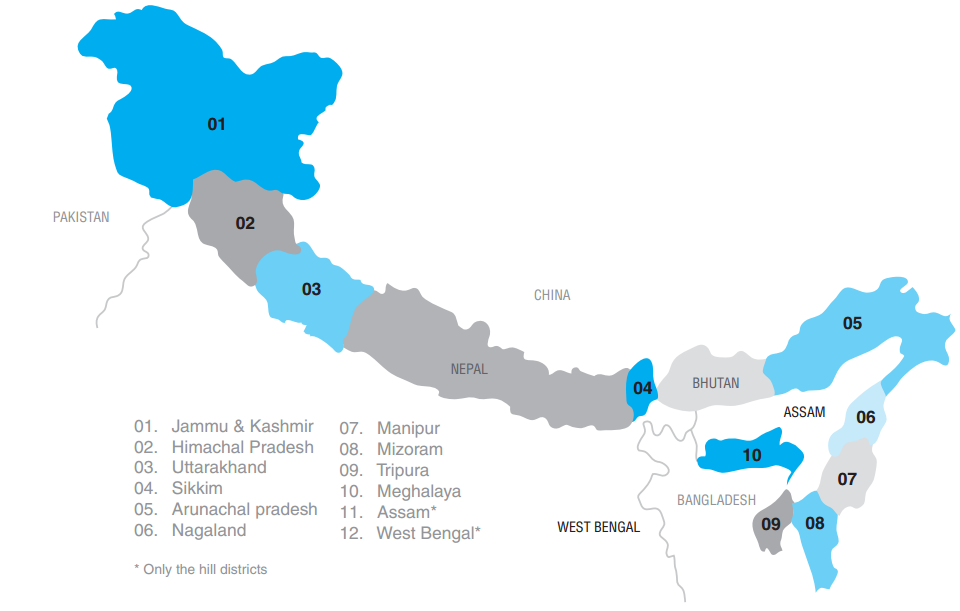
Note: J&K (as in picture as (1)) bifurcated into UT of J&K and UT of Ladakh in 2019.
What are the major issues in IHR Towns?
- Civic challenges - Himalayan towns, including state capitals like Srinagar, Guwahati, Shillong, and Shimla, face significant issues with sanitation, solid and liquid waste management, and water supply.
- Ineffective planning- Planning institutions often fail because they adopt models designed for plains.
- Resource shortage- City governments are severely understaffed, with a 75% shortage in human resources.
- For example, in the Kashmir Valley, over 40 urban local bodies have only 15 executive officers, excluding Srinagar.
- Environmental impact- In Srinagar, from 2000 to 2020, there was a 75.58% increase in built-up real estate where water bodies eroded by almost 25%.
- Nearly 90% of liquid waste is discharged into water bodies without treatment, further harming the environment.
- Inappropriate infrastructure- Unsustainable infrastructure, poorly designed roads, and inadequate waste management are adding to the problems.
- Climatic variations- Changing precipitation patterns and rising temperatures exacerbate these issues, further straining the socio-ecological fabric of the Himalayas.
- Tourism growth- The expansion of tourism, often replacing eco-friendly infrastructure with harmful constructions, has a negative impact on biodiversity and ecosystem services.
- Development pressure- They are stressing natural resources, leading to water scarcity, deforestation, land degradation, and biodiversity loss.
What are the government initiatives for IHR Towns?
- National Mission on Himalayan Studies (NMHS) – It focuses on research, technological innovation, and community-based solutions.
- They are tailored to the unique ecological and socio-economic conditions of the Himalayas.
- Sustainable urban development Initiatives- Programs like the Smart Cities Mission and AMRUT (Atal Mission for Rejuvenation and Urban Transformation) aims
- To improve urban infrastructure, including water supply, waste management, and sanitation, with adaptations for the Himalayan region's specific needs.
- Ecotourism initiatives- Various state governments in the IHR have promoted ecotourism to balance economic development with environmental conservation.
- Climate Resilient Infrastructure- The government is investing in infrastructure projects resilient to climate change, such as flood control, landslide mitigation, and earthquake-resistant buildings in the Himalayan region.
- National Mission for Clean Ganga (NMCG) – It is to clean and protect rivers originating in the Himalayas.
- It includes projects of pollution control, sustainable water use, ecosystem restoration in towns along the Ganges and its tributaries.
- CAMPA- Compensatory Afforestation Fund Management & Planning Authority Funds are allocated for afforestation projects in the IHR·
- It helps to mitigate the effects of deforestation and land degradation, aiming to restore ecological balance in urban and rural areas.
What lies ahead?
- Tailoring urban planning based on climate resilience and involving local communities in a bottom-up approach.
- A separate chapter on urban financing for the IHR towns should be included in the Finance Commission's report, increasing intergovernmental transfers to at least 1% of GDP.
- Emphasis should be on eco-centric planning processes, with public participation to ensure sustainability and resilience in urban futures.
- Promoting ecotourism is essential for balancing development with environmental preservation.
Reference
The Hindu| Unique Planning for Indian Himalayan Towns



