Prelims: Current events of national and international importance | Economy | Environment
Why in news?
Recently, the U.K. officially recognised India's carbon credit scheme under its carbon tax mechanism.
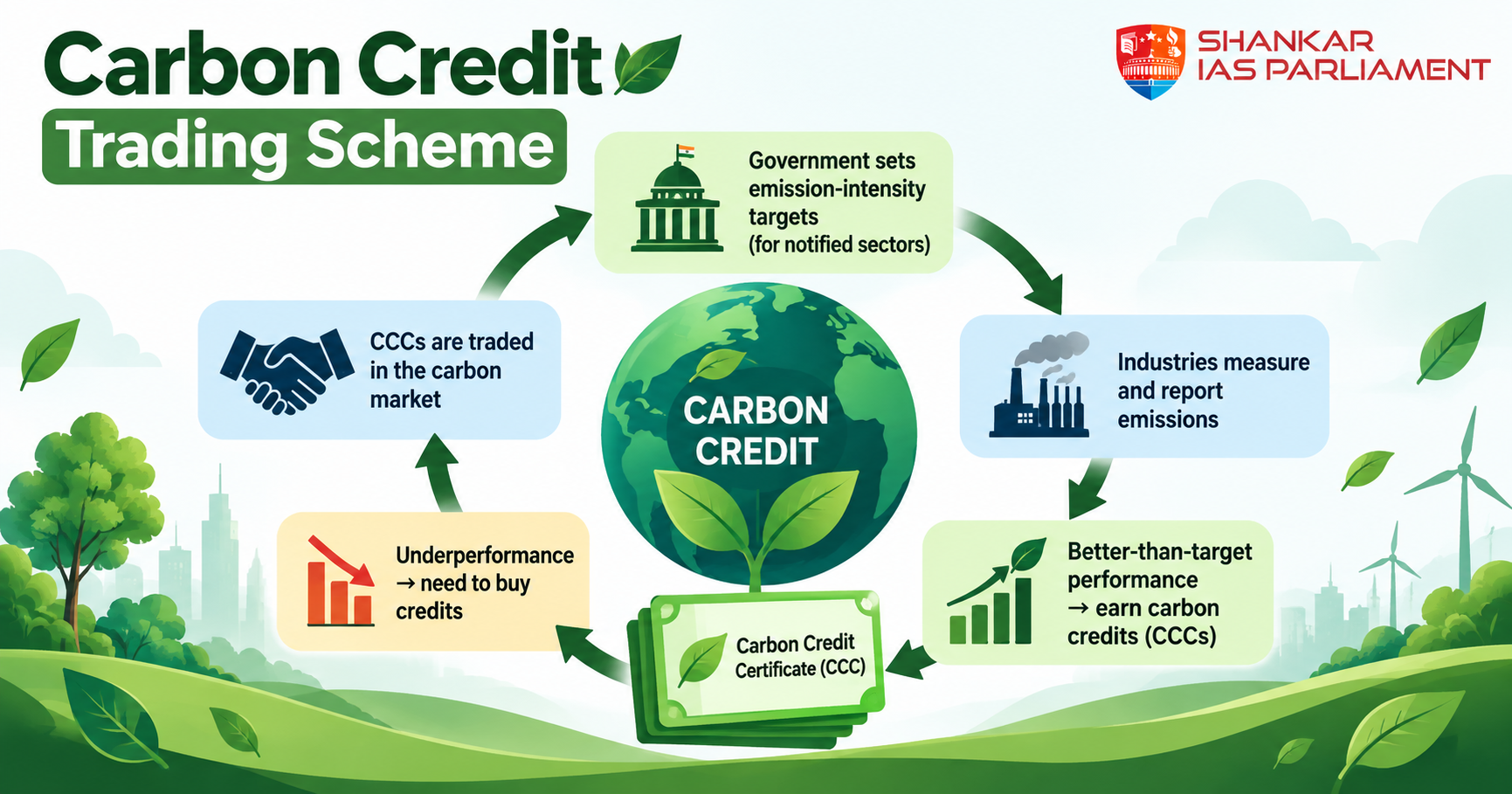
- Carbon Credit Trading Scheme (CCTS) – It is India's national framework designed to decarbonise the economy by pricing greenhouse gas (GHG) emissions.
- Aim – To incentivise and support entities in their efforts to decarbonise the Indian economy.
- Objective – To reduce, remove or avoid greenhouse gas emissions from the Indian economy by carbon pricing such emissions through the trading of Carbon Credit Certificates.
Carbon credits – These are tradable permits or virtual certificates representing the reduction, avoidance, or removal of one metric ton of carbon dioxide or an equivalent greenhouse gas from the atmosphere.
- Notified under – Energy Conservation (Amendment) Act, 2022.
- Administration – Managed by the Ministry of Power & administered by the Bureau of Energy Efficiency (BEE).
- Core Principle – Companies that emit less greenhouse gas than their assigned target earn tradable credits, while companies that exceed their limits must buy credits or face financial penalties.
- 2 key elements –
- A compliance mechanism for obligated entities (primarily industrial sectors) and
- An offset mechanism for voluntary participation.
- CCTS laid the foundation for the Indian Carbon Market (ICM) by establishing the institutional framework.
- It replaces the legacy Perform, Achieve, and Trade (PAT) energy efficiency program, shifting the focus directly from overall energy savings to verifiable emissions intensity reductions.
- Significance of the UK’s recognition – It can lower Carbon Border Adjustment Mechanism (CBAM)-related costs for Indian exporters, prevent double carbon charging, improve export competitiveness, and strengthen India–UK cooperation on carbon markets.
Reference
The Hindu | U.K. recognises India's carbon credit scheme



