Prelims: Current events of National and International Importance| Environment
Why in News?
Ministers urge Türkiye and Australia to advance fossil fuel transition roadmaps; Denmark, Luxembourg, Spain and Portugal announce national plans as negotiations remain divided over finance, equity and countries' energy choices; Denmark, Luxembourg, Spain and Portugal announced new national plans.
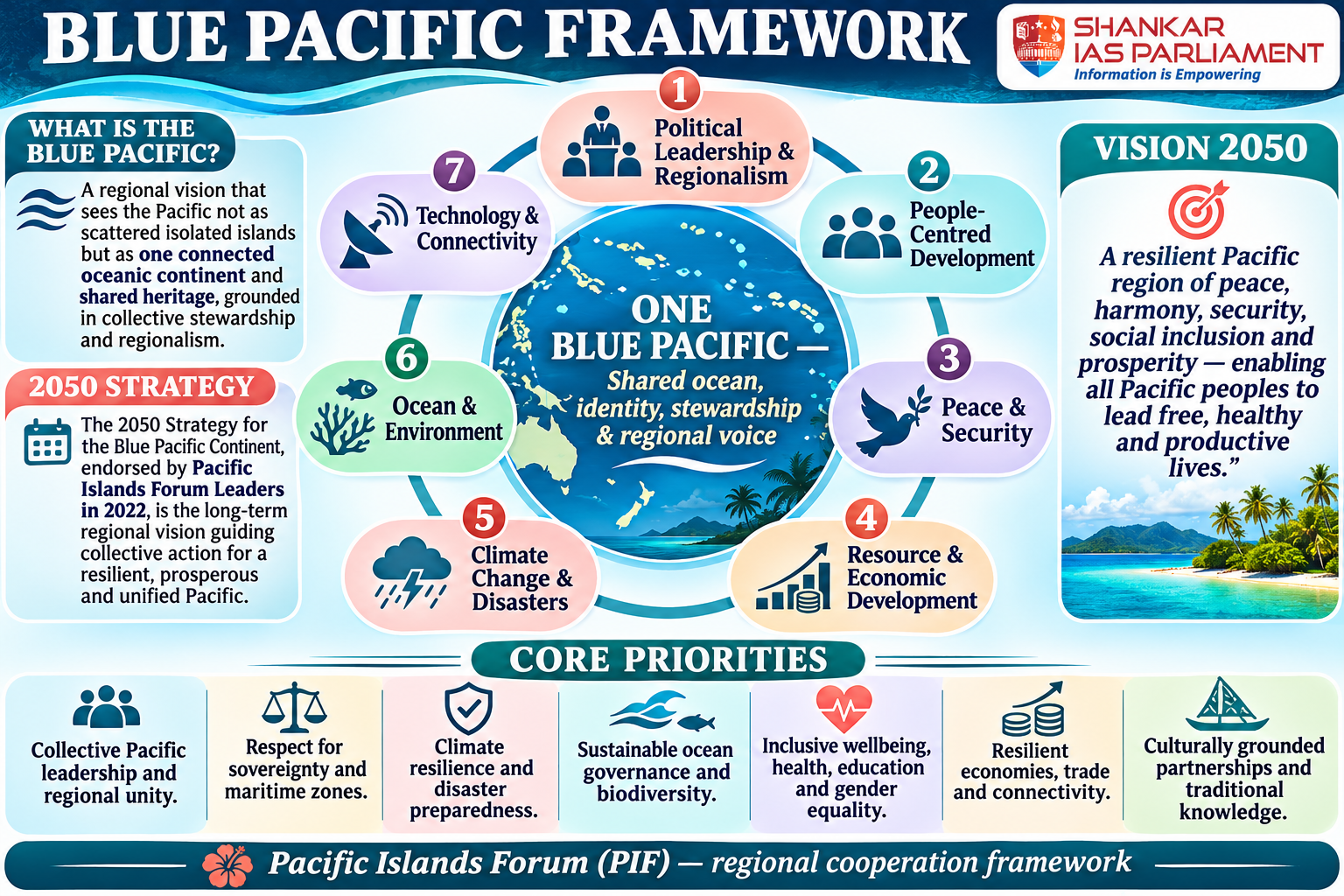
The Blue Pacific framework is a regional political and development approach established in 2017 by Pacific Islands Forum (PIF) leaders to redefine Pacific Island nations as unified, large ocean states rather than small, isolated islands.
At the national level, countries implement this vision by aligning their domestic development blueprints and marine policies with the overarching 2050 Strategy for the Blue Pacific Continent.
Core Pillars of the 2050 Strategy
- National plans across the 18 PIF member states are structured around seven thematic areas established in the 2050 Strategy Implementation Plan (2023–2030)–
- Political Leadership and Regionalism – Countries coordinate diplomatic efforts to amplify their collective voice in global forums and safeguard regional sovereignty.
- People-Centered Development – National policies prioritize health, education, gender equality, human rights, and the preservation of Indigenous cultures and traditional knowledge.
- Peace and Security – Plans address both traditional security and non-traditional threats like transnational crime, illegal fishing, and regional militarization.
- Resource and Economic Development – Governments focus on sustainable blue economies, resilient food systems, and equitable marine resource management.
- Climate Change and Disasters – National adaptation plans target severe sea-level rise, extreme weather early warning systems, and access to international climate finance.
- Ocean and Natural Environment – Policies enforce marine conservation, biodiversity protection, and pollution reduction across Exclusive Economic Zones.
- Technology and Connectivity – Domestic infrastructure projects aim to improve digital access, telecommunications, and regional transport links.
How National Plans Put the Vision into Action
- Rather than replacing domestic governance, the Blue Pacific framework integrates directly into country-level legislation and budgeting through three primary mechanisms–
- National Development Plans (NDPs) – Member states map their domestic multi-year development blueprints directly to the 2050 Strategy's thematic pillars to ensure local budgets support shared regional goals. Progress is tracked through the Blue Pacific 2050 Dashboard hosted by the Pacific Community (SPC).
- National Ocean Policies (NOPs) – Individual nations adopt legally backed marine spatial plans to sustainably manage 100% of their ocean territories.
- Examples listed by the Office of the Pacific Ocean Commissioner include Fiji's National Ocean Policy (2020–2030), Samoa's Ocean Strategy (2020–2030), the Cook Islands' Marae Moana Policy, and Palau's Sustainable Ocean Policy.
- Climate Adaptation and Financing Initiatives – Countries link their national survival plans and Nationally Determined Contributions (NDCs) to regional funding vehicles like Unlocking Blue Pacific Prosperity (UBPP).
- This initiative spans 22 Pacific countries and territories to advance 30x30 ocean-protection targets and secure local food value chains.
Reference
Lowy Institute| Blue Pacific framework



