0.1597
7667766266
x

Asymmetric Expansion of Solar Eruption

iasparliament Logo
November 12, 2026

Prelims: Current events of national and international importance | Science & Technology

Why in news?

VELC on board Aditya-L1 reveals asymmetric expansion of a solar eruption that could impact space weather.

  • Asymmetric expansion of a solar eruption – It refers to the uneven, lopsided growth of a massive cloud of solar plasma and magnetic fields—known as a Coronal Mass Ejection (CME)—as it blasts away from the Sun.
  • Instead of ballooning outward uniformly like a smooth, symmetrical sphere, the eruption stretches more in some directions than others and often tilts at an angle.
  • Aditya-L1 – India’s first space-based solar observatory, launched in September 2023, is now operational at the Sun–Earth L1 point, providing continuous observations of the Sun.
  • It carries 7 payloads, with the Visible Emission Line Coronagraph (VELC) serving as its primary payload.
  • VELC – Designed to observe the solar corona, VELC studies the early stages of CMEs through spectroscopy in the 530.3-nanometre green emission line, produced by highly ionised iron atoms in the corona.
  • This enables scientists to study the hot coronal plasma and measure its movement through Doppler shifts.
  • Designed and developed by the Indian Institute of Astrophysics at its MGK Menon Laboratory for Space Sciences on the CREST campus in Hosakote, with substantial support from ISRO.

Key findings

  • The scientists from the Indian Institute of Astrophysics (IIA), an autonomous institution of the Department of Science and Technology (DST), were able to reconstruct the full 3-D geometry and dynamics of solar eruptions.
  • Instruments & Data used – The findings combined Aditya-L1's Visible Emission Line Coronagraph (VELC), NASA's Solar Dynamics Observatory (SDO), and 3D modelling.
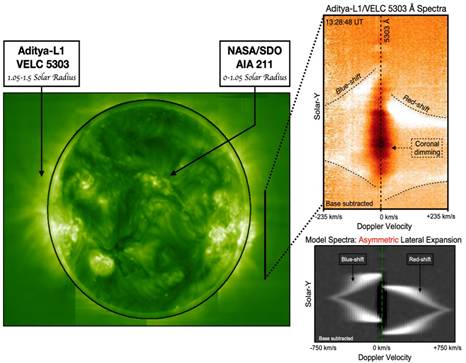
  • Eruption – The CME that occurred on 5 August 2024, near the western limb of the Sun, found that CME did not expand outward from the Sun as a symmetrical bubble. Instead, it exhibited non-uniform expansion, developing an asymmetric shape.
  • VELC’s spectroscopic observations detected distinct blueward and redward shifts in emission, indicating plasma moving towards and away from the observer, respectively.

expansion-of-soloar-eruption.jpg.upsc

  • Implications – Scientists say the asymmetric expansion of CMEs could influence their speed and interaction with the solar wind as they travel through the heliosphere.
  • These factors may affect the timing of their arrival at Earth and the intensity of potential space-weather disturbances.

Reference

DD News | Aditya-L1 Uncovers Asymmetric Expansion of Solar Eruption

There are no reviews yet. Be the first one to review.

ARCHIVES

sidetext