Prelims: Current events on National and International Importance| Science & Technology
Why in News?
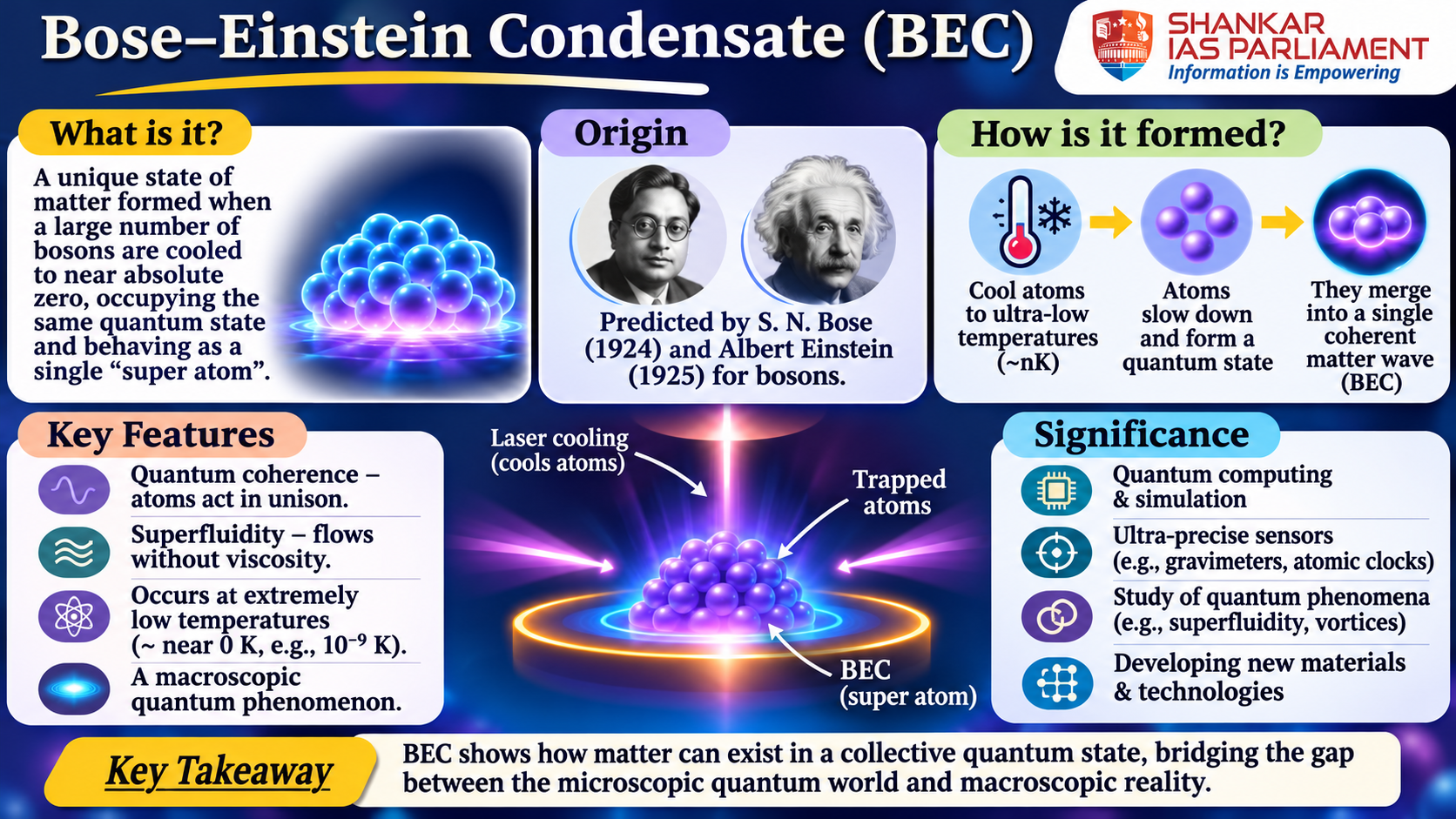
Chinese researchers created a record-cold Bose-Einstein condensate (BEC) at 9.7 picokelvins (9.7 trillionths of a kelvin above absolute zero) aboard the Tiangong space station's Mengtian laboratory module.
- Temperature– 9.7 picokelvins (roughly 280 billion times colder than deep space), beating the previous 2021 drop-tower record of 38 picokelvins by about four times.
- Atoms Used – Around 20,000 Rubidium-87 atoms.
- Trapping Method– An optical dipole trap system inside the Cold Atom Physics Rack (CAPR) rather than standard magnetic traps.
- Observation Time– The ultracold atomic cloud expanded freely and remained trackable for seven seconds in microgravity, up from just two seconds in previous drop tests or one second on the International Space Station.
- Team & Publication– Led by physicists Xiaoji Zhou and Xuzong Chen (Peking University) and Weibiao Chen (Chinese Academy of Sciences), with findings published in Science.
Why Microgravity Matters?
- No Gravitational Sag– On Earth, gravity pulls atoms down and forces researchers to squeeze them tightly against magnetic or optical fields, which heats them up.
- Longer Measurements– Weightlessness lets the quantum gas expand slowly and gently without dropping out of reach, opening doors for quantum simulations, ultra-precise space sensors, and tests of general relativity.
Reference
Physics World| Record-Cold Rubidium Bose-Einstein Condensate



