Mains: GS II – International Organizations
Why in News?
Recently, a Parliamentary Committee on External Affairs has recommended appointing a dedicated Polar/Arctic Affairs Ambassador to strengthen India's engagement with Arctic and polar issues.
What is Arctic Council?
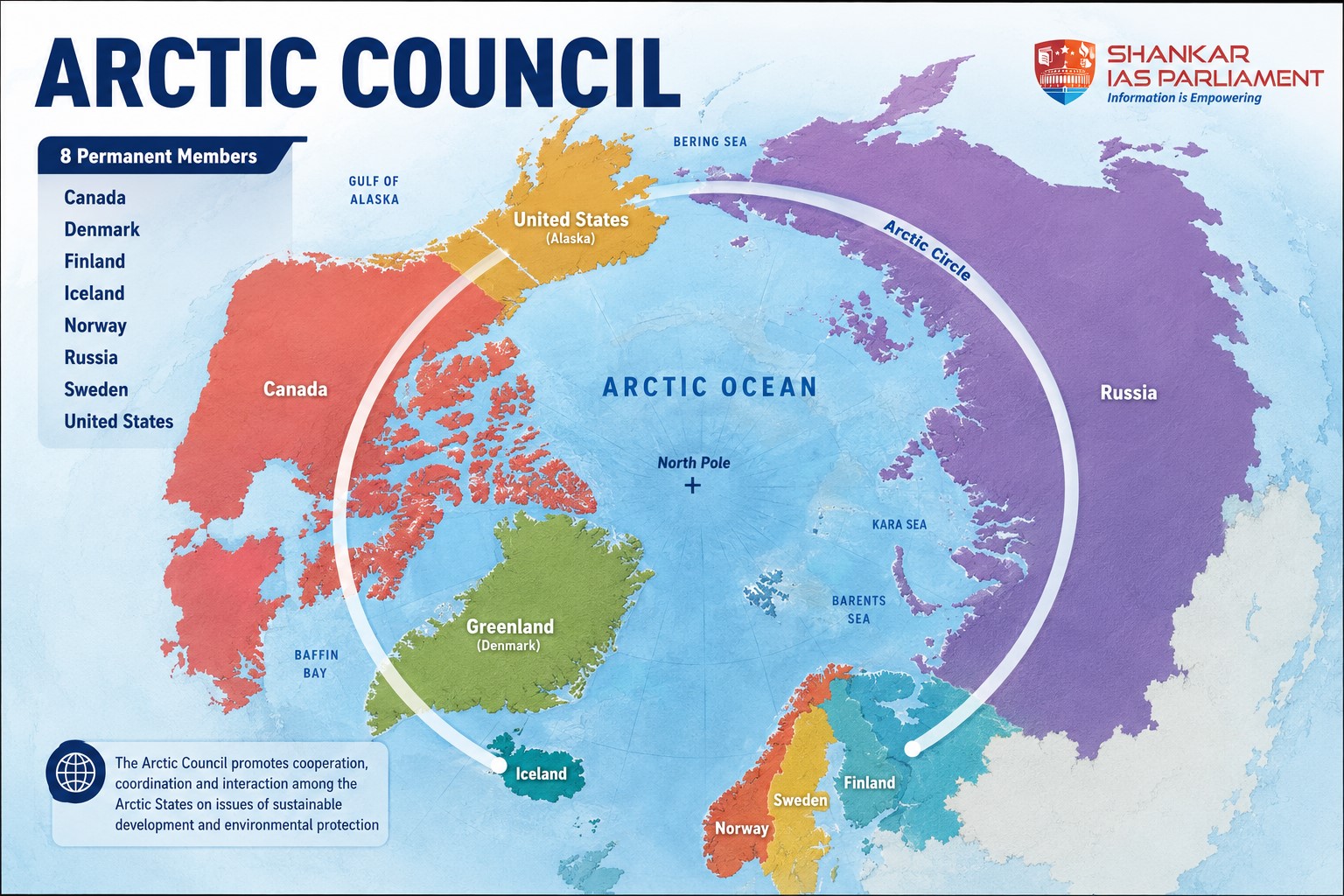
- The Arctic Council – It is a high-level international group that promotes cooperation on environmental protection and sustainable development in the Arctic.
- Members – Core members include Canada, Denmark, Finland, Iceland, Norway, Russia, Sweden, and the United States.
- Foundation – Established on September 19, 1996, via the Ottawa Declaration.
- Permanent Participants – Organizations representing Arctic Indigenous peoples.
- Observers – Non-Arctic states (including India) and international bodies focused on regional issues.
- Focus Areas – Environmental monitoring, pollution reduction, and ecosystem health via specialized working groups.
- Working groups – The functions of the council are performed primarily by six working groups:
- ACAP (Arctic Contaminants Action Program) – Reduces pollutant emissions and hazardous chemical releases.
- AMAP (Arctic Monitoring and Assessment Programme) – Monitors climate change, ecosystems, and human health.
- CAFF (Conservation of Arctic Flora and Fauna) – Protects Arctic biodiversity and living resources.
- EPPR (Emergency Prevention, Preparedness and Response) – Deals with environmental accidents, spills, and search-and-rescue coordination.
- PAME (Protection of the Arctic Marine Environment) – Focuses on the protection and sustainable use of Arctic oceans and seas.
- SDWG (Sustainable Development Working Group) – Improves the living conditions and social well-being of Arctic communities
Decisions of the Arctic Council and its working groups are made by consensus of the member countries.
What are the functions of Arctic Council?
- Environmental Protection – Monitoring climate change, tracking pollution, and conserving biodiversity.
- Sustainable Development – Supporting social, economic, and cultural well-being for northern inhabitants.
- Scientific Research – Coordinating circumpolar scientific assessments through specialized working groups.
- Emergency Response – Improving preparedness for search-and-rescue and environmental disasters.
It operates as a consensus-based forum for Arctic states and indigenous communities, focusing on scientific research and policy recommendations rather than binding laws or military security.
What are the challenges faced by Arctic Council?
- Ruptured Cooperation – Russia’s invasion of Ukraine in 2022 led member states to temporarily pause participation, fracturing traditional consensus-based diplomacy.
- Militarization – Increased military activities and strategic competition among global powers in the Arctic undermine its status as a zone of peace.
- Exclusion of Military Issues – The Council's mandate explicitly forbids addressing military security, leaving a massive governance gap as regional tensions rise.
- Rapid Warming – The Arctic warms significantly faster than the rest of the planet, accelerating sea-ice loss and disrupting global weather systems.
- Ecosystem Stress – Melting ice opens vulnerable marine areas to heavy shipping, resource exploitation, and pollution risks like oil spill.
What measures could be taken to strengthen Arctic Council?
- Dedicated Funding – Establish a centralized, transparent permanent secretariat budget rather than relying heavily on shifting state contributions and project-specific financing.
- Binding Mandates – Transition from purely consensus-based soft law recommendations to broader enforceable, legally binding regional agreements on environmental safety and shipping.
- Resource Allocation – Increase support for working groups like the Arctic Monitoring and Assessment Programme (AMAP) to track rapid climate shifts effectively.
- Pragmatic Science Channels – Maintain lower-level expert and working-group collaboration even when high-level diplomatic friction strains relations with member states like Russia.
- Indigenous Integration – Deepen the permanent active role of Indigenous Peoples' organizations in setting the core agenda and fusing traditional knowledge with empirical science.
- Observer Engagement – Better utilize non-Arctic observers and international bodies for technological and financial contributions to sustainable regional development.
|
India's Role in the Arctic – Parliamentary Committee Recommendations
|
- Present status – At present, Arctic-related matters are handled by the Polar Cell in the Ministry of External Affairs, whereas several countries have institutionalised mechanisms with dedicated ambassadors or representatives.
- The Committee also urged the Government to seek an upgrade from Observer Status to Member Status in the Arctic Council whenever membership is reviewed.
- Limited role – It noted that current observer status limits India's role in decision-making, financial contributions, and direct research activities.
- Status of other countries – Arctic Council member states and several observer countries, including Japan, China, Singapore, and South Korea, have dedicated Polar/Arctic Ambassadors.
- It argued that India should adopt a similar approach to enhance international cooperation and policy coordination.
- Potential of India – Recognising the Himalayas as the "Third Pole" due to their vast ice reserves and global climatic significance, the Committee emphasised that India has a strong stake in Arctic affairs.
- It concluded that full membership of the Arctic Council would enable India to contribute more effectively to Arctic governance while representing the interests of the Global South.
|
References
- The Hindu| Arctic Council & India
- Arctic Council Organization



