Daily Current Affairs Prelims Quiz 12-06-2024 (Online Prelims Test)
1) Which of the following categories of disasters have been notified under the Disaster Management (DM) Act, 2005?
Drought
Earthquake
Heatwaves
Hailstorm
Cold waves
Select the correct answer using the codes given below:
a.
b.
c.
d.
Answer : c
Notified Disasters in India
The ongoing spell of extreme heat in many parts of the country has once again reopened discussions on the inclusion of heatwaves as one of the notified disasters under the Disaster Management (DM) Act, 2005.
The Disaster Management (DM) Act, 2005 was enacted in the wake of the 1999 Odisha super-cyclone and the 2004 tsunami.
It defines a disaster as a “catastrophe, mishap, calamity or grave occurrence” arising from “natural or man-made causes” that results in substantial loss of life, destruction of property, or damage to the environment.
It must also be of such nature which is “beyond the coping capacity” of the community.
If such an event happens, then the provisions of the DM Act can be invoked.
The provisions in the Act allow states to draw money from the two funds that have been set up under this law, which are:
The National Disaster Response Fund (NDRF) at the national level
The State Disaster Response Fund (SDRF) at the state level
The money in these funds cannot be used for any purpose other than response and management of notified disasters.
The states first utilise the funds available in the SDRF, and only if the magnitude of the disaster is unmanageable with the SDRF, states seek the money from the NDRF.
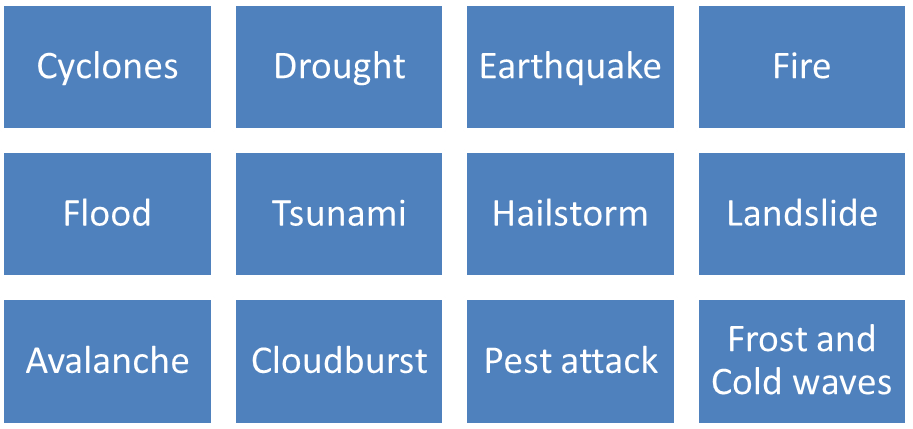
Currently, there are 12 categories of disasters which are notified under this Act, that include:
Heatwaves is not one of the disasters notified under the Disaster Management Act, 2005.
Reasons for Exclusion of heatwaves in the Act:
Previously Seen as Common – In 2005, when the DM Act was enacted, heatwaves were considered a regular summer occurrence, not a disaster.
Financial Concerns – The government would be liable to provide compensation for deaths and injuries attributed to heatwaves.
Attribution Difficulty – As heatwaves often exacerbate pre-existing conditions, pinpointing heat itself as the cause of death can be challenging.
Finance Commission's Stance – The 15th Finance Commission felt the existing list of disasters sufficiently addresses state needs.
2) Consider the following statements with respect to National Highways Infra Trust (NHIT)
It is an infrastructure investment trust (InvIT) established under the Indian Trusts Act, 1882.
It is registered under the Securities and Exchange Board of India.
Which of the above statement(s) is/are correct?
a.
b.
c.
d.
Answer : c
National Highways Infra Trust (NHIT)
The National Highway Authority of India has recently unveiled a new corporate identity with the launch of a logo of its infrastructure Investment Trust, National Highways Infra Trust (NHIT).
National Highways Infra Trust (NHIT) is an infrastructure investment trust (InvIT) established under the Indian Trusts Act, 1882.
NHIT was registered as a trust with SEBI in October 2020, to support the Government of India's National Monetization Pipeline (NMP).
It operates a diversified portfolio of fifteen toll roads with an aggregate length of approximately 1,525 kilometres, spread across 9 states.
The 9 sates include Assam, Gujarat, Karnataka, Madhya Pradesh, Maharashtra, Rajasthan, Telangana, Uttar Pradesh and West Bengal.
3) Consider the following statements with respect to Global Economic Prospects Report
Global growth is stabilizing for the first time in three years.
It is a flagship report of World Bank.
India’s economy has been buoyed by strong domestic demand, with a surge in investment, and robust services activity.
How many of the statements given above are correct?
a.
b.
c.
d.
Answer : c
Global Economic Prospects Report
The World Bank recently released its flagship Global Economic Prospects Report.
Global Economic Prospects Report is a flagship of World Bank.
Key findings for the report:
Stabilization in Growth – Global growth is projected to stabilize at 2.6% in 2024 and slightly increase to 2.7% in 2025-26, marking the first steady year in three years despite geopolitical tensions and high interest rates.
Subdued Long-term Outlook – The growth rate remains below historical standards, nearly half a percentage point lower than the 2010-19 average.
About 60% of economies, representing over 80% of global population and output, will underperform compared to the 2010s average in 2024-25.
EMDE Growth – Growth in emerging market and developing economies (EMDEs) is expected to moderate from 4.2% in 2023 to 4% in 2024 and 2025, with vulnerable economies facing significant challenges.
Moderation in Inflation – Global inflation is projected to moderate to 3.5% in 2024, but at a slower rate than previously assumed.
Cautious Monetary Policies – Central banks are likely to maintain high policy interest rates due to persistent inflationary pressures, with rates expected to remain about double the 2000-19 average.
Key findings about India:
India and Indonesia are examples of robust performance.
India’s economy has been buoyed by strong domestic demand, with a surge in investment, and robust services activity.
India is expected to see continued solid per capita growth.
In India, growth is estimated to have picked up to 8.2 percent in fiscal year (FY) 2023/24.
In India, inflation has kept within the Reserve Bank’s target range of 2 to 6% since September 2023.
4) Consider the following statements with respect to Atomic Clocks
It contains an element like caesium or calcium and a source of microwave radiation.
India uses a Cs-133 atomic clock to define the second for timekeeping within its borders.
Optical atomic clocks are even more accurate than the traditional atomic clocks.
How many of the statements given above are incorrect?
a.
b.
c.
d.
Answer : d
Atomic Clocks
The recent development of a portable optical atomic clock represents a significant advancement in timekeeping technology, especially for applications at sea.
Atomic clocks maintain precise time by using the consistent frequency of atomic transitions.
It contains an element like caesium or calcium and a source of microwave radiation.
India also uses a Cs-133 atomic clock to define the second for timekeeping within its borders.
Cs-133 is a highly stable atom and is found naturally, which is why it is so commonly used in atomic clocks.
The Traditional optical atomic clocks, while extremely accurate, are typically large, power-hungry, fragile, and expensive.
Optical atomic clocks – Are those that use strontium (Sr) or ytterbium ions, operate at even higher frequencies in the optical range, including visible, ultraviolet and infrared light.
Optical atomic clocks are even more accurate than the traditional atomic clocks.
5) Tmesipteris oblanceolate, sometimes seen in the news recently, is associated with?
a.
b.
c.
d.
Answer : a
Tmesipteris Oblanceolate
Scientists have recently found the largest known genome insideTmesipteris Oblanceolate, a small plant.
Tmesipteris oblanceolata is a small, unassuming fern found in forests on the island of Grande Terre, east of Australia.
Despite its small appearance, this fern was found to have the largest known genome on Earth, with its cells containing over 50 times more DNA than human cells.
The genome of T. oblanceolata contains around 160 billion base pairs of DNA, breaking the previous record held by the plant Paris japonica at 148 billion base pairs.
This discovery overturns the assumption that more complex organisms must have larger genomes to code for more proteins.
In reality, only a tiny fraction of large genomes actually codes for proteins.
The reasons why some species like this fern have accumulated such massive amounts of non-coding "junk" DNA over evolution are not fully understood.
Potential mechanisms include accumulation of virus-like DNA sequences through copying errors and genome duplications from hybrid mating between related species.
While very large genomes are often seen as inefficient, some hypothesize that stable environments with little competition may allow giant genomes to persist in some species.
The fern's genome may be approaching an upper limit on genome size that cells can handle, though other researchers think even larger plant genomes could potentially exist.