Daily Current Affairs Prelims Quiz 05-06-2024 (Online Prelims Test)
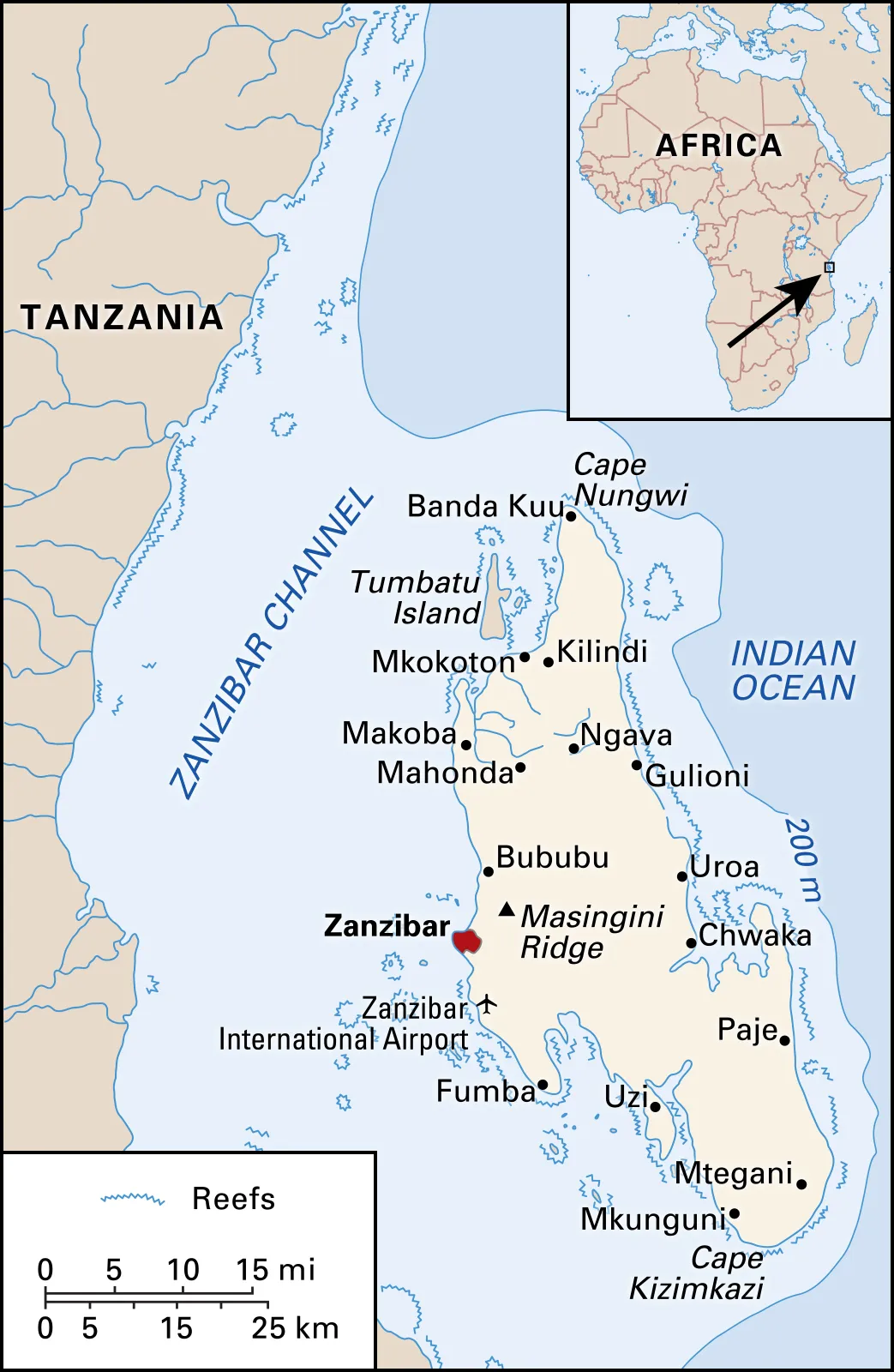
1) Zanzibar, sometimes seen in the news recently, is an archipelago in?
a.
b.
c.
d.
Answer : a
Zanzibar
India has recently extended its hand to support Zanzibar in testing and replicating India’s sustainable WASH models to combat their water crisis.
Zanzibar is an island in the Indian Ocean, lying 35 km off the coast of east-central Africa.
It is a part of United Republic of Tanzania, Africa.
Rainfall is reliable and well-distributed in comparison with most of eastern Africa.
Zanzibar is one of the driest areas in the world, and the archipelago is experiencing an acute freshwater shortage
Causes for water crisis in Zanzibar
Due to deteriorating water infrastructure and the effects of climate change.
It is estimated that 80% of water becomes wastewater and less than 1% of this wastewater is treated.
The lack of central sewage or sewerage system has led to mixing of raw sewage and storm-water streams and clogging of storm-water drainage systems due to poor disposal of solid wastes.
According to the Zanzibar Water Authority, only about 50% of the daily water demand of 200 million litres is currently being met.
Role of India in solving the water crisis – The Ministry of Health Social Welfare Elderly and Children, India with other agencies has been engaged in implementing water and sanitation facilities.
India has been developing adaptation strategies and infrastructure models aimed at making WASH services more resilient to climate risks.
India can support Zanzibar in testing and replicating our sustainable WASH models, customised to suit the country’s specific requirements and terrain.
Through its excellence in research on development themes such as WASH, India can also aid in the adoption of these models in Zanzibar by conducting studies.
This effort can be facilitated by the Indian Institute of Technology-Madras, which opened a Zanzibar campus in Tanzania in 2023.
2) Consider the following statements:
Istanbul Programme of Action set an ambitious overarching goal of enabling half the number of Least Developed Countries to meet the criteria for graduation by 2020.
India is the largest contributor to the United Nations Office for South-South Cooperation.
Buenos Aires Plan of Action (BAPA) promotes and implements technical cooperation among Developing Countries.
How many of the statements given above are correct?
a.
b.
c.
d.
Answer : c
Istanbul Programme of Action
The Istanbul Programme of Action (IPoA) charts out the international community’s vision and strategy for the sustainable development of Least Developed Countries (LCDs).
Focus – To develop the productive capacities of LCDs during the decade 2011-2020.
The IPOA set an ambitious overarching goal of enabling half the number of LDCs to meet the criteria for graduation by 2020.
South-South Cooperation (SSC)
South-South Cooperation (SSC) is a broad framework for collaboration between developing countries, also known as countries of the Global South.
SSC was integrated into the 2011 Istanbul Programme of Action to help Least Developed Countries, Landlocked Developing Countries and Small Island Developing States.
India is the largest contributor to the United Nations Office for South-South Cooperation.
Triangular cooperation
It involves Southern-driven partnerships between two or more developing countries supported by one or more developed countries or multilateral organization(s) to implement development cooperation programmes and projects.
Buenos Aires Plan of Action, 1978
Promotes and Implements Technical Co-operation among Developing Countries.
Urges all Governments, the entire United Nations Development system and the international community as a whole, to take effective action for its implementation.
3) Consider the following statements with respect to Direct Seeded Rice (DSR)
It is the process of growing rice from seeds sown in the ground as opposed to transplanting seedlings from a nursery.
Unlike puddled transplanted rice (PTR) method, DSR delivers faster planting and maturing, conserves scarce resources like water and labour.
Which of the above statement(s) is/are incorrect?
a.
b.
c.
d.
Answer : d
Direct Seeded Rice (DSR)
The Indian Council of Agricultural Research has commercialised herbicide-tolerant basmati rice varieties, claiming they can control weeds in rice crops while also promoting water-saving direct seeded rice.
Direct Seeded Rice (DSR) describes the process of growing rice from seeds sown in the ground as opposed to transplanting seedlings from a nursery.
DSR is seen to be most productive, environmentally friendly and financially feasible rice production systems used today.
Since 1950s, it has been recognised as the primary way of growing rice in countries.
Unlike puddled transplanted rice (PTR) method, DSR delivers faster planting and maturing, conserves scarce resources like water and labour.
It is more conducive to mechanization, and reduces emissions of greenhouse gases that contribute to climate change.
Mechanized DSR also creates avenues for employment through new service provisions and is less labour intensive and free from drudgery, hence more attractive to youth and women farmers.
Pusa Basmati 1121 (PB 1121) is a landmark Basmati rice variety having Basmati quality traits intro-gressed from traditional Basmati varieties.
Pusa Basmati 1509 Early maturing, reduced height, non-lodging and non-shattering variety.
It matures in 115 days which is 30 days early to Pusa Basmati 112.
It saves 33% water.
4) Consider the following statements with respect to International Air Transport Association (IATA)
The International Air Transport Association (IATA) is the trade association for the world’s airlines established in 1945.
For the very first time, India will host the International Air Transport Association's (IATA) annual global airlines summit in 2025.
Which of the above statement(s) is/are correct?
a.
b.
c.
d.
Answer : a
International Air Transport Association (IATA)
India is all set to host IATA's annual global airlines summit after 42 years.
The International Air Transport Association (IATA) is the trade association for the world’s airlines, representing some 330 airlines over 80% of total air traffic.
It supports many areas of aviation activity and help formulate industry policy on critical aviation issues.?
Vision – Working together to shape the future growth of a safe, secure and sustainable air transport industry that connects and enriches our world.
Mission – IATA represents, leads, and serves the airline industry.
Members – From 57 founding members in 1945, IATA now represents some 330 airlines in over 120 countries.
IATA membership is open to airlines operating scheduled and non-scheduled air services that maintain an IATA Operational Safety Audit (IOSA) registration.
Benefits for members:
International recognition and lobbying
Targeting key industry priorities
Driving industry change
Reducing costs
Communication campaigns
Training and other services
India will host the world’s most premier aviation event, the annual general meeting (AGM) of IATA in 2025 after a gap of 42 years.
It has returned to Delhi for the third time, having previously been held at New Delhi in 1958 and 1983.
5) Consider the following pairs:
Volcanoes Types of Volcanoes
Mount Ibu – Stratovolcano
Kilauea – Shield-volcano
Eyjafjallajokull – Lava dome
How many of the pair(s) given above is/are correctly matched?
a.
b.
c.
d.
Answer : b
Types of Volcanoes
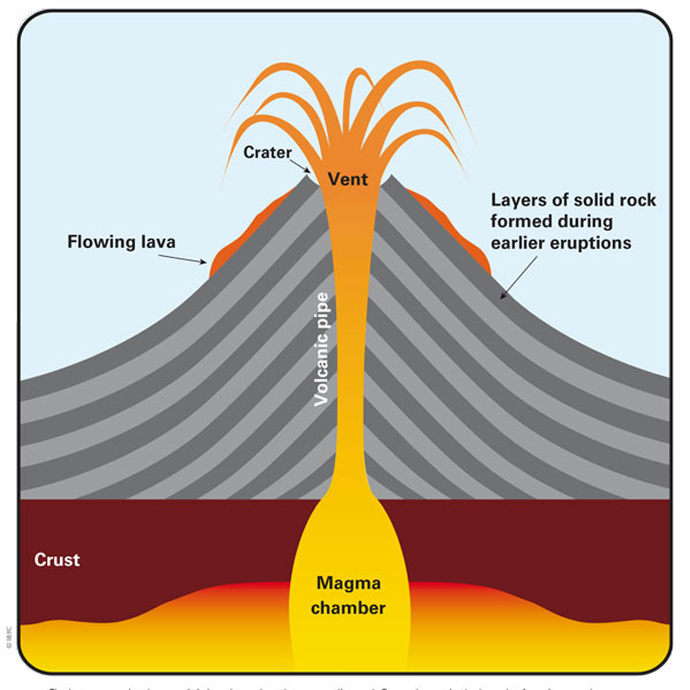
A volcano is an opening in the earth’s crust through which lava, volcanic ash, and gases escape.
Volcanic eruptions are partly driven by pressure from dissolved gas.
Beneath a volcano, liquid magma containing dissolved gases rises through cracks in the Earth’s crust.
As the magma rises, pressure decreases, allowing the gases to form bubbles.
When magma erupts at the surface as lava, it can form different types of volcano depending on:
The viscosity, or stickiness, of the magma,
The amount of gas in the magma,
The composition of the magma and
The way in which the magma reached the surface.
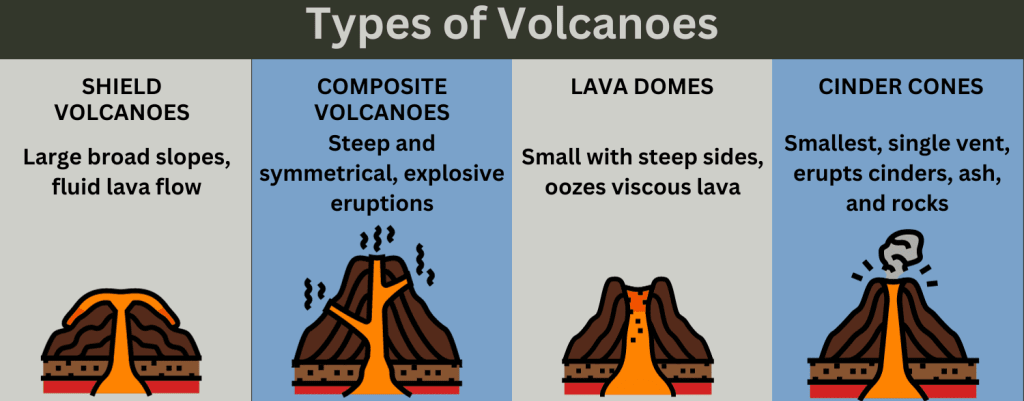
There are 2 broad types of volcano:
Stratovolcano
Shield volcano
Although there are lots of different volcanic features that can form from erupted magma (such as cinder cones or lava domes) as well processes that shape volcanoes.
Shield volcanoes – In this type, a volcano produces low viscosity, runny lava, it spreads far from the source and forms a volcano with gentle slopes.
Most shield volcanoes are formed from fluid, basaltic lava flows.
Examples – Mauna Kea, Mauna Loa and Kilauea.
Stratovolcano – Stratovolcanoes have relatively steep sides and are more cone-shaped than shield volcanoes.
They are formed from viscous, sticky lava that does not flow easily.
The lava therefore builds up around the vent forming a volcano with steep sides.
Stratovolcanoes are more likely to produce explosive eruptions due to gas building up in the viscous magma.