Why in News?
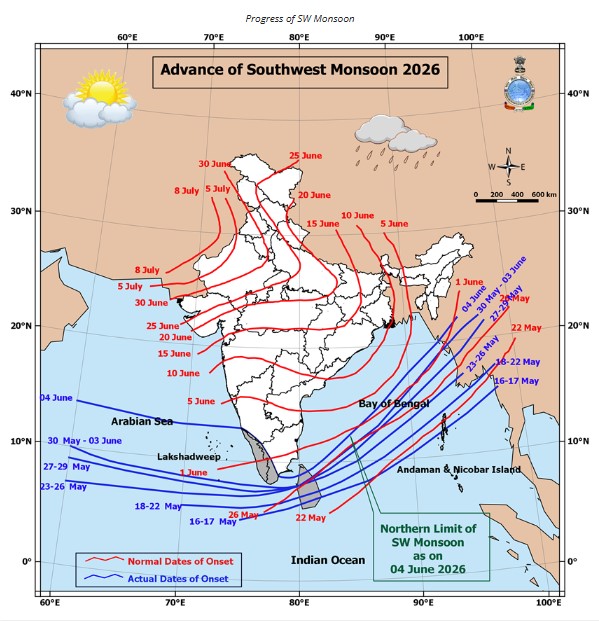
Recently, the India Meteorological Department (IMD) has confirmed the arrival of monsoon in Kerala on 4 June 2026.
Why does the southwest monsoon enter India through Kerala?
- Geographical location – Kerala lies on the southwestern tip of the Indian peninsula, directly facing the Arabian Sea.
- Moisture-laden winds originating over the Indian Ocean and Arabian Sea first encounter the Kerala coast.
- Role of the western ghats – The Western Ghats run parallel to Kerala's coastline and act as a physical barrier to the advancing monsoon winds.
- As the winds rise along the mountain slopes, they cool and condense, resulting in heavy rainfall through orographic precipitation.
- Favourable atmospheric conditions – The differential heating of land and sea during summer creates low-pressure conditions over the Indian subcontinent, drawing moisture-rich winds towards the Indian mainland through Kerala.
What is the importance of the southwest monsoon for India?
- Agricultural significance – Nearly half of India's net sown area remains dependent on rainfall.
- The monsoon provides about 75–80% of India's annual rainfall.
- It supports Kharif crops such as rice, pulses, cotton, sugarcane, maize, and oilseeds.
- Timely and adequate rainfall enhances agricultural productivity and rural incomes.
- Food security – A good monsoon ensures higher crop production and adequate food grain stocks.
- It contributes to nutritional security and reduces the risk of food shortages.
- Stable agricultural output helps maintain affordable food prices.
- Economic importance – Agriculture supports a significant proportion of India's workforce.
- Strong monsoon performance boosts rural demand, consumption, and economic growth.
- Poor monsoons can negatively affect GDP growth, inflation, and employment.
- Water resource management – Monsoon rainfall replenishes rivers, lakes, groundwater reserves, and reservoirs.
- It ensures drinking water availability for urban and rural populations.
- Adequate storage supports irrigation throughout the year.
- Energy security – Reservoirs filled by monsoon rains support hydroelectric power generation.
- Reduced rainfall can increase dependence on thermal power and fossil fuels.
What are the monsoon alerts and preparedness in Kerala?
- Orange alert – Indicates very heavy rainfall (11–20 cm in 24 hours).
- Requires preparedness for potential flooding, landslides, and disruption of normal activities.
- Yellow alert – Indicates heavy rainfall (6–11 cm in 24 hours).
- Calls for vigilance and monitoring of local conditions.
- The alert system is crucial for disaster preparedness, particularly in vulnerable districts prone to landslides and flash floods.
What is the impact of El Niño and La Niña on the Indian monsoon?
- El Niño – It is a climatic phenomenon characterised by abnormal warming of sea surface temperatures in the central and eastern Pacific Ocean.
- Effects on India – It has the following effect on Indian subcontinent:
- Weakens the southwest monsoon circulation.
- Leads to below-normal rainfall in many parts of India.
- Increases the likelihood of heatwaves and drought conditions.
- Negatively affects agricultural output and water availability.
- Contrasting role of La Niña – La Niña generally strengthens monsoon winds and is associated with above-normal rainfall over South Asia.
- Concerns for 2026 – Recent international forecasts indicate the possibility of a moderate to strong El Niño event.
- If it intensifies during the monsoon season, India may experience the foloowing:
- Deficient rainfall in several regions.
- Reduced agricultural productivity.
- Pressure on food prices.
- Greater water stress and energy challenges.
What are the challenges associated with monsoon variability?
- Agricultural instability – Irregular rainfall leads to droughts or floods, damaging crops and reducing yields. Farmers face income loss and uncertainty in planting cycles.
- Water resource uncertainty – Unpredictable monsoons affect groundwater recharge and reservoir levels. This creates water shortages for drinking, irrigation, and daily use.
- Flooding and infrastructure damage – Heavy rainfall causes floods that damage roads, homes, and transport systems. It disrupts daily life and leads to large economic losses.
- Economic impacts – Poor monsoons reduce agricultural output, affecting national income. Food prices rise, and governments spend more on relief measures.
- Health risks – Flooding increases waterborne diseases like cholera and dengue.
- Delayed monsoons can also cause heat-related health issues.
- Energy production issues – Hydropower generation depends on rainfall, so low rain reduces power supply. Excess rain can damage energy infrastructure.
- Climate change amplification – Climate Change is making monsoons more erratic.
- This leads to extreme rainfall events and longer dry periods.
- Socioeconomic inequality – Poor communities are more vulnerable due to lack of resources. They struggle more to recover from droughts and floods.
- Migration and livelihood disruption – Crop failure forces rural populations to migrate to cities.
- This increases pressure on urban areas and disrupts livelihoods.
What are the ethical dimensions involved?
- The Southwest Monsoon raises ethical concerns related to equity, sustainability, and climate justice.
- Millions of farmers, especially small and marginal cultivators, depend on monsoon rains for their livelihoods, making fair access to water and disaster relief essential.
- Erratic monsoons disproportionately affect vulnerable communities, highlighting issues of social justice and intergenerational responsibility.
- Ethical governance requires sustainable water management, climate-resilient agriculture, and inclusive policies that protect food security, livelihoods, and environmental resources while ensuring that the burdens of climate change are not unfairly borne by the poor.
What lies ahead?
- The onset of the Southwest Monsoon over Kerala is far more than a regional weather event; it serves as a critical indicator of India's agricultural, economic, and ecological well-being.
- Given the increasing uncertainties posed by climate change and phenomena such as El Niño, strengthening climate resilience, water management, and agricultural adaptation remains essential for ensuring sustainable development and food security in India.
To solve mains question click here
Reference
The Hindu| Southwest Monsoon