0.2655
7667766266
x

Daily Mains Practice Question 02-07-2026

iasparliament Logo
July 02, 2026

GS I - Geography

What is the Indian Ocean Dipole (IOD)? Discuss its phases and evaluate how the Dipole Mode Index (DMI) is used in monitoring monsoon variability. (15 marks, 250 words)


Reference: Click Here: IAS PARLIAMENT   THE HINDU   WORLD CLIMATE SERVICE


Answer

Introduction:

The Indian Ocean Dipole (IOD) is an ocean-atmosphere phenomenon defined by the difference in sea-surface temperatures between the western and eastern tropical Indian Ocean. The Indian Ocean Dipole is often called the "Indian Niño"; it influences weather and climate patterns across India, Africa, Australia, and Indonesia.

Main Body

What are the phases of IOD?
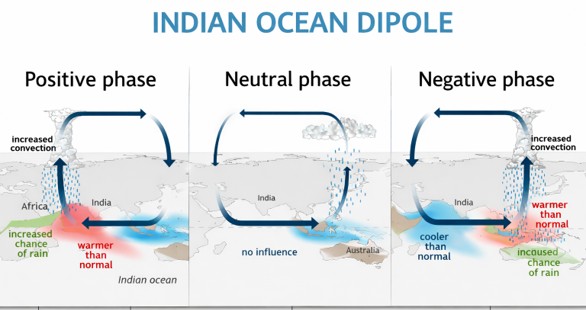
  • Positive IOD – The western Indian Ocean becomes warmer than normal & the eastern part becomes cooler. This pressure and temperature difference drives moist winds toward India, strengthening monsoon rainfall.
  • Negative IOD – The western Indian Ocean becomes cooler than normal & the eastern part warms up. This causes moist winds to move away from India, often leading to less rainfall and increased 'break' (dry) days in the monsoon.
  • Neutral IOD – Sea-surface temperatures (SST) remain close to average, with little to no contrast between the two poles. The wind and ocean circulation remain nearly normal and exert minimal influence on the Indian monsoon.

Indian Ocean Dipole

  • Current status – The Indian Ocean Dipole (IOD) is currently in a neutral phase.

What about the Dipole Mode Index (DMI) & how it is used in monitoring monsoon variability?

  • The DMI is used to measure the Indian Ocean Dipole (IOD), which calculates the difference in sea surface temperature (SST) anomalies between two specific areas in the equatorial Indian Ocean.
  • Positive DMI – The western Indian Ocean is warmer comparative to the eastern side.
  • Negative DMI – Eastern Indian Ocean is warmer comparative to the western side.
  • Neutral DMI – The difference is near-zero.

Role of DMI in monitoring Monsoon

  • Early indicator of Monsoon – It helps the forecasters to assess the strength of the southwest monsoon and seasonal rainfall risks several months in advance.
  • Tracks Rainfall Variability – Positive DMI enhances moisture transport towards India (increasing rainfall) & negative DMI shifts convection towards Indonesia (reducing rainfall to India).
  • Assesses ENSO-IOD Effects – A strong positive DMI partially neutralises the adverse effects of  El Niño, whereas a negative DMI can aggravate them.
  • Improves Monsoon Forecasting – Meteorological agencies use DMI data along with ENSO indicators and other climate indices to predict rainfall variability.
  • Supports Disaster Preparedness – The DMI-based monitoring assists in planning for droughts, floods, reservoir management, agriculture, and water resource allocation.

Limitations of DMI

  • DMI captures only SST gradients and may not fully represent atmospheric circulation changes.
  • Monsoon variability is also influenced by factors such as ENSO, monsoon depressions, and intra-seasonal oscillations; therefore, DMI should be interpreted alongside other climatic indicators.

Conclusion:

The IOD is a key driver of Indian monsoon variability, and the DMI provides a simple but effective measure for tracking its evolution. While DMI is helpful for seasonal forecasting and drought-risk assessment, its utility is maximised when combined with other climate indicators such as ENSO to understand the complex dynamics governing India's monsoon.


Login or Register to Post Comments
There are no reviews yet. Be the first one to review.

ARCHIVES

MONTH/YEARWISE - MAINSTORMING

Free UPSC Interview Guidance Programme
sidetext

