4. What is the Fujiwhara effect? Explain its impact on the movement and intensity of tropical cyclones. (150 words, 10 marks)
Direction: Intro----- impact on the movement and intensity-------Conclusion.
Introduction:
Describe the Fujiwhara effect.
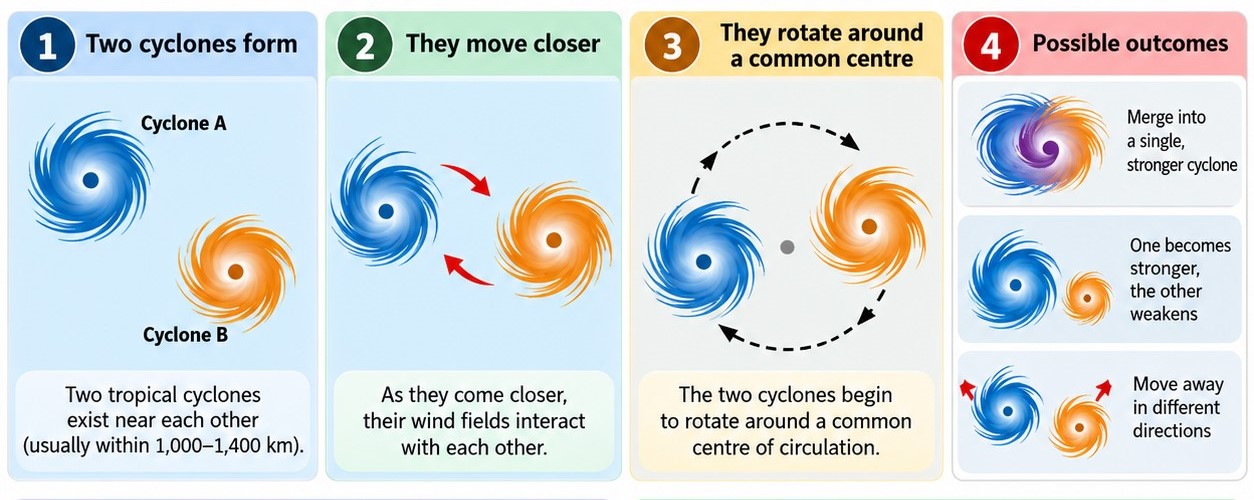
Meteorological phenomenon - two nearby tropical cyclones come relatively close to each other, interact and rotate around a common centre of circulation.
Named after Japanese meteorologist Sakuhei Fujiwhara.
Does not always strengthen cyclones - depends on the relative size, intensity and structure of the systems.
Main Body
Impact on the movement of tropical cyclones
- Change in direction – Cyclones may deviate from their original tracks - curve toward, away from, or orbit around each other.
- Cyclonic rotation around a common centre – Northern Hemisphere rotate counter-clockwise & Southern Hemisphere; the rotation is clockwise.
- Unpredictable landfall – Interaction can significantly alter the rainfall.
- Difficult to forecast – causes more damage.
Impact on intensity of tropical cyclone
- Weak interaction – Cyclones may simply alter their trajectories, affecting the direction and speed of the cyclone.
- Strong interaction – One cyclone may weaken while the other becomes dominant.
- Partial merger – Two systems can combine into a larger circulation, producing a stronger system, which may transform into a mega cyclone.
- Shear and disrupted circulation – Interaction can also weaken both systems.
Conclusion:
Give a positive conclusion.
Though the effects are more, it is a rare phenomenon – not a regular one; it occurred last in 2023.
5. Tundra regions are ecologically fragile but economically important.” Examine this statement critically. (150 words, 10 marks)
Directions: Intro----- ecologically fragile + economically important------Conclusion.
Introduction:
Define the tundra region.
Found in arctic, Antarctic and high-altitude areas with extremely low temperatures, permafrost, short growing seasons and sparse vegetation.
Main Body
Ecologically fragile
- Slow regeneration of vegetation – Low temperatures and short growing seasons.
- Permafrost vulnerability – Permafrost thaw leads to releasing stored carbon and methane.
- Specialised biodiversity – Reindeer, Arctic foxes and polar bears are highly adaptable to these harsh conditions.
- Effects of Climate change – Loss of snow and ice reduces albedo, accelerating regional warming.
- Disturbance to sensitive region – Roads, mining and oil extraction can damage vegetation and destabilise permafrost for decades.
Economically important
- Mineral and energy resources – Significant reserves of oil, natural gas and minerals such as nickel, copper and rare earth elements.
- Emerging shipping routes – Arctic maritime routes have more potential due to the decline of sea ice.
- Pastoralism and livelihoods – Indigenous communities depend on reindeer/caribou herding, hunting and fishing.
- Tourism and scientific research provide additional economic opportunities.
Critical examine
- However, economic exploitation itself can undermine the ecological foundations and the livelihood of this region.
- Therefore, development should prioritise a sustainable and inclusive approach for low-impact extraction, indigenous participation, strict environmental assessment, permafrost-sensitive infrastructure and climate-resilient planning.
Conclusion:
Give a balanced conclusion.
Tundra regions: development–conservation dilemma - economic potential must be harnessed without crossing ecological thresholds.
6. Discuss the role of aeolian processes in desertification and land degradation. (150 words, 10 marks)
Direction: Intro------Role in desertification and land degradation-----Conclusion.
Introduction:
Describe aeolian processes.
Refers to the erosion, transportation and deposition of soil and sediment by wind, particularly in arid and semi-arid regions.
Main Body
Role of aeolian processes in desertification and land degradation
- Removal of fertile topsoil reduces soil fertility and agricultural productivity
- Wind erosion and soil degradation – Repeated wind erosion causes damage to rocks and vegetation & degrade soil structure.
- Formation and movement of sand dunes
- Encroachment of sand dunes in agricultural fields, roads, settlements and grazing lands.
- Vegetation loss led damage – Overgrazing, deforestation and excessive cultivation reduce vegetation cover; exposed soil becomes more susceptible to wind erosion, accelerating desertification.
- Nutrient redistribution – Wind can transport nutrient-rich dust away from degraded areas.
- Interaction with climate change – Increasing temperatures, droughts and changing rainfall patterns intensify wind erosion – more vulnerable to degradation.
Conclusion:
Give a neutral conclusion and suggest some measures.
Aeolian process is a natural processes - combating desertification requires not only controlling wind erosion but also restoring vegetation, soil moisture and sustainable land-use practices. SDG 15.3 - Land Degradation Neutrality.


