4. Explain the factors responsible for inefficiency of agri-produce marketing. How e-commerce helps to reduce inefficiency of agri-produce marketing? Explain. (150 words, 10 marks)
Direction: Intro---- Factors responsible for inefficiency + Help of e-commerce------Conclusion.
Introduction:
Briefly discuss agri-produce marketing; mention APMC.
Main Body
Factors responsible for inefficiency of agri-produce marketing
- Structural & institutional factors – Fragmented landholdings, intermediate/middleman problem, etc.
- Infrastructure issues – Inadequate storage facilities, transportation/logistics issues, limited processing facilities, etc.
- Price-related issues – Non-legalisation of MSP, price volatility, limited access to finance, etc.
- Technological and administrative constraints.
Role of E-commerce in reducing inefficiency
- No intermediaries – Direct market access to farmers.
- Transparent and real-time pricing
- Better supply chain management
- Quality assurance and traceability
- Faster payments and financial inclusion.
- Some digital initiatives such as e-NAM, ONDC, etc.
Conclusion:
Give a positive and balanced conclusion.
5. Explain by giving two examples, how biotechnology has helped the Indian farmers in processing their perishable crops. (150 words, 10 marks)
Direction: Intro----Examples + its help to farmers------Conclusion.
Introduction:
Starts with the use, impact or presence of biotechnology in Indian agriculture.
Main Body
Two examples
- Biotechnology for delayed ripening of fruits – Flavr Savr tomato
- Genetic engineering suppresses the enzyme polygalacturonase, which breaks down pectin in cell walls, delaying softening and helping maintain firmness for longer, which provides more time for transportation and marketing.
- Other technology – Ethylene regulation - Ethylene is a plant hormone responsible for ripening many fruits – the research targets ethylene production or perception to delay ripening.
- Biotechnology for increasing shelf life – Non-browning fruits
- Gene-silencing technology can reduce the activity of polyphenol oxidase (PPO), which slows enzymatic browning in cut fruits such as apples, which improves appearance and marketability of fresh-cut products.
- Example: Arctic apples, developed using RNA interference technology.
- Other technology – Biopreservation using beneficial microorganisms – Selected beneficial microbes or their antimicrobial products can inhibit spoilage organisms.
How has biotechnology helped Indian farmers in processing?
- Delayed-ripening tomatoes help maintain firmness during transportation and storage, reducing spoilage
- Potential to reduce post-harvest losses.
- Create opportunities for value addition.
- Increases income for farmers.
- Provide longer-lasting marketable products and reduce dependence on immediate fresh sales.
Conclusion:
Give a balanced conclusion.
Biotechnology can reduce post-harvest losses and improve farmers’ returns by extending shelf life and enabling value addition.
6. Distinguish between a Fast Breeder Reactor (FBR) and a thermal nuclear reactor. In the context of first indigenously developed prototype FBR at Kalpakkam, explain the term 'criticality'. What are its implications for clean energy future of our country? (150 words, 10 marks)
Direction: Intro----- Distinguish between an FBR & a thermal nuclear reactor + Criticality + Implications----Conclusion.
Introduction:
Start with nuclear energy in India- its status, capacity, etc.
Main Body
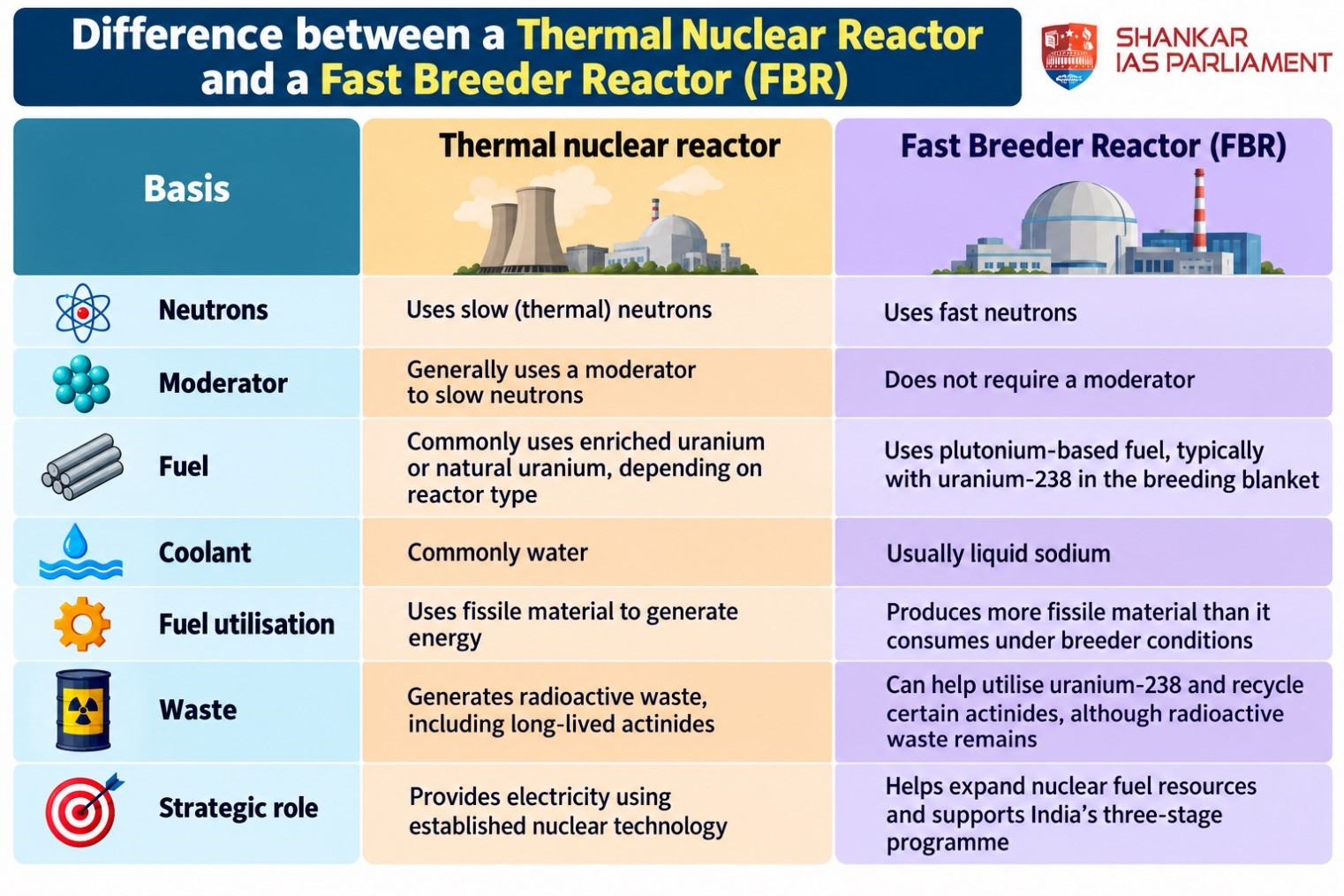
Distinguish between a Fast Breeder Reactor (FBR) and a thermal nuclear reactor.
Criticality
- Criticality – It is the state in which a nuclear reactor sustains a controlled, self-sustaining nuclear fission chain reaction.
- It marks a major milestone in reactor commissioning but does not necessarily mean that the reactor has started supplying electricity commercially.
- India’s indigenously developed 500 MWe Prototype Fast Breeder Reactor (PFBR) at Kalpakkam, Tamil Nadu, attained first criticality on 6 April 2026, marking a major step in the country’s nuclear energy programme.
Implications for India’s clean energy future
- Strengthen India’s energy security
- Advances the three-stage nuclear programme
- Supports decarbonization
- Promotes indigenous technology.
Conclusion:
Give a balanced conclusion.


