1. What do you mean by the Digital Rupee? In this context, explain the working and progress of India's Central Bank Digital Currency (CBDC). (150 words, 10 marks)
Direction: Intro----Working & Progress------Conclusion.
Introduction:
Define the digital rupee.
A digital form of the Indian rupee that constitutes legal tender, equivalent in value to physical currency, issued by the RBI.
Main Body
Working of CBDC
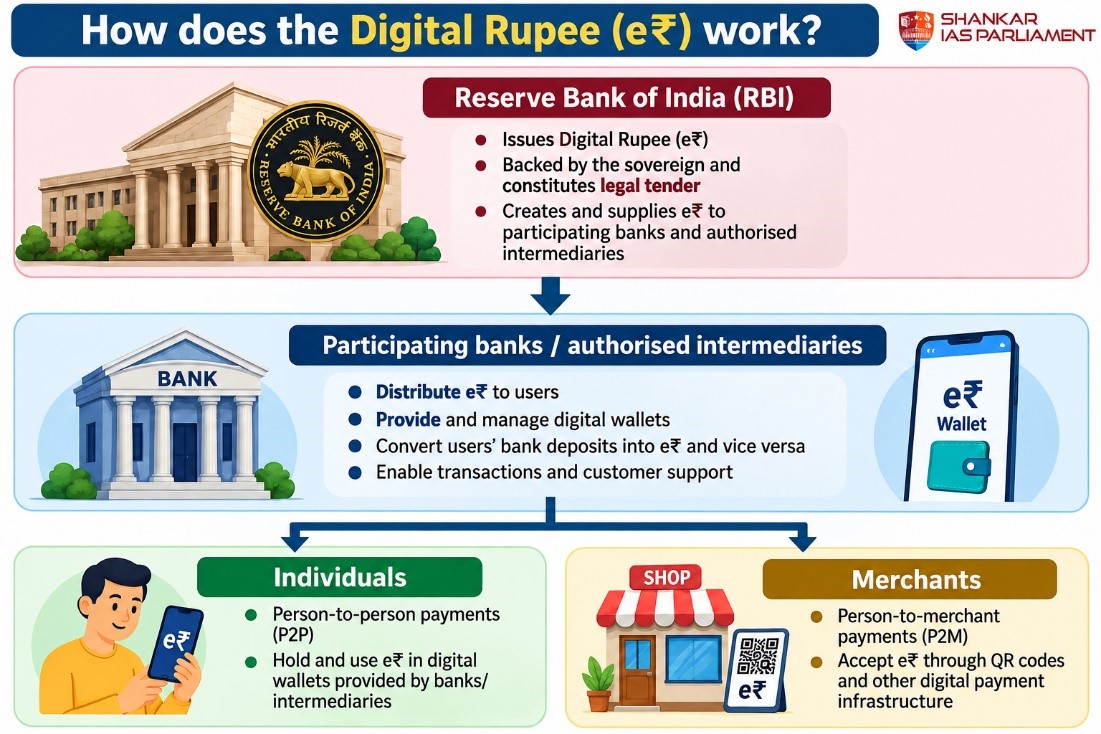
Progress so far
- Legal Foundation (March 2022) – Legal amendments enabled the Digital Rupee’s recognition as legal tender.
- Wholesale Pilot (Nov 2022) (e₹-W) – launched for government securities settlement.
- Retail Pilot (Dec 2022) (e₹-R) – launched for P2P and merchant payments.
- Expansion (2023–24) – Pilot expanded across banks; interoperability with UPI QR codes introduced.
- Innovation (2024–25) – Experiments expanded to programmability, offline payments and non-bank distribution.
- Broader Use Cases, 2026 – As of October 1, 19 banks offer retail CBDC wallets; the wholesale pilot has 16 participants and covers government securities, call money and tokenised financial instruments.
Conclusion:
Give a positive conclusion.
India’s Digital Rupee represents an important step in the evolution of sovereign money in the digital economy.
2. Examine the view that financial inclusion is an integral part of social and economic inclusion in a country like India. Also throw light on the usefulness of the R.B.I.'s Financial Inclusion Index. (150 words, 10 marks)
Direction: Intro----How it promotes social and economic inclusion + usefulness of the R.B.I.'s Financial Inclusion Index-------Conclusion.
Introduction:
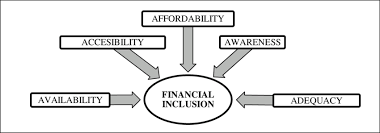
Describe financial inclusion.
Main Body
How does financial inclusion promote social and economic inclusion?
- Empowerment of vulnerable groups
- Poverty alleviation and resource distribution
- Human development access
- Efficient service and welfare delivery
- Affordable credit for the needy
- Employment generation.
Usefulness of the RBI’s FI-Index
- Comprehensive parameters – Access (35%), Usage (45%), and Quality (20%).
- Measure progress in financial inclusion – financial literacy, consumer protection, etc.
- Guides policymakers and regulators for evidence-based policymaking
- Identifying specific gaps
- Strengthen accountability.
Conclusion:
Give a balanced conclusion.
Financial inclusion is a means of achieving social justice and inclusive economic growth, rather than merely expanding bank accounts.
3. Describe the various Technology Missions initiated in Indian agriculture and examine their role in food security. (150 words, 10 marks)
Direction: Intro---- Various Technology Missions + Role in food security-------Conclusion.
Introduction:
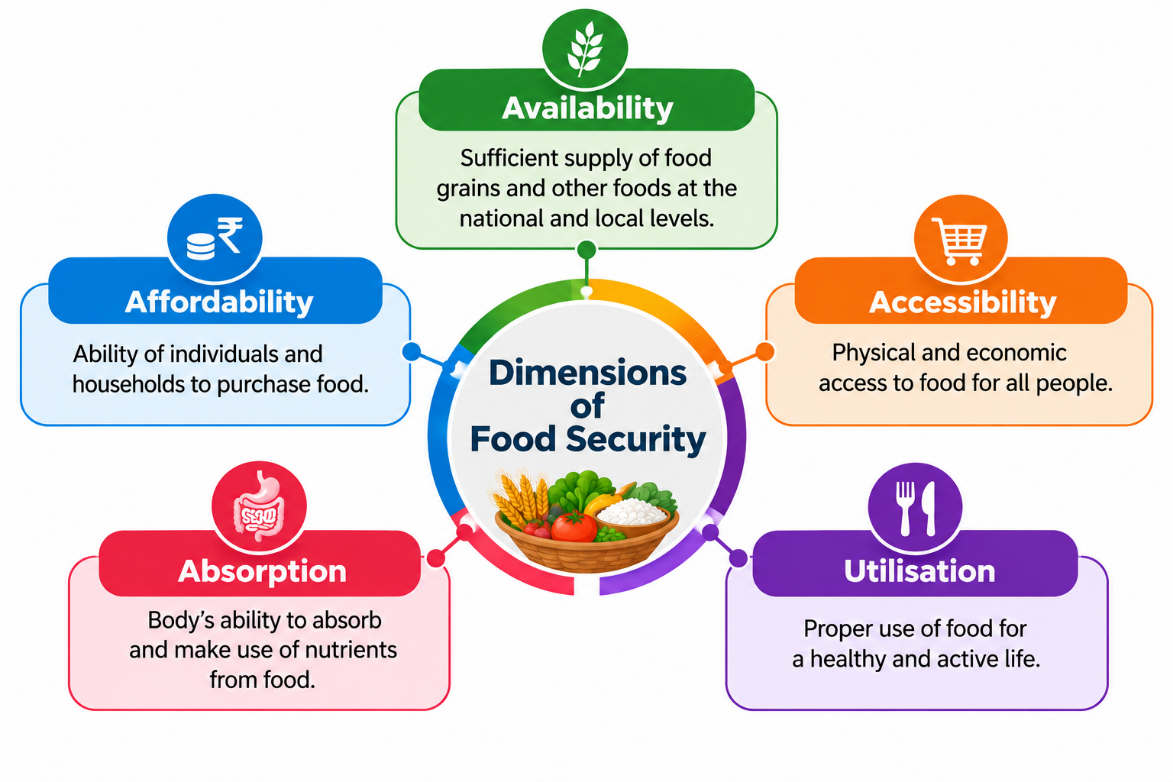
Mention the status of agriculture in India with some data.
Main Body
Various Technology Missions
- Technology Mission on Oilseeds (1986) – Introduced improved seeds, modern cultivation practices and better processing to increase domestic oilseed production and reduce import dependence.
- Technology Mission on Pulses – Promoted high-yielding varieties, improved agronomic practices and integrated pest management to raise pulse productivity and availability.
- National Mission on Sustainable Agriculture (2014–15) – Promoted climate-resilient agriculture, soil health management, efficient water use and sustainable farming practices.
- National Mission on Edible Oils – Oil Palm (2021) – Expanded oil-palm cultivation to strengthen domestic edible-oil production and reduce import dependence.
- Digital Agriculture Mission (2024) – Promotes digital public infrastructure, including AgriStack and farmer-centric digital services, to improve access to information, services and agricultural support.
Role of the technology mission in food security
- Increase agricultural productivity
- Reduced import dependence
- Improved nutritional security
- Climate resilience and resource efficiency
- Reduced post-harvest losses
- Improved farmer income.
Conclusion:
Give a balanced conclusion and suggest some measures.


