Prelims: Current events of National and International Importance | Science and Technology
Why is in news?
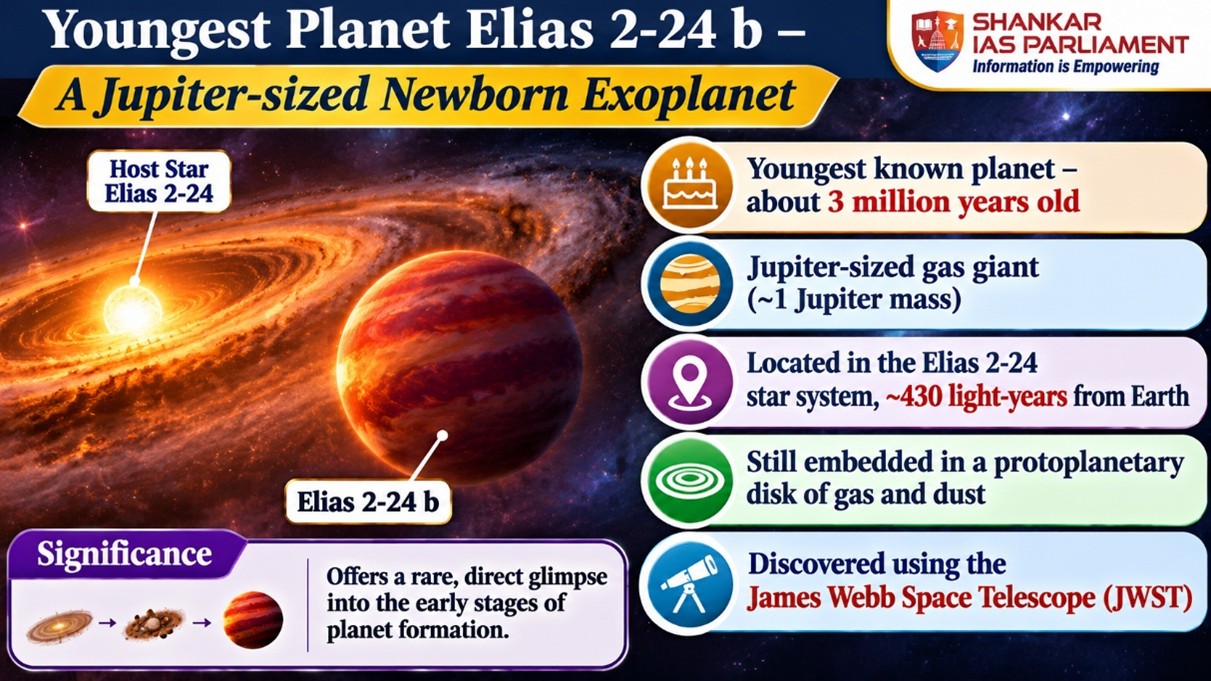
Astronomers confirmed Elias 2-24 b as the youngest known exoplanet detected so far. The Jupiter-mass planet is less than one million years old and is still embedded in, and gathering material from, the gas-and-dust disk around its young host star.
About Elias 2-24 b
- It is an exoplanet orbiting the young star Elias 2-24, located approximately 450 light-years from Earth.
- It has a mass comparable to Jupiter and is still in the process of formation.
- It is located in a gap in the protoplanetary disk, approximately 55 times the Earth–Sun distance from its host star.
- The planet is actively accreting material from the surrounding disk, offering a rare opportunity to observe a giant planet while it is still growing.
- It is less than one million years old, substantially younger than previous record-holders, which were more than five million years old.
How was it detected?
- Researchers led by Andrea Bernardi reanalyzed archival observations from the W. M. Keck Observatory in Hawaii.
- The team combined observations from 2018 and 2020 to track the faint source and establish that its motion was consistent with a planet rather than a background star or imaging artefact.
- A coronagraph blocks the bright light of the host star, making it easier to detect faint objects nearby.
- The confirmation drew on observations and evidence from the Keck Observatory, the Atacama Large Millimeter/submillimeter Array (ALMA) and the European Southern Observatory’s Very Large Telescope (VLT).
- The discovery was reported in The Astrophysical Journal Letters in September 2026.
Protoplanetary disk
- A protoplanetary disk is a rotating disk of gas and dust surrounding a young star, from which planets form.
- Collisions and accumulation of dust, ice and rocky material can lead to the formation of planetesimals and eventually planets.
- Observations by ALMA have revealed rings and gaps in such disks; emerging planets can gravitationally clear gaps as they orbit.
- Elias 2-24 b provides direct evidence linking a planet to a gap in a young star’s disk.
Significance of the discovery
- It offers a rare observational window into the earliest stages of giant-planet formation.
- It supports the core accretion model, in which a solid core grows by accumulating material and subsequently attracts gas.
- Its young age and large orbital distance challenge existing models, which struggle to explain how a Jupiter-mass planet could form so early and so far from its star.
- Studying the system may help scientists refine models of planetary evolution and understand the early history of our own Solar System.
Key terms
- Exoplanet: A planet orbiting a star beyond the Solar System.
- Coronagraph: An instrument that blocks light from a bright source, such as a star, to reveal faint nearby objects.
- Accretion: Growth through the accumulation of surrounding gas, dust or other material.
- Light-year: The distance light travels in one year; a unit of astronomical distance.
- ALMA: Atacama Large Millimeter/submillimeter Array, a radio telescope facility in Chile.
Prelims watch-outs
- Elias 2-24 b is an exoplanet, not a planet in our Solar System.
- It is approximately Jupiter-mass, less than one million years old and about 450 light-years away.
- The host star’s protoplanetary disk and its gap are central to the discovery; the coronagraph helped separate the faint planet signal from stellar glare.
Reference
AIR | Youngest exoplanet Elias 2-24 b



