India’s Push for Better Livelihoods
India is shifting its focus from increasing women’s workforce participation to improving the quality of their employment through entrepreneurship, credit, market access, skilling, social security and safer workplaces.
Rising Women’s Workforce Participation
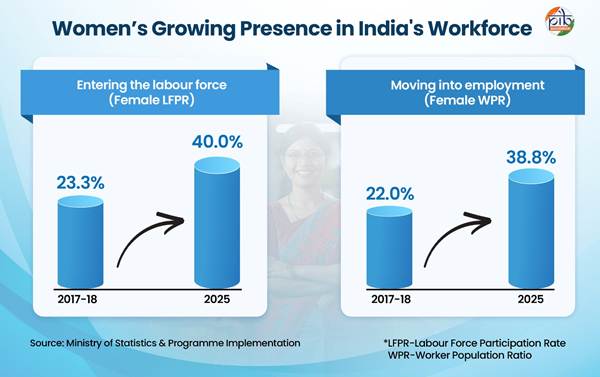
- Labour Force Participation Rate (LFPR): Increased from 23.3% in 2017–18 to 40% in 2025.
- Worker Population Ratio (WPR): Increased from 22% to 38.8% during the same period.
- An estimated 20 crore women aged 15 years and above were employed in 2025.
- LFPR measures the share of the population working or seeking/available for work, while WPR measures the proportion actually employed.
Women’s Growing Economic Participation
Entrepreneurship and Enterprise
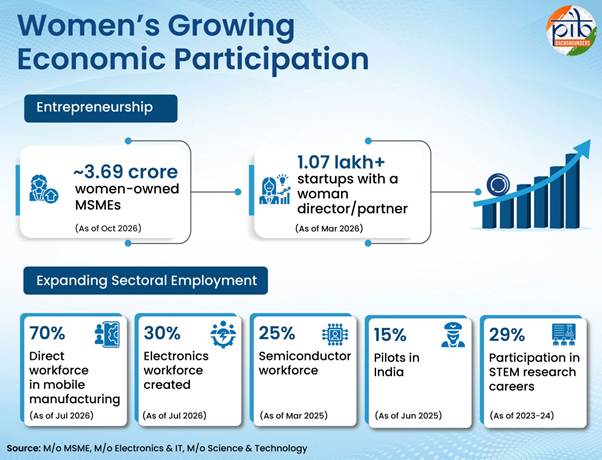
- Women-owned MSMEs: Approximately 3.69 crore registered MSMEs were women-owned as of October 2026, accounting for nearly 38% of registrations.
- Startups: Over 1.07 lakh recognised startups had at least one woman director or partner by March 2026, representing around 48% of recognised startups.
Participation in Emerging Sectors
- Electronics: Women constitute nearly 70% of the direct workforce in mobile phone manufacturing and around 30% of the workforce created in the wider electronics manufacturing sector over the last decade.
- Semiconductors: Women account for approximately 25% of the workforce and nearly one-fourth of India’s chip design and engineering workforce.
- Civil aviation: Women constitute 15% of pilots, 15% of air traffic controllers, 11% of flight dispatchers and 33% of DGCA Flight Operations Inspectors.
- STEM research: Women’s participation in research careers increased from 13% in 2000–01 to 29% in 2023–24.
Government Initiatives for Women-Led Enterprises
A. Formalisation
Formal recognition improves women entrepreneurs’ access to credit, government schemes, skills and business development services.
- Swavalambini Scheme (2025): Supports aspiring women entrepreneurs through entrepreneurship training, financial and market guidance, legal support and 21 weeks of mentorship.
- Yashasvini Campaign (2024): Promotes women’s entrepreneurship, aiming for gender parity on the Udyam Registration Portal and Udyam Assist Platform by 2029.
- It facilitated over 22 lakh women-owned MSME registrations by July 2026.
- Women-owned MSEs accounted for 3.8% of public procurement in FY 2025–26, exceeding the mandated 3% target.
B. Access to Credit
- Pradhan Mantri MUDRA Yojana (PMMY): Provides collateral-free loans up to ₹20 lakh.
- Women accounted for two-thirds of the 57.79 crore loans sanctioned since its launch in 2015, as of April 2026.
- Credit Guarantee Scheme for MSEs: Offers 90% guarantee coverage and a 10% concession on guarantee fees for women-led MSEs.
- It approved approximately 30.75 lakh guarantees worth ₹2.07 lakh crore for women-owned MSEs by February 2026.
- Prime Minister’s Employment Generation Programme (PMEGP): Provides subsidies of 25% in urban areas and 35% in rural areas for eligible women entrepreneurs.
- Women accounted for nearly 40% of assisted micro-enterprises by May 2026.
- Startup India: Funding support includes the Fund of Funds for Startups, Startup India Seed Fund Scheme and Credit Guarantee Scheme for Startups, which support investment, seed funding and credit access for women-led startups.
C. Market Access
- Womaniya Initiative (GeM): Connects women-owned MSEs and self-help groups with government buyers.
- By July 2026, over 2.17 lakh women-owned MSEs were registered.
- Contracts worth over ₹28,000 crore were awarded to women MSEs in FY 2025–26.
- Procurement and Marketing Support Scheme: Supports participation in trade fairs and exhibitions, offering women-owned MSEs a 100% subsidy on built-up space rent.
- TEAM Initiative: Promotes digital marketing and market access through the Open Network for Digital Commerce (ONDC).
- Around 1,700 women-owned MSEs were registered by FY 2025–26.
Skilling Women for Emerging Sectors
- PMKVY 4.0: Supports training in AI, semiconductors and renewable energy.
- National Apprenticeship Promotion Scheme (NAPS): Provides paid on-the-job training and stipend assistance.
- Craftsman Training Scheme (CTS): Develops vocational and technical skills through Industrial Training Institutes.
- NAVYA (2025): Targets skilling 3,850 adolescent girls in non-traditional and future-oriented occupations; 1,105 had been trained by August 2026.
- AI Careers for Women: Plans 30 Centres of Excellence in women’s colleges and aims to train 20,000 learners in AI.
- WISE-KIRAN: Supports women’s participation in science and technology through research fellowships, career re-entry, institutional programmes and STEM initiatives.
Labour Reforms for Safer Workplaces
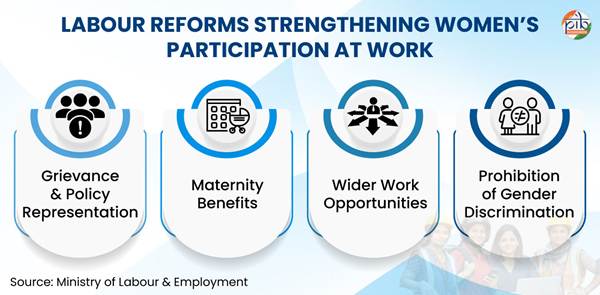
The four Labour Codes, consolidating 29 existing labour laws, strengthen women’s workplace rights through:
- Maternity benefits: Up to 26 weeks of paid maternity leave for eligible women, along with nursing breaks, medical bonuses and crèche facilities in establishments with at least 50 workers.
- Equal opportunity: Prohibition of gender discrimination in recruitment, wages and employment conditions.
- Wider employment: Women may work in all establishments, including night shifts, subject to consent and prescribed safeguards.
- Representation: Women’s representation in Grievance Redressal Committees must reflect their workforce share, while Central and State Advisory Boards must include at least one-third women.
Conclusion
- India’s women-led development strategy seeks to move beyond workforce participation towards quality employment, financial independence and sustainable livelihoods.
- Strengthening access to skills, finance, markets, formalisation and safe workplaces is essential to expanding women’s economic contribution and achieving the vision of Viksit Bharat.
Reference
PIB



