Why in news?
With the fertility rate falling below replacement, challenges of higher dependency, burgeoning healthcare and social security needs will emerge and India must mount the necessary policy-response.
What did the NFHS-5 say?
- NFHS-5 places the total fertility rate (TFR) at 2.0. known as replacement level of fertility.
- 29 states and UTs have a TFR of 1.9 or less.
- Since NFHS-5 was largely collected before the nation felt the heat of Covid-19, the ongoing shock and uncertainty caused by the pandemic will likely drive down birth rates even further.
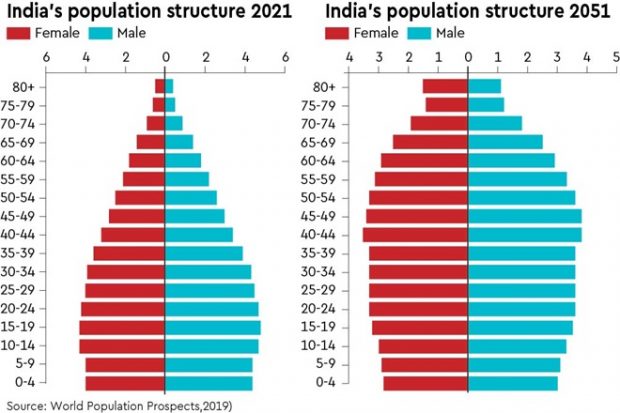
What are the implications of the demographic transition?
- The coming demographic transition has profound implications for India’s health, fiscal and gender policies.
- Health challenges- Drawing on the 2000 Population Policy, India’s health policies and programmes have focused on family planning, maternal and child health and communicable diseases.
- India’s focus is now slowly moving from under-nutrition to the rising problem of obesity in the general population.
- But new health challenges are emerging due to increased number of older adults. This includes
- Increase in number of non-communicable diseases- According to WHO, nearly 60% of deaths in the country can be attributed to non-communicable diseases
- Morbidities like diabetes, cardiovascular diseases and cancer
- Risk of food and nutrition insecurity- 6% of Indians over the age of 45 have experienced insufficient food in the household
- Increasing medical costs
- Difficult-to-afford health insurance - Less than 1% of older adults have health insurance
- Transportation constraints
- Inaccessibility of specialised services
- Added fiscal costs- The decreasing fertility rate will also pose a fiscal challenge in the form of an increasing dependency ratio.
- The dependency ratio in India moved from 5.4 in 1960 to 9.8 in 2020 and will increase to more than 20.3 in 2050.
- As the younger population declines, resource investment in the youth will shrink.
- Demand for work within the older adult population will grow and may result in delayed retirement, leading to a “job squeeze” in which the young and old alike compete for a limited number of jobs.
- A new gender issue- As the older portion of the population grow, the number of older adult women will be greater than the number of men.
- In three decades, it is expected that the life expectancy of women, at 65 years, will be two years more than that of men.
- Due to the difference in life expectancy, more women will live as widows in the later stages of their lives with their social and economic security at risk.
- As the average years spent in school among women aged 40-45 is not very encouraging, there will be many older women who are less empowered and vulnerable to social insecurity.
What can be done to smoothen the concerns of demographic transition?
- Policy goals- India needs to move simultaneously towards two goals
- Investing in today’s youth to build a healthy and empowered population in long run
- Creating a more protected platform to provide immediate benefits for older adults.
- By doing so, India can achieve healthy ageing and flatten the curve where disease, disability and disempowerment accumulate with age.
- Investment on youth- India must invest more on youth to help them secure good employment and incomes.
- Health- Targeted behaviour-change communication for healthy life practices will enable the youth to grow healthier.
- Education- Strengthening the education system to make it globally-competitive is the first step towards increasing the market value of the youth.
- Skill development- Flagship skill-growing schemes like Pradhan Mantri Kaushal Vikas Yojana and Deen Dayal Upadhyaya Grameen Kausalya Yojana should be allocated greater funds and shift their focus to the youth.
- Policy changes- Shifting policies toward older adults will create a sustainable older-adult-friendly society in future. This includes
- Making specialised health services available at the primary care level,
- Improving the older-adult-friendly transportation system
- Replicating the model of ASHA workers
- Creating a cadre of health outreach workers trained in first-line care of geriatrics (medical care for older adults)
- Social security- India must increase its old age pension share, which is currently 1% of the GDP.
- Senior workforce participation can be an added advantage when older adults bring their experience and wisdom to the workplace to optimise youth energy.
Reference
- https://www.financialexpress.com/opinion/with-birth-rate-in-decline-india-must-change/2420133/



