0.2706
7667766266
x

White-rumped Vulture

iasparliament Logo
February 28, 2026

Prelims: Current events of national and international importance | Conservation

Why in News?

Recently, experts have reported stable vulture numbers in Wayanad despite reduced breeding, with invasive plants and human activity affecting nesting areas.
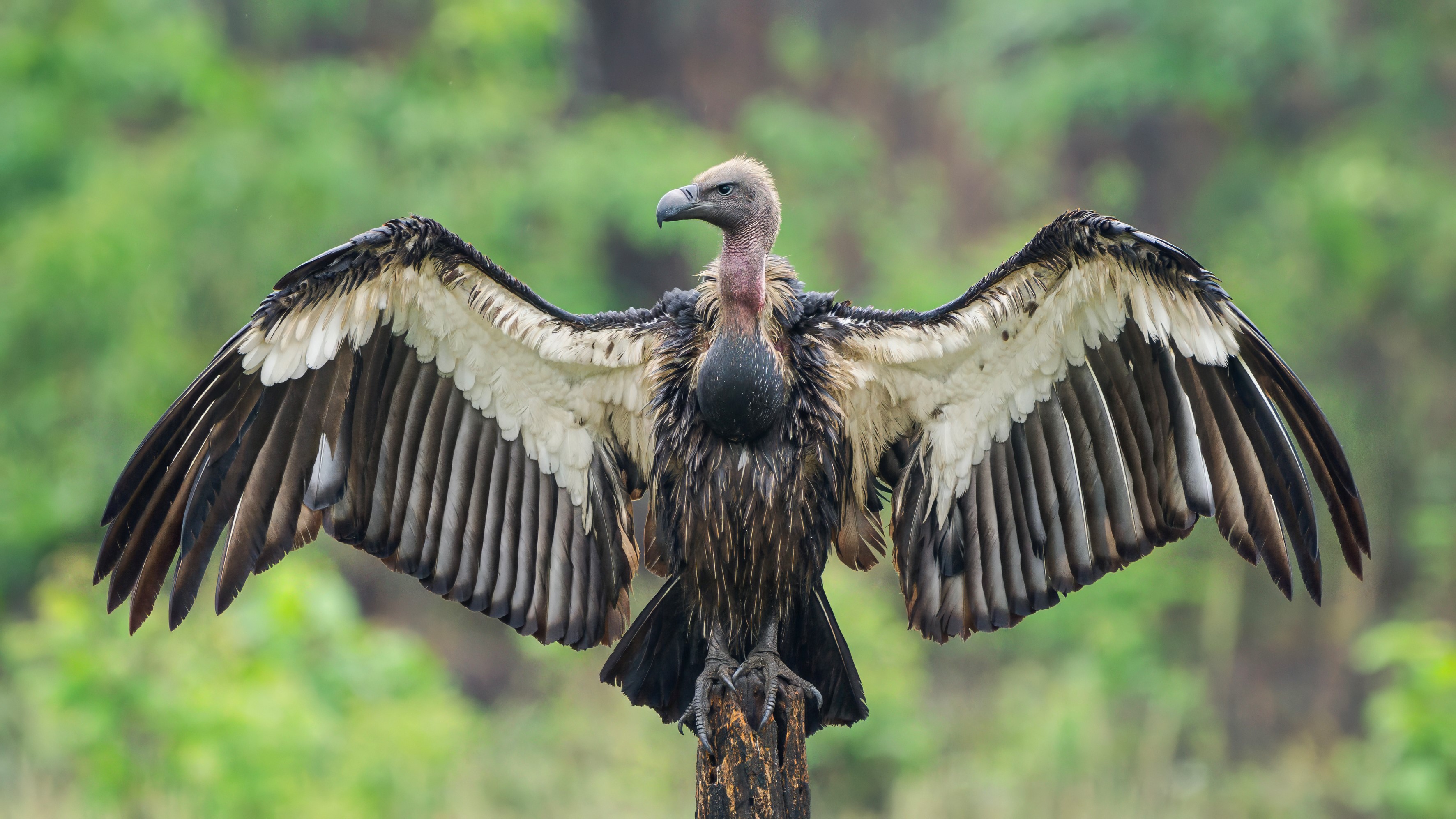
  • Scientific Name – Gyps bengalensis.
  • Family – Accipitridae.
  • Habitat – Mostly plains with open areas, light woodland, villages and cities. Occasionally found in hilly regions.
  • Distribution – Native to India, Nepal, Bangladesh, Bhutan, Pakistan, Myanmar, and Cambodia.
  • Extinction - Possibly extinct in Afghanistan, Iran, Laos, Thailand, and Vietnam. Extinct in China and Malaysia
  • Key Identification – Size – Medium-sized vulture (75–85 cm).
  • Adult Mostly black body feathers with a white ring of feathers around the neck (neck-ruff) and white feathers on the lower back (rump).
  • Wings have silvery feathers, the head and neck are dark, and the bill is short, thick, and silver-colored.
  • Juvenile Brown body feathers with white streaks on wing and back feathers and soft down on the head and neck.

White-rumped-vulture

  • Behaviour – Aggregates at carcasses and uses regular feeding sites. Highly social, forms large flocks and communal roosts (gathers together to rest or sleep).
  • Breeding Breeds in colonies in tall trees, often near human habitation.
  • Diet – Obligate scavenger feeding on fresh and decaying carcasses (dead animals).
  • Conservation Status –
    • IUCN – Critically Endangered.
    • Wildlife Protection Act, 1972 – Schedule I
  • Threats –Rapid population decline due to Non-Steroidal Anti-Inflammatory Drugs (NSAIDs) such as diclofenac, aceclofenac, and ketoprofen used in livestock, causes kidney failure and visceral gout in vultures.
  • Other threats Habitat loss, deforestation, poisoning, electrocution, collisions, and reduced food availability from changes in livestock management.

Vultures of India

  • There are 9 species of vultures, five of which belong to the genus Gyps, and the remaining four are monotypic.
  • Oriental White-backed Vulture – G.bengalensis
  • The Long-billed Vulture – G.indicus
  • Slender-billed Vulture – G.tenuirostris
  • The Himalayan Vulture – G.himalayensis
  • The Eurasian Griffon – G.fulvus
  • Egyptian Vulture – Neophron percnopterus
  • Red-headed Vulture – Sarcogyps calvus
  • Cinereous Vulture – Aegypius monachus
  • Bearded Vulture (Lammergeier) – Gypaetus barbatus

References

  1. TH | White-rumped Vulture
  2. IUCN | White-rumped Vulture
Login or Register to Post Comments
There are no reviews yet. Be the first one to review.

ARCHIVES

MONTH/YEARWISE ARCHIVES

sidetext
Free UPSC Interview Guidance Programme
sidetext


