Why in news?
The government has set up the new bad bank structure (NARCL-IDRCL) to acquire stressed assets from banks and then sell them in the market
What are bad banks?
- Technically, a bad bank is an asset reconstruction company (ARC) or an asset management company that takes over the bad loans of commercial banks, manages them and finally recovers the money over a period of time.
- The bad bank is not involved in lending and taking deposits.
- It just helps commercial banks clean up their balance sheets and resolve bad loans.
- The takeover of bad loans is normally below the book value of the loan and the bad bank tries to recover as much as possible subsequently.
- US-based Mellon Bank created the first bad bank in 1988.
What is the recent new bad bank structure about?
- India’s first-ever bad bank, National Asset Reconstruction Company Limited (NARCL) will acquire stressed assets worth about Rs 2 lakh crore from various commercial banks
- It will pay 15% of the agreed price in cash and the remaining 85% will be in the form of Security Receipts.
- The rest will be paid when the assets are sold by IDRCL
- The other entity, India Debt Resolution Company Ltd (IDRCL), will then try to sell the stressed assets in the market
- To make it work, the government has granted the use of Rs 30,600 crore to be used as a guarantee.
- If the bad bank is unable to sell the bad loan, or has to sell it at a loss, then this government guarantee of RS.30,600 crore will be invoked.
What is the need for bad banks?
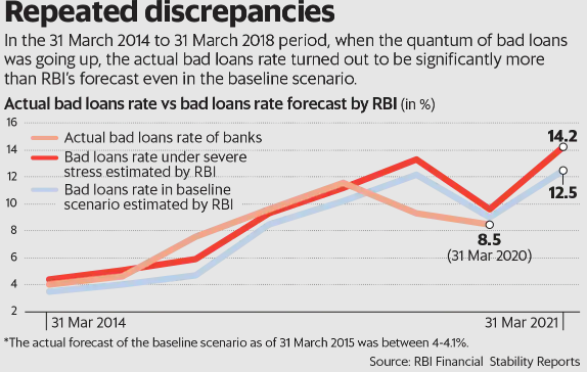
- According to RBI’s Financial Stability Report, the gross non-performing assets (GNPA) ratio of banks may rise to 9.8 per cent by March 2022 from the 7.48 per cent in March 2021
- Within the bank groups, public sector banks' (PSBs') GNPA ratio is 9.54 per cent in March 2021
- To improve the financial health of PSBs, the government was forced to recapitalise them using taxpayers’ money
- So bad banks are needed to relieve the commercial banks of their stressed assets.
- It also improves the bank’s position and help them resume their normal banking operations, especially lending.
Source: The Indian Express



