What is the issue?
National Family Health Survey 2019-21 (NFHS-5) has recorded a decline in the total fertility rate and public health experts are taking a moment to let this sink in, as it indicates the population is stabilising.
What has the NFHS-5 said about TFR?
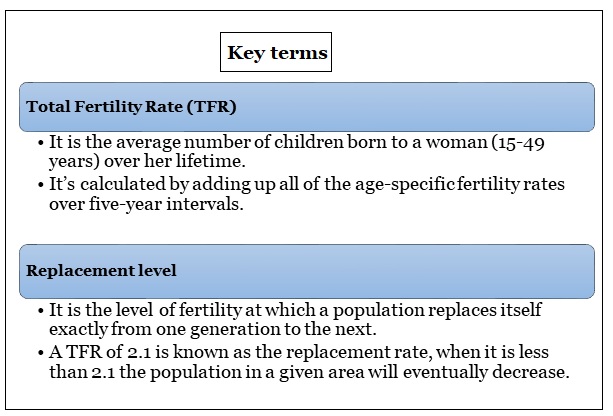
- The total fertility rate (TFR) in a specific year is defined as the total number of children that would be born to each woman if she were to live to the end of her child-bearing years and give birth to children in alignment with the prevailing age-specific fertility rates.
- It is calculated by totalling the age-specific fertility rates as defined over five-year intervals.
- As per the NFHS-5, the TFR has declined from 2.2 in 2015-16 to 2.0 in the latest one.
- The TFR was 1.6 in an urban population and 2.1 in a rural setting.
- The latest NFHS done in two phases provides information on population, health, and nutrition across India, down to the state and union territories.
- According to reports, five states with TFR above 2 were Bihar, Meghalaya, Uttar Pradesh, Jharkhand and Manipur.
- States like Kerala and Tamil Nadu has a TFR at 1.8.
- The state with lowest TFR in this survey is West Bengal which is at 1.6.
What has made this demographic transition possible?
- Better contraception initiatives
- Government health and family welfare schemes
- Education of the girl child
- Increase in institutional births
- Overall improvement in health and nutrition
Does this mean that India will not overtake China to become the most populous nation globally?
- It depends on too many variables to make that prediction, including how China handles its declining population.
- India has achieved the critical step of stabilising growth by pegging the replacement level fertility at 2.1.
- But experts believe that India may still be on the path to becoming the most populous nation.
Replacement level fertility is defined as the level at which the decline on a sustained basis would result in a generation replacing itself.
What policy changes should the government make to adjust to this reality?
- The government should focus on more of educating the girl child as the family’s overall well-being improves with education.
- Education gives young people, especially girls, a greater sense of awareness and well-being that prevents early marriages and pregnancies which is critical in checking the population.
- Alongside, family planning and reproductive health awareness need to be imparted to adults, and they need to be encouraged to adopt these measures.
Reference
- https://www.thehindubusinessline.com/blexplainer/what-the-fertility-rate-decline-means-for-india/article3799606ece



