Mains: GSIII – Science and Technology
Why in News?
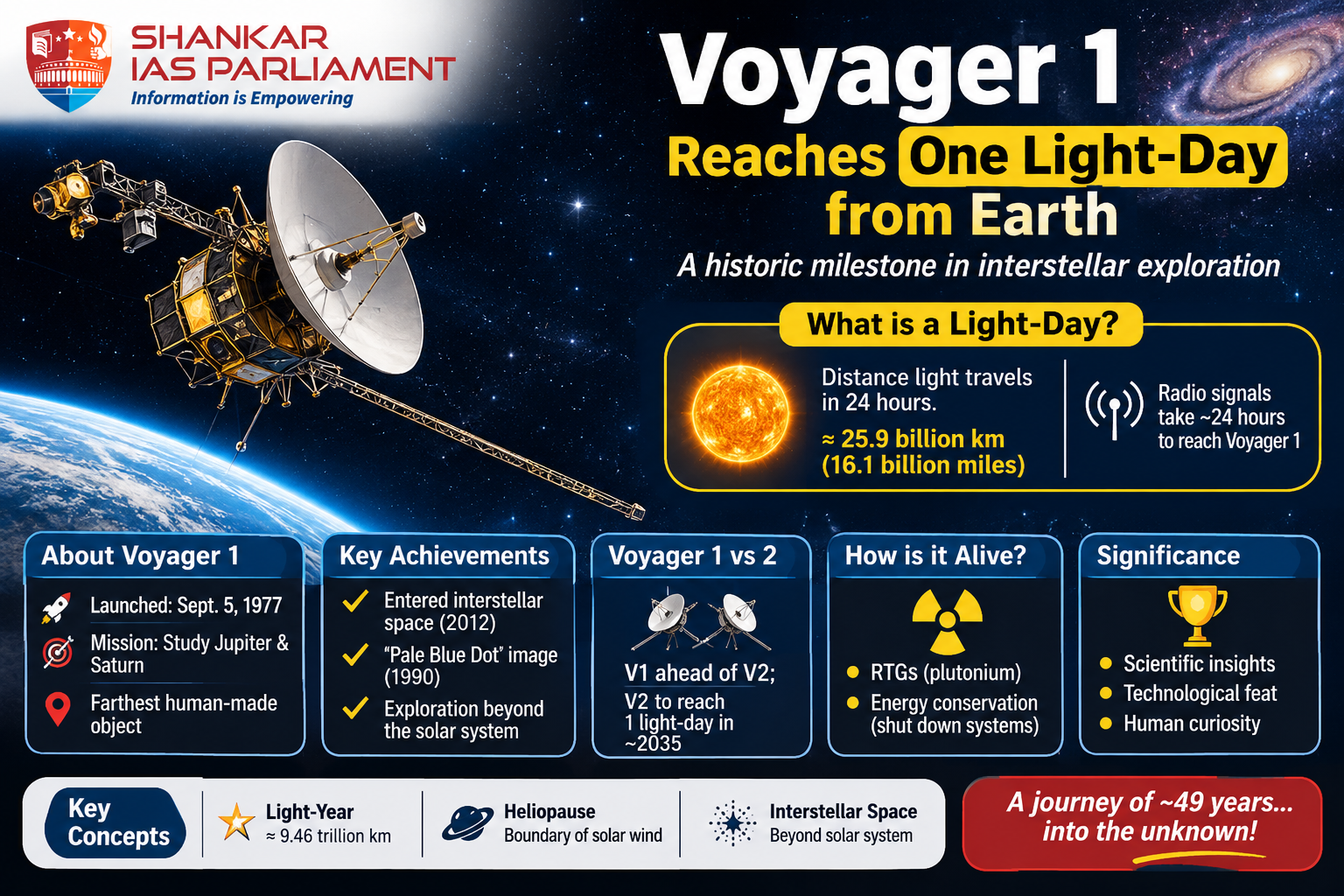
Recently the NASA’s Voyager 1 became the first human-made object to reach a distance of one light-day from Earth on November 18, 2026.
What is One Light-Day?
- A light-day – It is a unit of distance representing the distance travelled by light in 24 hours.
- Light travels at approximately 300,000 km per second.
- At this distance, radio signals between Earth and Voyager 1 take approximately 24 hours one way and 48 hours for a round trip.
What is Voyager 1 mission?
- Launch – September 5, 1977.
- Organisation – NASA (National Aeronautics and Space Administration).
- Original Mission – Designed for a four-year mission to study Jupiter and Saturn.
- Current Status – Farthest human-made object from Earth.
- Speed – Approximately 38,000 miles per hour.
- Trajectory – Travelling in the direction of Gliese 445 (AC +79 3888), a star located over 17 light-years away in the constellation Ursa Minor.
What are the Major Achievements of Voyager 1?
- Exploration of Outer Planets – Conducted close-up studies of Jupiter and Saturn, providing valuable information about their moons, rings and atmospheres.
- Entry into Interstellar Space – Became the first spacecraft to enter interstellar space in August 2012, crossing the heliopause.
- Pale Blue Dot – Captured the iconic image of Earth from approximately 6 billion kilometres away in 1990.
- Interstellar Exploration – Continues transmitting scientific data about the environment beyond the heliosphere.
|
Voyager 1 and Voyager 2
|
- Both spacecraft were launched in 1977 to explore the outer planets.
- Voyager 2 was launched 16 days before Voyager 1.
- Voyager 1 eventually overtook its twin due to its different trajectory.
- Voyager 2 is expected to reach the one-light-day distance from Earth in November 2035.
|
How is NASA Keeping Voyager 1 Operational?
- Power Source – Uses Radioisotope Thermoelectric Generators (RTGs), which convert heat from decaying plutonium-238 into electricity.
- Power Decline – Both Voyager spacecraft lose approximately 4 watts of electrical power annually.
- Energy Conservation – NASA has gradually switched off non-essential heaters and scientific instruments to conserve electricity.
- Ground Support – Engineers at NASA’s Jet Propulsion Laboratory continue sending commands and managing spacecraft operations.
What is the Significance of the Voyager Mission?
- Scientific Knowledge – Expanded understanding of Jupiter, Saturn and the interstellar environment.
- Technological Achievement – Demonstrates the durability of spacecraft engineering and long-distance communication.
- Human Exploration – Represents humanity's ability to explore regions far beyond the solar system.
- Future Research – Provides valuable information about cosmic radiation, magnetic fields and interstellar plasma.
What are the Challenges of Deep-Space Exploration?
- Communication Delay – Increasing distances create significant delays in transmitting commands and receiving scientific data.
- Limited Power – Radioactive decay gradually reduces the electricity available for spacecraft operations.
- Ageing Equipment – Nearly five decades of operation have increased the risk of technical failures.
- Operational Limitations – Limited power requires NASA to progressively shut down scientific instruments.
What lies ahead?
- The Voyager 1 mission represents an extraordinary achievement in space exploration, demonstrating scientific curiosity, technological innovation.
- It further showcases the humanity's determination to explore the unknown.
Quick facts
|
Important Concepts
|
|
Concept
|
Explanation
|
|
Light-year
|
Distance travelled by light in one year.
|
|
Light-day
|
Distance travelled by light in 24 hours.
|
|
Heliopause
|
Boundary where the solar wind's influence becomes weaker than the surrounding interstellar medium.
|
|
Interstellar Space
|
Region beyond the heliosphere between stars.
|
|
RTG
|
Device converting heat from radioactive decay into electrical energy.
|
Reference
The Hindu| NASA’s Voyager 1 reaches one light-day from Earth



