Prelims: Current events of National and International Importance| Energy & Infrastructure
Why in News?
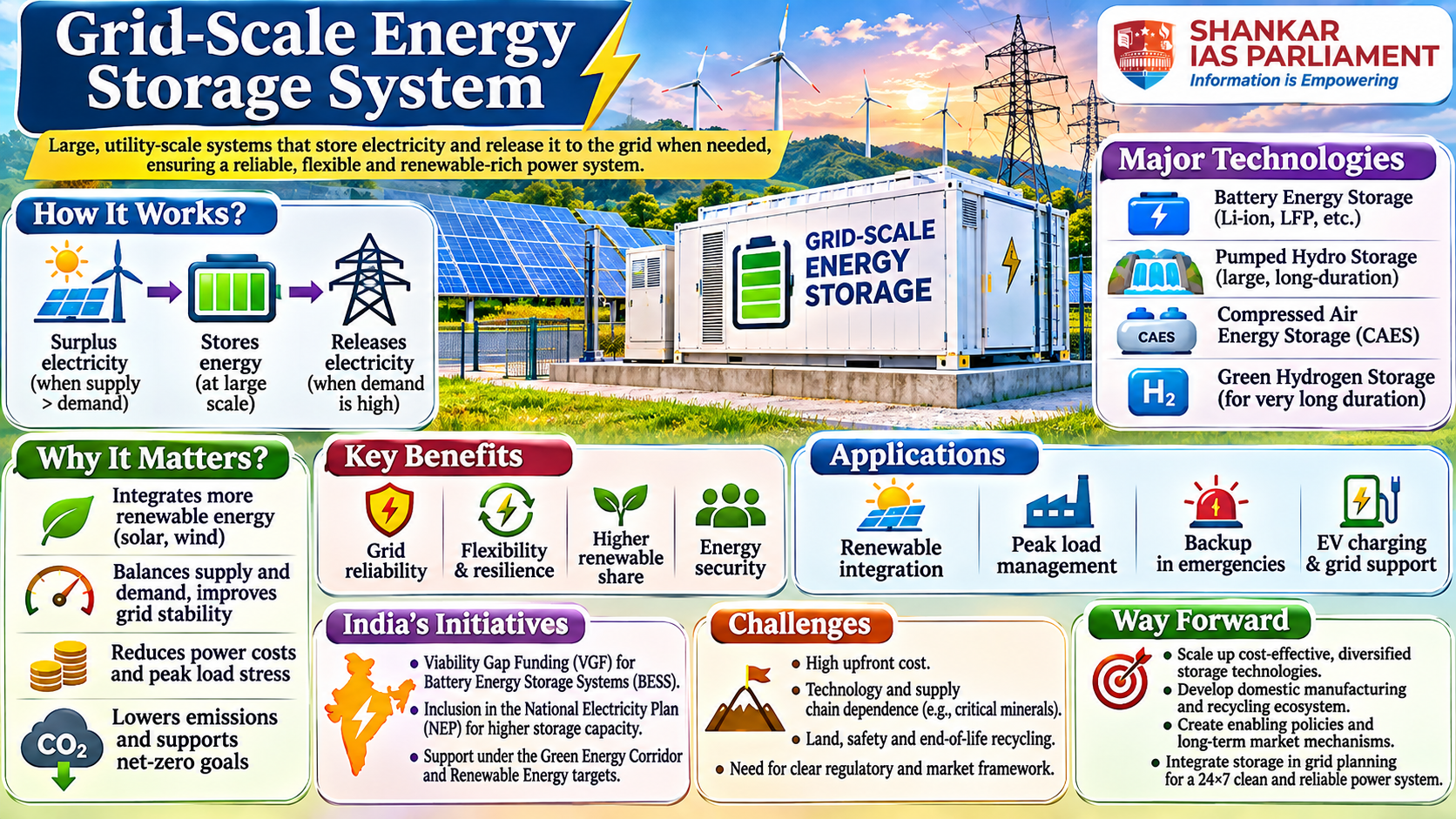
The Union Cabinet, chaired by Prime Minister Narendra Modi, has approved a Rs.14,500 crore Viability Gap Funding (VGF) scheme to develop 92 GWh of grid-scale energy storage capacity across India from FY 2026–27 to FY 2030–31.
- Target Capacity Mix
- 60 GWh — Pumped Storage Projects (PSP / Hydro Pumped Storage)
- 30 GWh — Battery Energy Storage Systems (BESS)
- 2 GWh — Emerging and alternative storage technologies
- Mandates & Features
- Domestic Content Requirement (DCR) – BESS projects carry a mandatory local content rule (reported at 40% domestic content) to boost indigenous manufacturing and cut imports.
- Allocation Method– Capacities will be awarded via tariff-based competitive bidding.
- Eligibility– Both public- and private-sector electricity distribution companies (discoms)—and public/private entities for alternative tech—can apply.
- Goal– Adds capacity equivalent to roughly 170% of India's current grid-scale storage base, helping the country progress toward a larger national target of 411 GWh by 2031–32.
The Viability Gap Funding (VGF) Scheme is a central sector scheme in India that provides financial grants (upfront or deferred) to bridge the economic shortfall of infrastructure projects built through Public-Private Partnerships (PPPs)
Reference
The Hindu| 92 GWh of grid-scale energy storage capacity



