0.1096
7667766266
x

Urban Cooperative Banks

iasparliament Logo
August 08, 2026

Mains: GS III – Economy

Why in News?

Recently RBI has decided to resume the Licensing of the Urban cooperative Banks (UCBs).
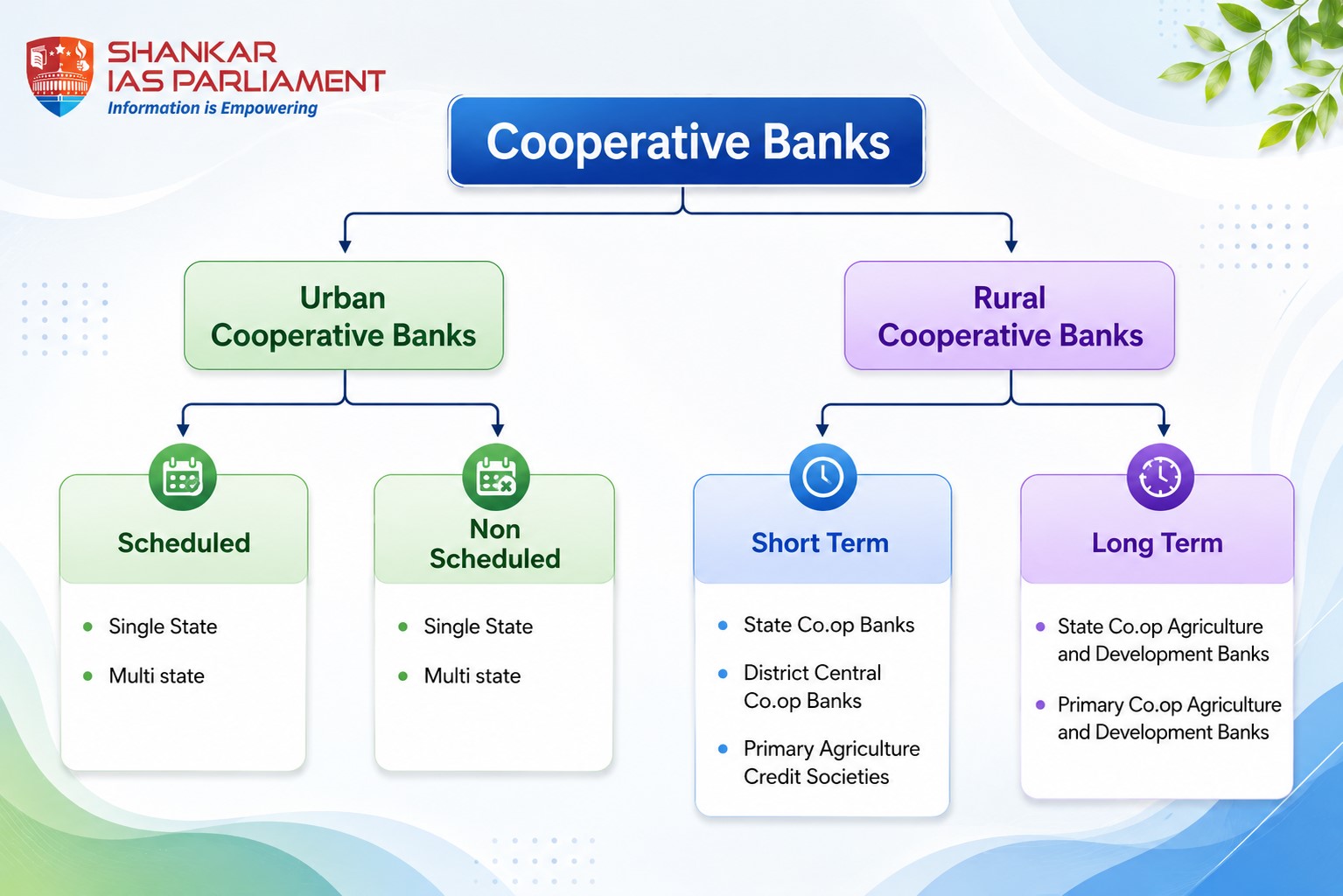
What are Urban Co-operative Banks (UCBs) in India?

  • UCBs – They are primary co-operative financial institutions operating mainly in urban and semi-urban regions.
  • Historical evolution - The movement received legal backing from the Cooperative Credit Societies Act, 1904.
  • The first urban cooperative credit society was registered at Kanjivaram, Madras Province, in October 1904.
  • UCBs expanded rapidly, reaching 2,104 banks by March 2003, including 56 scheduled UCBs.
  • Subsequently, the number declined to around 1,500 because of cancellations, mergers, conversions and liquidations.
  • Norm – They function on the principles of mutual assistance, democratic participation and member ownership.
  • Target groups – Their major clientele includes small borrowers, local traders, small businesses and salaried middle-income groups.
  • Structure and Governance – UCBs are owned and managed by their members, who elect the Board of Directors.
  • The co-operative principle of “one member, one vote” ensures equal voting rights irrespective of the amount of share capital held.

UCBs . UPSC

  • Registration – UCBs operating within a single state are registered under the respective State Co-operative Societies Act.
  • Those operating across multiple states are registered under the Multi-State Co-operative Societies Act, 2002.
  • Regulation and Control – UCBs are subject to a dual regulatory framework, involving both banking regulators and co-operative authorities.
  • Reserve Bank of India (RBI) – The RBI oversees their banking operations, including licensing, capital adequacy, interest-rate related matters, prudential regulations and overall banking supervision under the Banking Regulation Act, 1949.
  • Registrar of Co-operative Societies (RCS) – The RCS deals primarily with non-banking and administrative aspects, such as registration, management, audit, elections and liquidation of co-operative societies under the relevant state or central legislation.

UCBs combine the democratic and member-oriented character of co-operatives with the regulatory framework applicable to banking institutions.

What is the significance of UCBs?

  • Support to small borrowers – UCBs primarily serve small businesses, local traders, MSMEs and salaried groups, especially within their local communities.
  • Easy access to credit – They provide an alternative source of formal credit for urban poor and informal-sector workers, reducing dependence on informal moneylenders.
  • Community-based banking – Their local presence promotes trust, thrift, mutual assistance and personal accountability among members.
  • Democratic governance – UCBs follow the cooperative principle of “one member, one vote”, allowing members to elect their representatives.
  • Inclusive growth – Their surplus is generally used to strengthen reserves and support members/community welfare, rather than primarily benefiting external shareholders.
  • Priority Sector Lending – UCBs channel credit towards priority sectors, particularly MSMEs and other underserved segments, supporting employment and inclusive economic development.

UCBs = Financial Inclusion + Local Credit + Democratic Governance + Community Development + MSME Support


UCBs act as a bridge between formal banking and underserved urban communities, promoting both economic inclusion and cooperative participation.

What are the challenges faced by UCBs?

  • Political interference – Political influence over bank boards can result in biased, directed or irregular lending decisions.
  • Conflict of interest – Directors or influential members may obtain preferential loans, increasing the chances of malpractice and fraud.
  • Fraudulent accounting and regulatory violations contributed to major bank failures.
  • Weak professionalism – Lending and management decisions may be influenced by personal, community or political considerations rather than sound banking principles.
  • Dual regulatory framework – The division of responsibilities between the RBI and State authorities has historically created coordination and regulatory difficulties, although recent reforms have strengthened RBI’s supervisory powers.
  • The “one member, one vote” structure sometimes discouraged additional capital infusion.
  • Limited capital mobilization – Unlike commercial banks, UCBs have limited avenues to raise additional capital, particularly through capital markets, restricting their ability to expand and absorb financial shocks.
  • High NPAs – Rising non-performing assets (NPAs) reduce profitability, weaken balance sheets and constrain lending capacity.
  • Technology gap – Smaller UCBs often lack modern digital infrastructure and strong cybersecurity systems, making it difficult to compete with technologically advanced commercial banks and fintech platforms.
  • Major Examples of FailureCases such as Madhavpura Mercantile Cooperative Bank (MMCB) and Punjab and Maharashtra Cooperative Bank (PMC Bank) highlighted problems of excessive exposure, poor governance, concealed stressed assets and inadequate risk management.

What measures could be taken to strengthen UCBs?

  • Professional expertise – Ensure that a significant share of directors possess expertise in banking, finance, law or accountancy.
  • Balanced tenure – Provide directors with stable but time-bound tenures, ensuring continuity while preventing excessive concentration of power.
  • Early supervision – Strengthen monitoring mechanisms such as Prompt Corrective Action (PCA) to identify and address financial weaknesses at an early stage.
  • Shared technology support – Use institutions such as NUCFDC to provide UCBs with common IT infrastructure, cybersecurity support and technical expertise.
  • Digital adoption – Reduce the cost and entry barriers for smaller UCBs to adopt platforms such as Aadhaar Enabled Payment System (AePS).
  • Modern banking services – Expand digital banking products, mobile-based services and doorstep banking to improve customer convenience.
  • Branch expansion – Allow financially sound UCBs to open additional branches within prescribed limits with greater regulatory flexibility.
  • Diversified lending – Increase permissible limits for housing and selected gold loans, enabling UCBs to diversify their loan portfolios.
  • Faster recovery – Provide greater flexibility for loan recovery and one-time settlement (OTS) mechanisms, broadly aligning them with commercial banking practices.

Why RBI is Reigniting UCBs?

  • RBI has decided to resume licensing of UCBs after more than two decades.
  • The objective is not to increase their number indiscriminately, but to create a smaller group of strong, professionally managed and well-capitalised UCBs.
  • This is important because MSMEs continue to face credit gaps, while large commercial banks primarily serve the formal economy.
  • New Regulatory Approach – RBI's strengthened framework focuses on:
    • Higher entry requirements
    • Stronger capital base
    • Better governance and risk management
    • Technology readiness and cybersecurity
    • Greater supervisory oversight
    • A four-tier regulatory structure introduced in 2022
  • For new licences, the proposed framework includes:
    • Minimum capital – Rs.300 crore
    • Capital Adequacy Ratio – At least 12%
    • Net NPA – Not more than 3%
    • Ideally 10 years of operational experience
    • At least 5 years of sound financial performance


What lies ahead?

  • UCBs can become an important “third pillar” of Indian banking, alongside commercial banks and small finance banks, if they Strengthen governance, Improve capitalization, Adopt technology, Enhance cybersecurity, Reduce NPAs , Professionalise management.

References

  1. RBI| UCBs
  2. The Hindu| Issues with UCBs


Login or Register to Post Comments
There are no reviews yet. Be the first one to review.

ARCHIVES

sidetext


