0.1188
7667766266
x

UPSC Daily Current Affairs| Prelim Bits 25-01-2025

iasparliament Logo
January 25, 2025

GSLV-F15 NVS-02 Mission

Why in News?

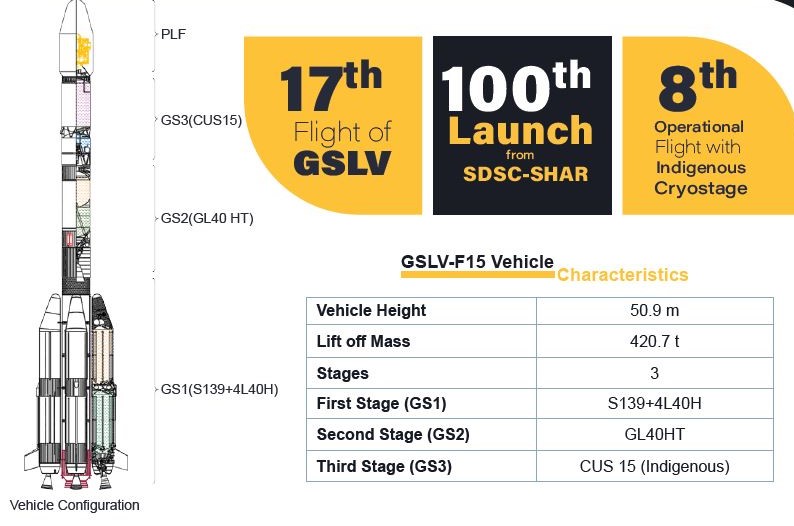
GSLV-F15 NVS-02 mission is the 100th launch from the Satish Dhawan Space Centre in Sriharikota, scheduled for January 29.

  • GSLV-F15 NVS-02 – Geosynchronous Satellite Launch Vehicle (GSLV)- F15/ Navigation with Indian Constellation-2 Satellite (NVS-2).
  • GSLV-F1517th flight of India’s Geosynchronous Satellite Launch Vehicle (GSLV).
    • 11th flight with – Indigenous Cryo stage.
    • 8th operational flight with – Indigenous Cryogenic stage.
  • Payload – Its fairing is a metallic version with a diameter of 3.4 meters.
  • It will place NVS-02 satellite into a Geosynchronous Transfer Orbit (GTO).

  • NVS-02 satellite – It is the 2nd satellite in the NVS series.
  • Navigation with Indian Constellation (NavIC)NVS-02 satellite is part of NavIC.
  • It is India’s independent regional navigation satellite system designed to provide accurate Position, Velocity and Timing (PVT) service to users in India.
  • It extends to region of about 1500 km beyond Indian land mass.
  • U.R. Satellite Centre (URSC)NVS-02 was designed, developed and integrated at the U.R. Satellite Centre (URSC) with the support of other satellite-based work centres.
  • Navigation Payloads – It operates in L1, L5, and S bands and employs Tri-band antenna.
  • Rubidium Atomic Frequency Standard (RAFS) – Is the main component of the navigation payload.
  • RAFS is an atomic clock which acts as a stable frequency reference for the navigation payload.
  • Ranging Payloads – It consists of C-band (CxC) transponder used for 2-way Code Division Multiple Access (CDMA) ranging to facilitate precise orbit determination.

  • Lift off mass – 2,250 kg.
  • Power handling capability – Approximately 3 kW.
  • Usage – A combination of indigenous and procured atomic clocks for precise time estimation.

References

  1. The Hindu| 100th Launch from Satish Dhawan Space Centre
  2. ISRO| GSLV-F15 NVS-02 Mission

Tamilnadu Iron Age

Why in News?

A groundbreaking study reveals that Tamil Nadu's Iron Age began as early as 3,345 BCE, predating the Hittite Empire's iron usage by a millennium.

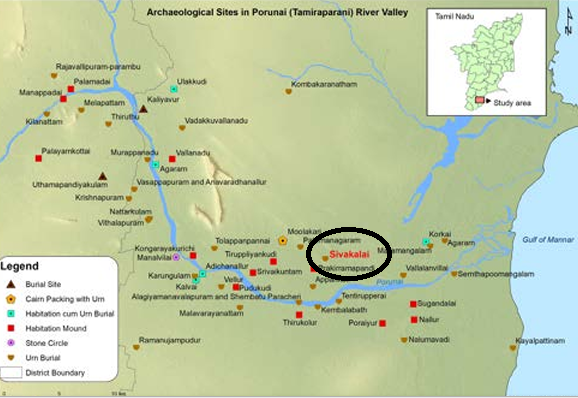
  • Sivagalai -It is an Iron Age habitation-cum-burial site in the Thamirabarani river valley in Thoothukudi district.

sivakalai

  • Sivagalai excavation - A total of 24 trenches were excavated at these sites, which exposed around 160 urns, a majority of them being redware
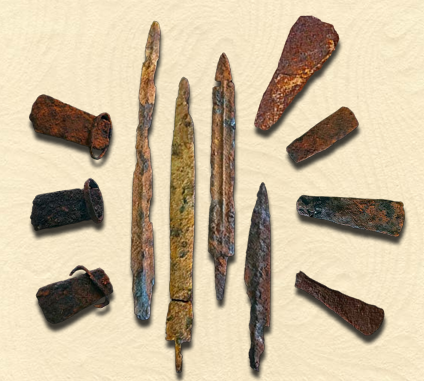
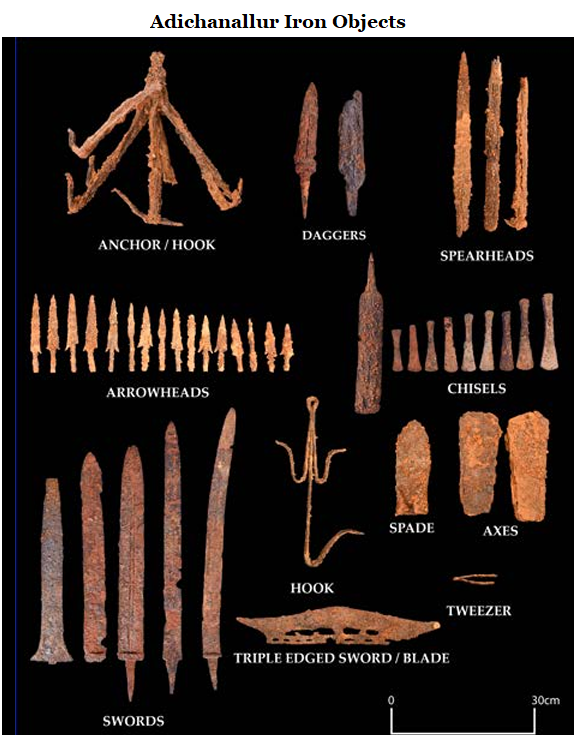
  • Findings - Skeletal remains, paddy grains, over 85 iron objects including knives, arrowheads, chisels, axes, rings, and swords, were found at the site.

2

  • Radiometric dating - The samples from Sivagalai were analyzed by three prestigious research institutions
    • Beta Analytics in the United States
    • Physical Research Laboratory in Ahmedabad
    • Birbal Sahni Institute of Palaeosciences in Lucknow.
  • Advanced dating techniques - The samples from Sivagalai, however, were subjected to advanced dating techniques
    • Accelerometer mass spectrometry radiocarbon (AMS14C) dating for charcoal
    • Optically stimulated luminescence (OLS) dating for ceramics.
  • The Report – Findings of the dating study were presented as ‘Antiquity of Iron: Recent Radiometric Dates from Tamil Nadu’, authored by K Rajan and R Sivanantham.
  • Findings - Radiometric dating of burial urn samples from Sivagalai indicate a thriving Iron Age civilization in southern India in 4th millennium BCE, contemporaneous with copper civilization of  Indus Valley.
  • While the regions to the north of the Vindhyas were still in the Copper Age, southern India may have entered the Iron Age due to a lack of commercially exploitable copper ores.
  • Adichanallur charcoal - Adichanallur in Thoothukudi district, of Tamilnadu produced a charcoal sample associated with iron objects that was dated to 2517 BCE.
  • First smelted iron - For the first time in the world, smelted iron has been dated back to the middle of the third millennium BCE.
  • Hittite Empire (in modern-day Turkey)- This was believed to be the first civilization to use iron, with evidence dating back to around 1,380 BCE.
  • Other Iron regions of India - Brahmagiri in Karnataka and Gachibowli near Hyderabad, were dated to around 2140 BCE and 2200 BCE, respectively.

3

References

  1. The Economic Times | Did the Iron Age actually begin in Tamil Nadu?
  2. The Indian Express | Tamilnadu Iron Age
  3. The Hindu | Sivagalai sheds light on iron’s antiquity in Tamil landscape

Fiscal Health Index (FHI), 2025

Why in news?

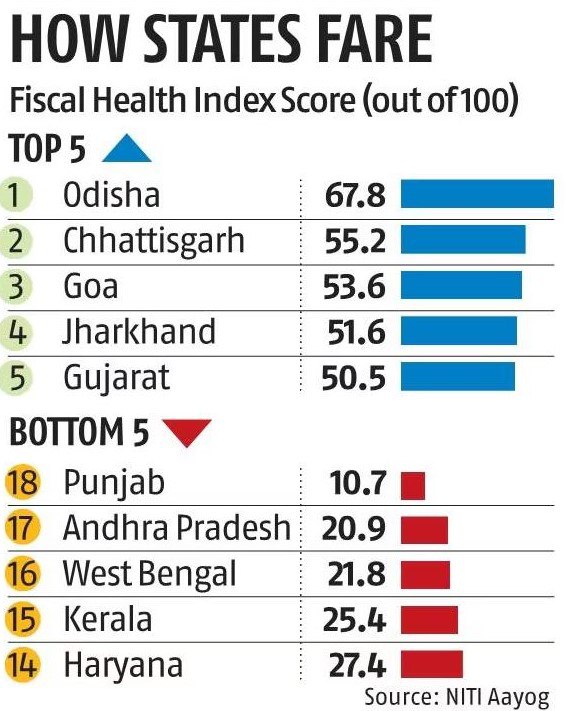
The Fiscal Health Index (FHI) was recently released by Niti aayog that provides a comprehensive assessment of the fiscal health of 18 major States.

  • Aim – To throw light on the fiscal status at the sub-national level and guide policy reforms for sustainable and resilient economic growth.
  • Fiscal Health Index 2025 – Is first of kind in India, a comprehensive assessment with insights into state-specific challenges and areas for improvement.
  • Five key sub-indices – The index is based on 5 key sub-indices that include Quality of Expenditure, Revenue Mobilisation, Fiscal Prudence, Debt Index, and Debt Sustainability.
  • Launched by – Niti Aayog.
  • 18 major States – The index assess the fiscal health of the only 18 major states.
  • Comptroller and Auditor General (CAG) – The report uses the data from CAG.
  • Odisha – With a cumulative score of 67.8, Odisha tops the ranking in fiscal health among 18 major States, followed by Chhattisgarh and Goa with scores of 55.2 and 53.6, respectively.
  • Odisha tops the Debt Index (99.0) and Debt Sustainability (64.0) rankings with better than average scores under Quality of Expenditure and Revenue Mobilization.
  • Strong fiscal health – The achiever States display strong fiscal health, excelling in revenue mobilization, expenditure management, and debt sustainability.
  • West Bengal and Punjab – States like West Bengal and Punjab witnessed growing debt burdens, increasing debt-to-GDP ratios and raising serious concern about debt sustainability.

  • Significance – FHI helps to promote more integrated approach to fiscal health and sustainable growth, with shared responsibility of both levels of government in achieving national prosperity.
  • FHI offers a roadmap for achieving fiscal consolidation, improving transparency, and fostering effective resource management.
  • FHI is not merely a ranking but a tool designed to assess and thereby improve the fiscal health of States.
  • It provides a framework to evaluate the financial well-being of state economies through key fiscal indicators.

References

  1. PIB| Launch of the Fiscal Health Index 2025
  2. Business Standard| Fiscally Healthiest States

India’s Forests Fires

Why in News?

Recently, the data showed that in the past 5 fire seasons, over 11 lakh fires incidents reported in India.

  • Ministry of Environment, Forest and Climate Change – Mentioned that 4 states have reported over 1 lakh forest fire incidents each in the last five forest fire seasons.
  • 4 States – Odisha, Madhya Pradesh, Chhattisgarh and Maharashtra.
  • They accounted for 4,73,834 forest fires, which constitutes approximately 43% of the total forest fire incidents in India.

India has reported a staggering 11,09,588 forest fires. Each year from November to June, forests across the country ignites, threatening ecosystems, wildlife and livelihoods.

  • India State of Forest Report (ISFR) 2021 – Over 36% of the country’s forest cover is estimated to be vulnerable to frequent forest fires.
    • 2.81% - Extremely fire-prone.
    • 7.85% - Very highly fire-prone category.
  • ISFR 2023 – Around 275 million rural people in India depend on forests for their livelihood security.
  • Communities residing near forested areas rely heavily on forests for Non-Timber Forest Products (NTFPs).
  • Major Factors – Collection of tendu leaves and mahua flowers contributing to forest fires.
  • Shifting cultivation practices adopted by local farmers, where an estimated 4.35 million hectares (mha) of forest area is affected by fires.
  • Reasons for fires – Unsustainable exploitation of forest resources and coupled with increasing human activities threat to the balance of forest ecosystems.
  • Impacts – It leads to loss of:
    • Human lives
    • Depletion of biodiversity
    • Habitat destruction
    • Reduced agricultural productivity
    • Landscape degradation
    • Disruptions to local livelihoods

Reference

The Hindu Business Line| India’s Forests Ablaze


One Liners 25-01-2025

History, Art and Culture

76th Uttar Pradesh Foundation Day 2025

  • Statehood Day 1950, 24 January.
  • Historical background – It is recognized in the later Vedic Age as Brahmarshi Desha or Madhya Desha.
  • 1935 – Its name was shortened to United Provinces.
  • 1950 – United Provinces was renamed as Uttar Pradesh.
  • It is home to revered places such as,
    • Birthplace of Lord Ram in Ayodhya.
    • Lord Krishna in Mathura.
    • Holy city of Varanasi.
  • It is a “Holy Land” in shaping India’s history, mythological tales, and culture.

Geography

Uttar Pradesh

  • Capital – Lucknow.
  • Languages – Hindi and Urdu.
  • Bordered by – Uttarakhand and Himachal Pradesh in the north, Haryana in the west, Madhya Pradesh in the South and Bihar in the east.
  • Rivers – Ganga, Yamuna, Gomti, Ram Ganga, Ghagra, Betwa, Ken.
  • It is blessed with fertile and mineral-rich soil.

Polity & Governance

Mangrove Initiative for Shoreline Habitats and Tangible Incomes (MISHTI)

  • Launched in – 2023.
  • AimRestoration of mangrove forests by undertaking mangrove reforestation/ afforestation measures along the coast of India.
  • Coverage – 540 sq. km of mangroves across 9 coastal states and 4 Union territories.
  • Time period – 2023-2028 (5-years).
  • Focused on – Sundarbans delta, Hoogly Estuary in West Bengal and other wetlands.
  • Implementation - Funding will be done from State CAMPA, National CAMPA &MGNREGA and also from other sources.
  • Mangrove Alliance for Climate – “MISHTI” comes after India joined the Alliance.
  • It was launched during the 27th Conference of Parties (COP27) of the United Nations Framework Convention on Climate Change held in Egypt in November 2022.

Digital Tree Aadhaar programme

  • Launched in – 2021.
  • Launched by:
    • Jammu and Kashmir Forest Department.
    • J&K Forest Research Institute (JKFI).
  • Objective – To conserve the iconic Chinar trees, a symbol of the region's cultural and ecological heritage.
  • It includes geo-tagging each tree with QR codes to record vital information, such as location, health and growth patterns.

PM Suryaghar Muft Bijli Yojana.

  • Launched in – 2024.
  • Aim – To increase the share of solar rooftop capacity and empower residential households to generate their own electricity.
  • It is the world’s largest residential rooftop solar initiative.
  • Time period – Till 2026-27.
  • Implemented by – A National programme Implementation Agency (NPIA) at the National level and by the State Implementation Agencies (SIAs) at the state level.
  • Working – To provides for a subsidy of 60% of the solar unit cost for systems up to 2kW capacity.
  • 40% of additional system cost for systems between 2 to 3kW capacity.

Security

Pralay

  • Pralay  – It is the indigenous short-range surface-to-surface quasi-ballistic missile.
  • Range – Approximately  400 km.
  • It is the 1st ballistic missile in India for conventional strikes.
  • Approved by – Defence Acquisition Council (DAC).
  • Development by – Research Centre Imarat, Hyderabad of DRDO
  • Capability – To strike different types of targets using different types of warheads.
  • Deployment along – Line of Control (LoC).
    • Line of Actual Control (LAC).

SANJAY - The Battlefield Surveillance System (BSS)

  • SANJAY – It is an automated Battlefield Surveillance System (BSS) which integrates the inputs from all ground and aerial battlefield sensors.
  • It produces a Common Surveillance Picture of the battlefield over secured Army Data Network & Satellite Communication Network.
  • Developed by – Indian Army and Bharat Electronics Limited (BEL).
  • Applications - Monitors  vast land borders.
    • Prevent intrusions.
    • Assess situations with unparalleled accuracy.
    • Prove to be a force multiplier in intelligence, surveillance & reconnaissance.

Science

International Solar Conference (ISC)

  • Conference on – Sun, Space Weather and Solar-Stellar Connections.
  • Organised by – Indian Institute of Astrophysics (IIA).
  • Purposes – To commemorate the 125th anniversary of the Kodaikanal Solar Observatory (KSO).
  • Themes – Solar magnetism over long time scales.
    • Solar magnetism in high resolution.
    • Energetic phenomena.
    • Solar-stellar connection.
    • Heliosphere.
    • Space weather.

Kodaikanal Solar Observatory (KSO)

  • Established in – 1899.
  • Location – Palani hills, Tamil Nadu.
  • Operated by – Indian Institute of Astrophysics.
  • Observation – It houses a digital repository of 1.2 lakh digitized solar images and 1000s of other images of the Sun recorded every day.
  • It made understanding of sunspots, solar flares, coronal mass ejections and other solar phenomena.

Artificial Sun

Chinese scientists achieved a world record with artificial Sun.

  • Artificial Sun – It is a mega nuclear fusion device, which generates energy through a fusion process similar to that of the sun.
  • Aim - To create clean and sustainable energy through a fusion process for global energy supply.
  • Conducted at – Experimental Advanced Superconducting Tokamak (EAST).
  • Achievement – Maintained plasma temperatures exceeding 100 million degrees Celsius for nearly 18 minutes.
There are no reviews yet. Be the first one to review.

ARCHIVES

sidetext