Waterspout
A luxury yacht in Mediterranean Sea was hit and sank by a violent storm, could be a waterspout off the coast of Sicily, Italy.
- Waterspout – It is essentially a tornado over water that is a large column of air and mist rotating over a water body.
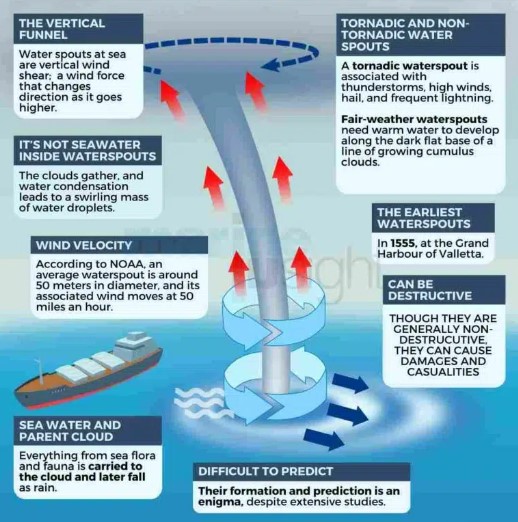
- Favourable Condition - They occur when there are high levels of humidity and relatively warm water temperatures compared to the overlying air.
- Size & Physical characteristics- The average waterspout can be around 165 feet in diameter, with wind speeds of 100 kilometres per hour.
- Duration - It typically lasts for around 5 minutes and occasionally it can last up to 10 minutes.
- Occurrence - Although waterspouts are more common in tropical waters, they can appear anywhere.
- Types of waterspouts - Tornadic waterspouts and Fair-weather waterspouts.
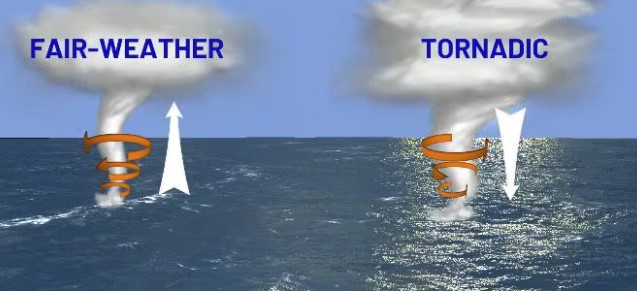
- Tornadic Waterspouts – They are actual tornadoes that form over water or move from land to water.
- They are accompanied by severe thunderstorms, high winds and seas, large hail, and frequent dangerous lightning.
- Tornadic waterspouts develop downward in a thunderstorm.
- They can be large and may lead to considerable destruction.
- Fair-weather waterspouts – They form over only water usually along the dark flat base of a line of developing cumulus clouds.
- It develops on the surface of the water and works its way upward.
- This type of waterspout is generally not associated with thunderstorms.
- Favourable condition - They are formed during fair weather.
- Movement - Fair weather waterspouts form in light wind conditions so they normally move very little.
- Typically, fair weather waterspouts dissipate rapidly when they make landfall, and rarely penetrate far inland.
- They are less dangerous and usually small.
- Increased frequency of occurrence – With increase in sea surface temperature, the frequency of waterspouts is increasing.
- The best way to avoid a waterspout is to move at a 90-degree angle to its apparent movement.
References
- IndianExpress | Waterspouts
- NOAA | Waterspouts
‘2+2’ dialogue of India and Japan
Recently, India and Japan held the 3rd edition of the "2+2" Foreign and Defence Ministerial Dialogue.
- Objective- The dialogue focused on deepening defence cooperation and ensuring a free, open, and rules-based Indo-Pacific amidst China's growing military presence in the region.
Key Outcomes of the meeting
- ASEAN Outlook on the Indo-Pacific (AOIP) - Both the countries strongly supported ASEAN's unity and the ASEAN Outlook on the Indo-Pacific (AOIP).
- It emphasizes principles like openness, transparency, inclusivity, and respect for international law.
- Special Strategic and Global Partnership- It aims to strengthen bilateral security and defence cooperation under Japan's 2022 National Security Strategy, recognizing it as a key pillar of the Japan-India Special Strategic and Global Partnership.
- Women, Peace, and Security (WPS) - Emphasized the role of women in conflict prevention and peacebuilding, welcoming increased participation in peacekeeping operations.
- Defence Cooperation- India aims to become a developed nation by 2047, with a strong focus on building domestic defence capabilities.
- It discussed future cooperation in space, cyber, and defence equipment and technology, and explored coordination for security assistance to third countries.
- Quad Cooperation- The meeting valued the cooperation within the Quad and committed to advancing it further for both the countries.
- Defence Exercises- It commended the progress in defence ties since September 2022, highlighting Japan's first air visit, participation in Tarang Shakti, and the 'Veer Guardian 2023' exercise.
- They agreed to reaffirm the importance of multilateral defence efforts in the Indo-Pacific and their commitment to ongoing exercises like Dharma Guardian, JIMEX, and Malabar.
India holds ministerial-level dialogues with only a few countries, including the United States, Australia, and Russia.
- Significance- The "2+2" dialogue is aimed at further deepening bilateral security and defence cooperation between India and Japan.
- It is a strategic plan adopted by the Association of Southeast Asian Nations (ASEAN) in 2019.
- The defence partnership with Japan is seen as crucial for ensuring freedom, inclusivity, and transparency in the Indo-Pacific region.
|
ASEAN Outlook on the Indo-Pacific (AOIP)
|
- Aim - To promote cooperation with external partners in the Indo-Pacific region.
- It also aims to address geopolitical tensions and the growing influence of major powers in the region.
- Principles - The AOIP's guiding principles include ASEAN centrality and ASEAN-led mechanisms, such as the East Asia Summit (EAS), as platforms for dialogue and implementation of cooperation.
- Key areas - The AOIP promotes cooperation in 4 key areas - Maritime cooperation, Economic, Connectivity, and Sustainable development.
- The AOIP also serves as a platform for
- The public, state-owned enterprises, and private sectors of ASEAN Member States, and
- ASEAN's external partners to engage in constructive discussions, cooperate on projects, and
- Enhance collaboration in the Indo-Pacific region
|
References
- The Hindu | ‘2+2’ dialogue
- PIB | 2+2 Ministerial Dialogue
- MOFA | 2+2 Foreign and Defence Ministerial Meeting
Drug delivery method using polymeric nanoparticles
Recently, scientists at Agharkar Research Institute (ARI) under the Department of Science & Technology (DST) have developed a nanoparticle-based drug delivery system.
- It is a unique method developed of drug delivery using Nikkomycin-loaded polymeric nanoparticles.
- Nikkomycins- Nikkomycins are nucleoside amide antibiotics produced by Streptomyces tendae Tü 901 and are known to show antifungal, anti-insecticidal, and acaricidal activities.
- They work by interfering with the building of the fungal cell wall which results in the fungal cell breaking open.
- The specific agent nikkomycin Z has weak activity against Aspergillus fumigatus which may be of benefit when used with other medications.
- The drug-loaded nanoparticles were effective in disrupting the growth of Aspergillus species.
Aspergillus fumigatus is a species of fungus in the genus Aspergillus and is one of the most common Aspergillus species to cause disease in individuals with immunodeficiency.
- Streptomyces- It is the largest genus of actinobacteria comprising high GC (guanine and cytosine) content in their genomic DNA.
- They are Gram-positive saprophyte and abundant in soil, water (fresh and sea), and air.
- One can also find this group of bacteria in association with plants and animals.
- ARI have used a chitin synthesis fungicide, Nikkomycin, produced by the bacterial Streptomyces spp. to develop Nikkomycin loaded polymeric nanoparticles.
- Polymeric Nanoparticles- It refers to solid particles composed of macromolecular polymers, with particle size ranging from 10 to 1000 nm.
- It can protect the encapsulated macromolecules from enzymatic degradation and change the dynamic behavior and tissue distribution of the encapsulated drugs in vivo.
- Chitin - Chitin is the most abundant aminopolysaccharide polymer occurring in nature and is the building material that gives strength to the exoskeletons of crustaceans, insects, and the cell walls of fungi.
- Chitin is absent in the human body, making this a targeted approach.
- The nanoformulation developed was found to be free of cytotoxic and hemolytic effects.
- The ARI team is hopeful about the method’s application in development of inhalation nanoformulations against pulmonary aspergillosis.
- Benefits - It may benefit patients with asthma, cystic fibrosis, HIV, cancer, lung diseases, and those on long-term corticosteroid medications.
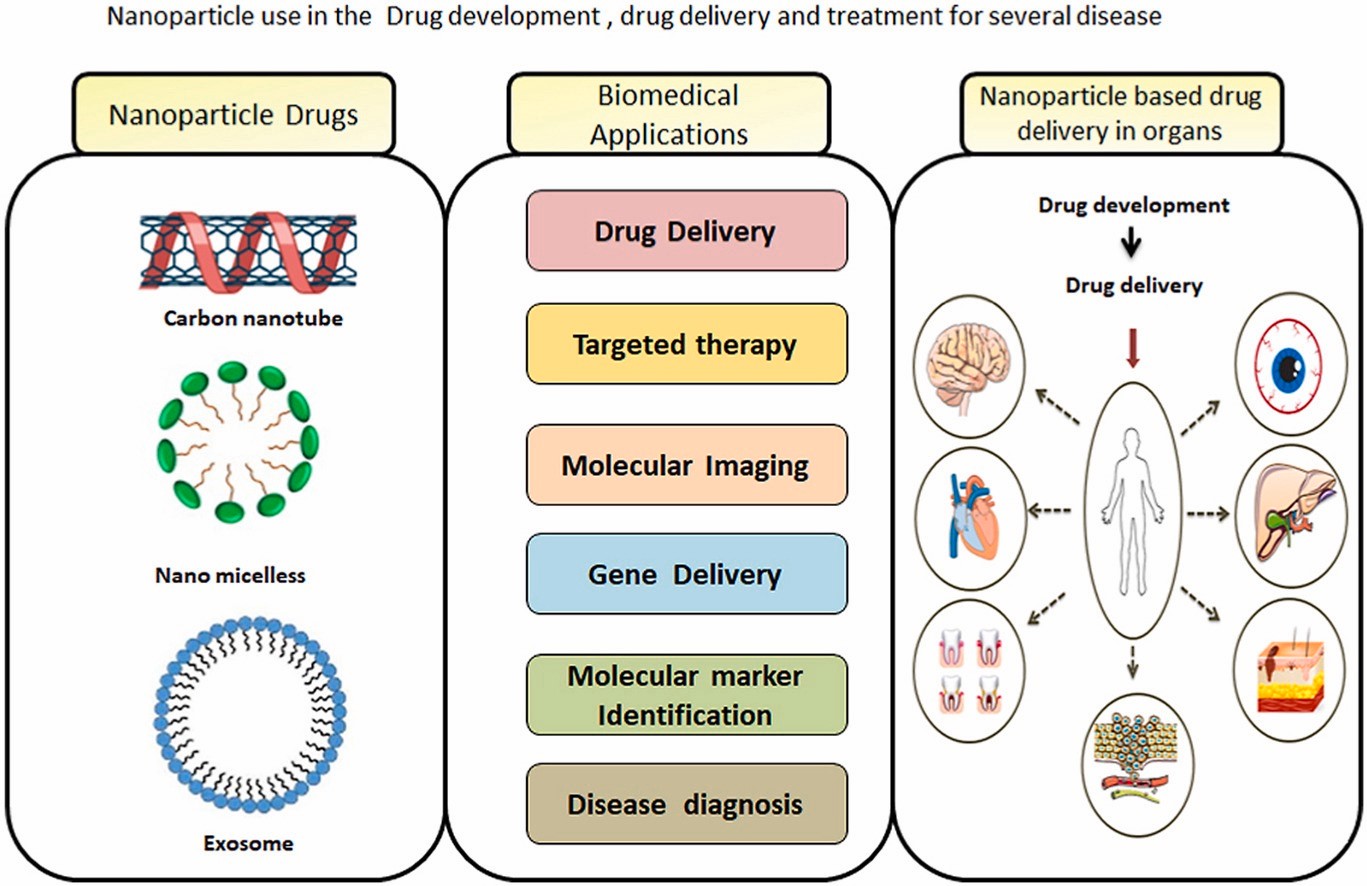
- Nanoparticles enable controlled and effective drug release, with polymeric nanoparticles being the most advanced delivery method.
- Safety and potential applications- The Nano formulation was free of cytotoxic and hemolytic effects, indicating safety for use.
Reference
PIB | Nanoparticle-based drug delivery system
Quantum nonlocality
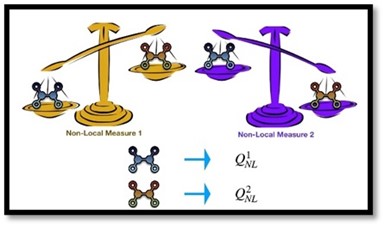
Recent research has revealed that it is impossible to create a universal standard for measuring non-local quantum correlations, a key finding in quantum mechanics.
- Quantum Nonlocality- It describes a connection between distant physical objects that does not allow for faster-than-light communication.
- It is often associated with entangled states, which violate Bell inequalities, a way to test whether nature agrees with Einstein's local realism or with the standard quantum mechanical interpretation.
- Bell's Theorem- It was introduced by physicist John Stewart Bell in 1964, it challenged the concept of 'local realism' in classical physics.
- Bell's theorem showed that quantum systems with multiple distant parts exhibit correlations that cannot be explained by local realism.
- This theorem was confirmed by experiments and earned the 2022 Physics Nobel Prize.
- Application- Quantum nonlocality has been significant in natural sciences and has applications in secure communication, random number generation, and cryptographic key creation.
- Finding- The study noted that the nature of nonlocality varies depending on the type of correlation, meaning there is no single, universal resource in quantum nonlocality.
- Each non-local resource is unique and capable of performing specific tasks that others cannot.
- Implications- The discovery expands the potential applications of quantum nonlocality and adds complexity to the understanding of quantum mechanics.
References
- PIB | Quantum nonlocality
- Azoquantum | Non-Local Quantum
National Financial Reporting Authority (NFRA)
The NFRA is set to meet with key financial regulators to adopt the revised International Standard of Audit 600 (ISA 600).
NFRA
|
Aspect
|
Explanation
|
|
Establishment
|
- NFRA was established in 2018 under the Companies Act, 2013.
|
|
Purpose
|
- It is an independent regulator setup to oversee and enforce compliance with accounting and auditing standards.
|
|
Jurisdiction
|
- NFRA has authority over auditors of listed companies, large unlisted companies, and companies with securities listed on any stock exchange in India or abroad.
|
|
Composition
|
- Chairperson who will be appointed by the Central Government and a maximum of 15 members.
|
|
Functions
|
- Set standards, monitor compliance, investigate misconduct, and impose penalties.
|
|
Significance
|
- Aims to enhance transparency and accountability in financial reporting.
|
|
Recent Activities
|
- Currently focusing on adopting revised International Standard of Audit 600 (ISA 600).
|
ISA 600
|
Aspect
|
Explanation
|
|
Aim
|
- To close auditing gaps that have caused major lapses and to ensure auditors gather sufficient evidence and evaluate component auditors' work.
|
|
Objectives of ISA 600
|
- Tighten oversight on auditors, especially regarding reliance on subsidiary audit reports.
- Enhance group auditor's supervision and review of component auditors' work and documentation.
- Improve communication, oversight, and ethical requirements between group and component auditors.
|
|
Audit Lapses and Malfeasance
|
- Auditors have been found shielding behind subsidiary audit reports, allowing malfeasance, such as siphoning off funds from listed companies.
- Reliance on subsidiary audits has been a recurring problem in lapses at companies like Reliance Capital, IL&FS, and CG Power.
|
|
Legal Framework
|
- The revised standards require adoption by financial regulators like ICAI, NFRA, and SEBI before implementation in India.
- The Chartered Accountants Act, 1949, considers disclosing information acquired during professional engagement without client consent as professional misconduct.
|
References
- Business Standard | ISA 600
- NFRA | About NFRA



